Published: 12:08 AM, 25 May 2026
Albino Buffalo and the Deep State: Bangladesh’s Ritual of Defiance
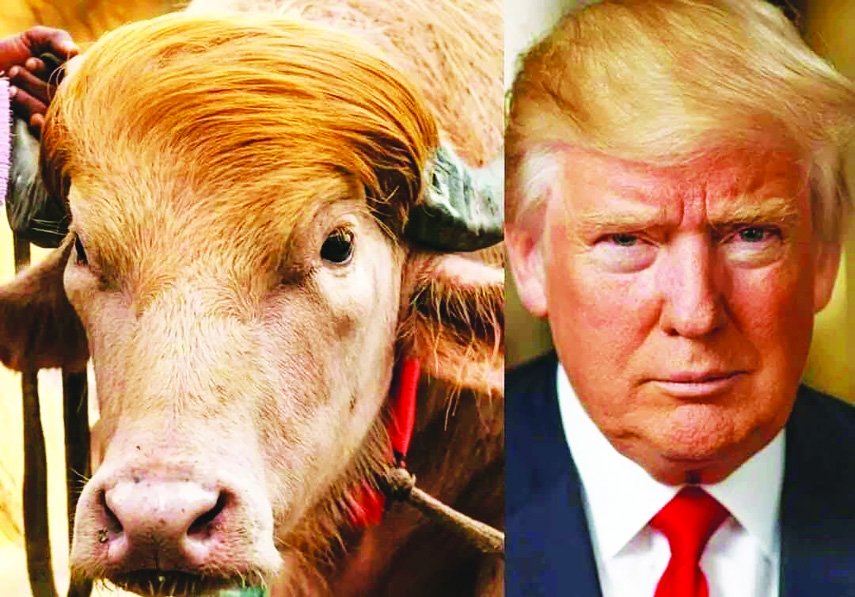
The picture of a buffalo with resemblance to US President Donald Trump has flooded international media ahead of Eid Ul Azha. - Collected
An unexpected protagonist has caught the attention of international media: an albino buffalo named "Donald Trump," who has created a massive stir in Bangladesh. As this Muslim-majority nation prepares for the sacred festival of Eid Ul Azha, the act of naming a defenseless animal after a sitting U.S. President and preparing it for ritual sacrifice poses a surreal yet profound question: does this arrangement signify a form of hidden affection, or does it mask a deep-seated undercurrent of geopolitical resentment? More importantly, will the subtext of this local spectacle ever register with the policymakers in Washington? To understand this entire phenomenon, one must deeply analyze contemporary Bangladesh’s turbulent political landscape.
The root cause has been identified as the Yunus administration's unilateral trade pact with the United States. Dr. Debapriya Bhattacharya, a prominent economist who chaired the interim government's white paper committee, has described the trade and energy deals struck with Washington during the transition period as an obstacle 'greater even than the Strait of Hormuz'. A pervasive narrative among a large segment of the population holds that the momentous July 2024 uprising was not entirely spontaneous, but rather a meticulously crafted blueprint driven by the agendas of Washington or the American "deep state." Following this dramatic transition, the country's long-standing political iconography and symbolic foundations are undergoing a radical transformation.
The term “deep state” has become one of the most debated and controversial concepts in modern American politics. In the United States, it generally refers to the belief that certain unelected officials, intelligence agencies, military institutions, bureaucrats, and influential networks within the government continue to shape national policy regardless of which political party is in power. Supporters of this idea argue that these hidden power structures can influence decisions behind the scenes, while critics believe the term is often exaggerated or used as a political weapon.
The concept gained widespread attention during the presidency of Donald Trump. Trump and many of his supporters frequently claimed that parts of the federal bureaucracy, intelligence community, and political establishment were actively working against his administration. According to this view, career officials within agencies such as the FBI, CIA, Pentagon, and State Department possessed enough institutional influence to resist or undermine elected leaders whose policies threatened established interests.
Historically, however, concerns about entrenched power structures in Washington existed long before Trump popularized the term. Throughout American history, critics from both the left and the right have argued that powerful institutions — including defense contractors, lobbyists, intelligence agencies, Wall Street interests, and permanent bureaucracies — often maintain continuity in foreign and economic policy despite electoral changes. For example, US military involvement abroad, intelligence operations and global strategic alliances have frequently continued across administrations of different political ideologies.
Supporters of the deep state theory point to incidents such as intelligence leaks, bureaucratic resistance, classified surveillance controversies, and the strong influence of corporate lobbying as evidence that hidden networks can shape political outcomes. They argue that elected presidents may face internal resistance if they attempt to challenge established geopolitical or economic interests.
Critics, however, strongly reject the notion of a coordinated “deep state” conspiracy controlling America. They argue that what some describe as a deep state is simply the normal functioning of a large and complex government system. The United States employs millions of civil servants, intelligence officers, military personnel, and policy experts whose job is to maintain institutional continuity regardless of political transitions. Critics also warn that excessive use of the term can damage trust in democratic institutions and encourage conspiracy thinking. Political scientists often prefer more neutral terms such as “bureaucratic inertia,” “institutional influence,” or “the national security establishment” rather than “deep state.” These concepts acknowledge that permanent institutions naturally possess influence and expertise without implying the existence of a secret conspiracy.
Ultimately, the debate over the US deep state reflects a broader tension within American democracy: the balance between elected political leadership and the enduring power of permanent institutions. Whether viewed as a dangerous hidden network or simply the predictable influence of established systems, the concept continues to shape political discourse in the United States and beyond.
The enduring tradition of honoring Sheikh Mujibur Rahman as the "Father of the Nation" the central architect of Bangladesh’s independence has now been widely contested and systematically dismantled in the fires of political retribution. In its place, a powerful new religious tide has rushed to converge with the legacy of Hazrat Ibrahim (AS) a shift that stands as a rare phenomenon in the history of state frameworks globally. According to Islamic belief, Hazrat Ibrahim (AS) is the great prophet who summoned humanity to pilgrimage and initiated the sacred tradition of Qurbani (sacrifice) during Eid Ul-Azha. By a strange coincidence, a namesake of the American president has now been cast as this year's ultimate sacrificial animal. Is this eccentric public display merely an expression of ironic endearment, or is it a calculated, highly symbolic manifestation of anti-imperialist defiance? The localized anger of this nation's people cannot be viewed in isolation. It is a direct reflection of a long-festering public resentment fueled by inherently one-sided treaties and the heavy-handed diplomatic leverage exercised by the United States.
This friction carries the haunting, rhythmic cadence of Bob Marley’s iconic, timeless anthem, Buffalo Soldier. As the United States rapidly approaches its historic 250th anniversary, the imagery of the buffalo returns to the global stage in an unexpected format—redefined not by the historical battles of the American frontier, but by the sharp blade of a ritualistic sacrifice in South Asia. Yet, looking beyond domestic borders, a broader survey of European, African, and Asian media reveals a much larger, more troubling global consensus. President Trump’s erratic statesmanship has inflicted severe, perhaps irreparable, damage on the timeless ideals of democracy once championed by his historic Republican predecessors. This systemic deterioration is captured perfectly in a recent, sharp commentary by the renowned geopolitical analyst and author Brahma Chellaney. Reacting to the sudden resignation of U.S. Director of National Intelligence Tulsi Gabbard who resigned due to her husband's medical condition, Chellaney noted that her departure represents a prima facie blow to internal debate: with the exit of one of the few remaining skeptics of U.S. military interventionism inside the administration, the last glimmer of hope has been extinguished. Consequently, Trump’s cabinet has effectively calcified into an blind "echo chamber" or a gathering of loyalists primed for meddling in sovereign states.
Chellaney points out a sobering reality: despite his isolationist rhetoric, Trump has already compiled a record of serial military interventions since returning to office, with Cuba now looming as his administration's next target. Just as Gabbard was effectively sidelined during previous regime-change operations in Venezuela and the escalation against Iran, her final exit removes the last internal barrier to aggressive foreign overreach. Ultimately, the spectacle of the albino buffalo in Dhaka is a micro-reflection of a macro-crisis in American foreign policy. As the lines between statesmanship, intervention, and global theater continue to blur, time alone will reveal who was truly short-sighted: the local architects of this "buffalo parody," the symbolic "buffalo soldiers" navigating Washington's global overreach, or strategic minds like Chellaney who watch the unraveling of American democratic credibility from afar.
Shoeb Chowdhury is a media personality, entrepreneur,
author, sports organizer and socioeconomic analyst.