Published: 11:34 AM, 13 April 2026
Must have the courage to say ‘no’ to new bank licences: Dr. Salehuddin Ahmed
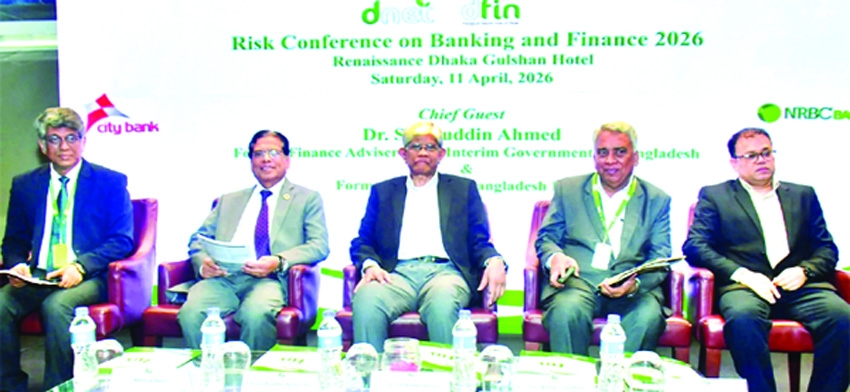
Former finance adviser to the interim government and ex-governor of Bangladesh Bank Salehuddin Ahmed urged the Bangladesh Bank to stand firm against political pressure regarding the approval of new banks. He emphasised that regulators must back their decisions with solid data and financial logic.
Speaking at a banking and finance conference as chief guest, the former finance advisor stressed that while political and corporate pressures are inevitable, the central bank’s role is to act as a guardian of the economy.
The conference, titled “Risk Conference on Banking and Finance 2026” was organized by the research firm Dnet at a city hotel on Saturday, brought together top bankers and researchers to discuss the systemic risks facing the country’s financial sector Ahmed said that during his tenure as the governor of Bangladesh Bank, he received many proposals to grant new bank licences. However, in those cases, the issues of technical capacity, policy framework and overall financial stability were seriously considered.
He said that currently, depositors are facing various problems while withdrawing money from some of the weak banks in the country. This reality makes it clear that it is necessary to be very careful while granting licences to new banks.
Dr. Salehuddin Ahmed, also informed that the contingent liabilities linked to state-owned institutions have surged to more than Tk five lakh crore , posing a significant fiscal risk for the government. Contingent liabilities typically arise from government-backed guarantees and do not immediately appear in the fiscal deficit.
“If these guarantees are called, it will be very risky for the government, as repayment capacity remains uncertain,” he said. Referring to financial inclusion, the former governor said that it is possible to bring a large population of the country under the financial system through technology-based solutions and expansion of digital financial services.
At the same time, he advised depositors to be careful and said that keeping money in weak banks under the lure of high interest rates increases the risk. Initiatives have already been taken to merge some such banks, which is important for maintaining the stability of the banking sector. Regarding the insurance sector, Salehuddin Ahmed said that despite the potential to play an important role in the economy, this sector often suffers from a crisis of confidence and often faces allegations of fraud. To change this situation, it is important to ensure effective supervision and transparency.
He further said that it is necessary to assess the financial capacity and awareness of the customer before granting loans. In addition, proper implementation of strong risk management policies can ensure sustainable development of the banking sector.
The conference opened with a welcome address by Mahmud Hasan, Executive Director of Dnet.
Following the welcome, Dr. Toufic Ahmad Choudhury (Former DG, BIBM; and Member, Governing Body, Dnet) and Professor Mustafizur Rahman, PhD (Distinguished Fellow, CPD; and Member, Governing Body, Dnet) shared their insights on the necessity of robust risk frameworks in the current economic landscape.
During a panel discussion, Mashrur Arefin, chairman of the Association of Bankers, Bangladesh (ABB), offered an assessment of the sector’s health.
“We were living in a fool’s paradise, believing defaulted loans were around 20 percent. The truth is, they are well over 30 percent,” he said. He also criticised a pervasive “culture of flattery” within the industry, where bankers prioritise pleasing their boards over sound management.