
Published: 10:29 AM, 16 April 2026
BGMEA leaders seek government’s support in ensuring uninterrupted energy supply
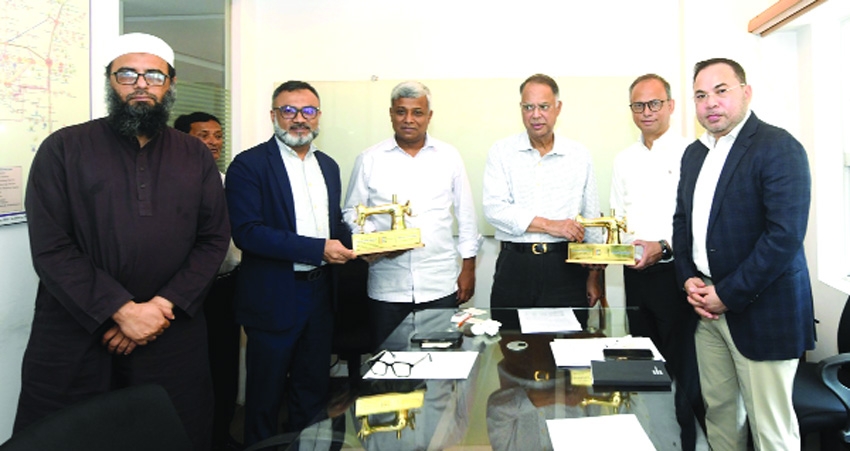
Leaders of Bangladesh Garment Manufacturers and Exporters Association (BGMEA) on Monday sought government’s support in ensuring uninterrupted energy supply for the country’s readymade garment (RMG) sector.
They sought the support when a delegation of the trade association representing the country’s readymade garment industry, met with the Minister for Power, Energy and Mineral Resources Iqbal Hassan Mahmood and State Minister Aninda Islam Amit at the ministry.
The delegation, led by BGMEA President Mahmud Hasan Khan, included First Vice-President Selim Rahman and Vice-President (Finance)Mizanur Rahman. Energy Secretary Mohammad Saiful Islam was also present at the meeting.
During the meeting, the BGMEA President said that although buyer confidence has started to restore following the recent general election, the ongoing Middle East conflict has once again posed challenges to the global market.
He noted that neighboring countries are ahead in energy security, and the current energy situation triggered by the conflict has put Bangladesh’s garment industry in a vulnerable position, according to a BGMEA press release, reports BSS.
He further informed that due to insufficient gas and electricity supply, production capacity in factories has declined by 25–30 percent. Mahmud Hasan Khan noted that while buyer confidence had improved following the national election, the industry is now grappling with fresh vulnerabilities linked to the Middle East conflict.
He emphasised that neighbouring countries are maintaining superior energy security, leaving Bangladesh’s primary export sector at a disadvantage.
The impact is particularly severe in industrial hubs such as Gazipur and Ashulia, where heavy load-shedding and a shortage of diesel for generators are stalling production lines and delaying international shipments, the BGMEA chief said. This energy crisis, coupled with rising raw material and transport costs, has significantly increased the overall cost of production, he said.
To address the situation, the BGMEA delegation placed several key proposals, including:
Emergency fuel supply: Ensuring prompt diesel supply to garment factories from nearby filling stations under special arrangements.
Gas connection and distribution: Providing urgent gas connections, especially for small and medium industries (with boiler capacity of 300–500 kg), and ensuring equitable gas distribution across industrial zones surrounding Dhaka.
Infrastructure development and automation: Installation of at least two additional Floating Storage Regasification Units (FSRUs) at the earliest and simplification of the process for installing EVC meters in industries.
Tax and duty reduction: Withdrawal of import duties and consumer-level taxes on imported fuel to reduce production costs and lessen the government’s subsidy burden.
The meeting also emphasized the importance of renewable energy. BGMEA requested special tariff concessions on the import of solar PV system components to promote environmentally sustainable industrialization. The association proposed reducing the existing high duties (ranging from 28.73 percent to 61.80 percent) on essential equipment such as solar panels, inverters, DC cables, and Battery Energy Storage Systems (BESS) to 1 percent.
The minister and state minister acknowledged the RMG sector's critical role in the national economy and assured the delegation that steps are being taken to address the energy shortfall. As an immediate relief measure, the government approved a BGMEA-designed format to facilitate the emergency supply of diesel from nearby filling stations to factories. They also acknowledged BGMEA’s proposed format to facilitate emergency diesel supply from nearby filling stations.


