Published: 12:01 AM, 20 April 2026
Harvard Health Systems Innovation Hackathon 2026 held at UIU
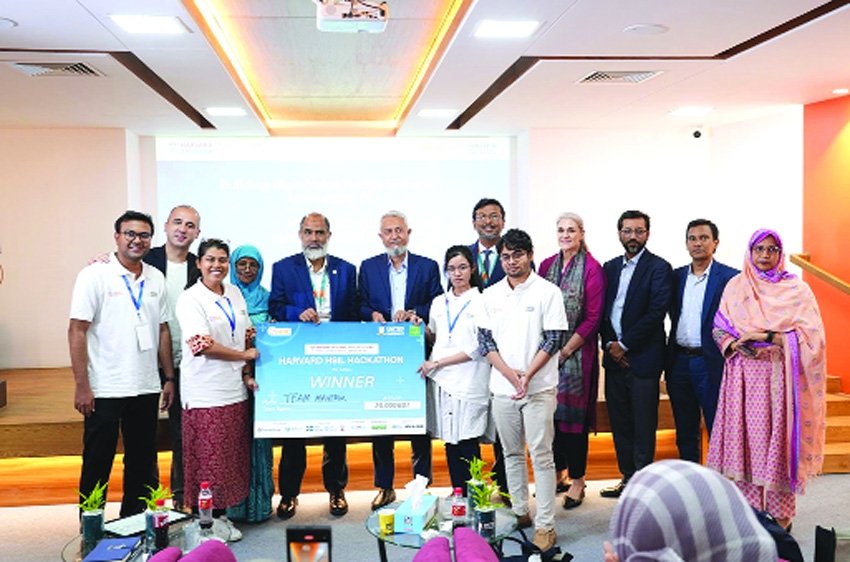
United International University (UIU) successfully organized the 7th edition of the Harvard Health Systems Innovation Lab (HSIL) Hackathon 2026 on Saturday at the Institute of Research, Innovation, Incubation, and Commercialization (IRIIC), UIU. Marking its second consecutive year as the only hub in Bangladesh for this global competition, the Dhaka edition brought together some of the country's most promising innovators under the global HSIL network.
The event was graced by Special Guest Prof. Dr. Sayeba Akhter, Chairman of the Bangladesh Medical Research Council (BMRC), and Guest of Honor Prof. Dr. Jalal Uddin Mohammad Rumi, Director (Administration), Directorate General of Health Services (DGHS). The program was chaired by Prof. Dr. Md. Abul Kashem Mia, Vice Chancellor of United International University, according to a press release. Held under the theme "Building High-Value Health Systems: Leveraging AI," the hackathon emphasized the growing role of artificial intelligence in improving healthcare quality, accessibility, and efficiency.
Recognized as one of the largest global health hackathons, HSIL 2026 was conducted across more than 50 global hubs in 46 countries, engaging over 14,000 participants worldwide. The Dhaka hub received over 650 applications from across the country.
Following a competitive selection process, 22 teams comprising 98 participants, along with four individual innovators, were selected to participate of which 17 teams made to the finale.
At the conclusion of the competition, two teams were declared winners of the Bangladesh hub: 'Team Maverick', representing the Military Institute of Science & Technology (MIST) and United International University (UIU), developed an AI-enabled platform for early detection and support of dyslexia in children through personalized, interactive learning.
The solution integrates performance analytics and guided interventions to support early diagnosis and continuous skill development. 'ShigellaAI Diagnostics Bangladesh', a team from icddr,b, introduced an AI-based clinical decision support tool to improve diagnosis and management of Shigella-related diarrhoeal diseases in resource-constrained settings.
The tool leverages routinely available clinical data to generate real-time risk scores, enabling more accurate and evidence-based treatment decisions.