Published: 12:19 AM, 25 April 2026
Experts warn of rising earthquake risks
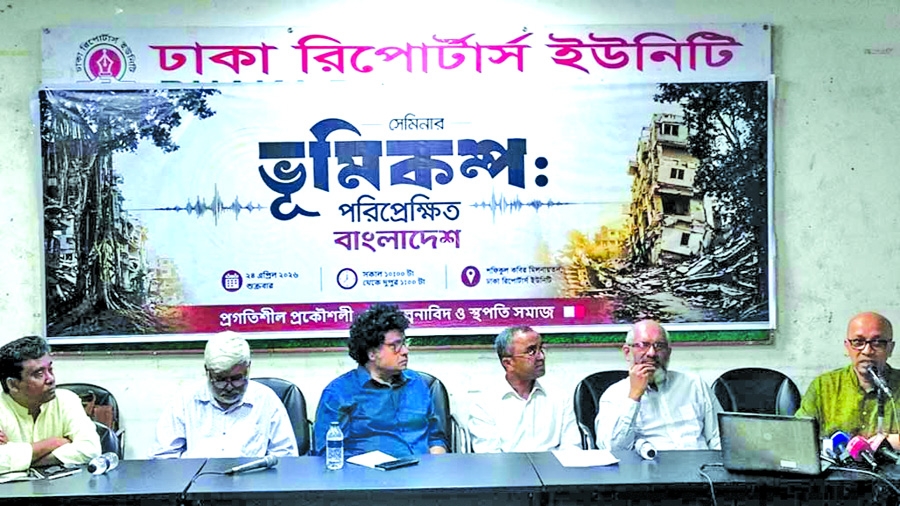
Engineers and urban experts have raised alarms over Bangladesh's increasing vulnerability to earthquakes, noting that over 100 tremors were recorded in and around the country in the first four months of 2026 alone.
Speaking at a seminar titled "Earthquake: Bangladesh Perspective" at the Dhaka Reporters Unity (DRU) on Friday, professionals identified a severe lack of scientific research and bureaucratic bottlenecks as the primary hurdles in tackling potential disasters, bdnews24 reports.
The event was organised by the Progressive Engineers, Planners, and Architects Society.
In a written statement, Engineer Mosharraf Hossain highlighted that 15 to 20 of the 100 tremors recorded this year were felt by the public.
He noted that the panic following the casualties and structural damage during the earthquake on Nov 21 last year remains a grim reminder of the country's risk level.
The speakers criticised the country's dependency on USGS data due to weak domestic seismographic surveying.
They pointed out that 13 seismograph machines at Dhaka University's geology department have remained idle since 2003 due to a lack of funding.
Furthermore, the Geological Survey of Bangladesh was accused of being run by "inexperienced bureaucrats" rather than experts, rendering the institution ineffective.
Experts highlighted a "governance vacuum" in Dhaka's construction sector.
While RAJUK now requires signatures on structural designs, there is no formal process to verify the technical accuracy of those designs, they said.
"The government must formulate a policy to audit buildings through certified consultants," the speakers urged.
They proposed the creation of a professional regulatory body to certify and licence everyone involved in the construction process to ensure accountability.
Mehedi Ahmed Ansary, a professor at BUET, emphasised that third-party design verification is the most critical step to ensuring structural safety.
Adding to this, Khandaker Sabbir Ahmed, former president of the Institute of Architects Bangladesh, suggested that the government should utilise corporate social responsibility (CSR) funds to retrofit unsafe buildings for owners who lack the financial means.
Prof Sakawat Hossain of Jahangirnagar University compared the impact of a magnitude 8.0 quake in Chile, which killed 700, to a magnitude 7.0 quake in Haiti that killed 200,000, arguing that the
difference lies solely in scientific construction and public awareness.
Urban planner Khondaker Niaz Rahman warned that infrastructure projects like the Marine Drive along the Cox's Bazar-Chattogram coastal belt are making the region more vulnerable to disasters.