Published: 12:07 AM, 26 April 2026
How long can Iran survive the US's Hormuz blockade?
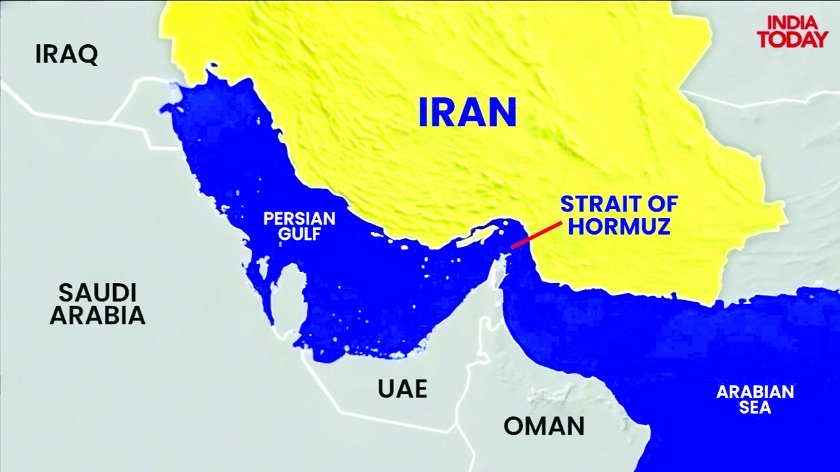
United States President Donald Trump has claimed Iran is "collapsing financially" and said the country is losing millions of dollars a day due to Washington's naval blockade of Iranian ports.
In a post on his Truth Social platform on Tuesday night, Trump wrote: "Iran is collapsing financially! They want the Strait of Hormuz opened immediately - Starving for cash! Losing 500 Million Dollars a day. Military and Police complaining that they are not getting paid. SOS!!!"
The US blockade of Iranian ports began at 14:00 GMT on April 13. Since then, the US has fired on and seized an Iranian-flagged tanker near the Strait of Hormuz, and redirected ships in the open seas carrying cargo to or from Iran. Iran's armed forces have called this "an illegal act" that "amounts to piracy".
In response to the US naval blockade, Iran has closed the Strait of Hormuz to all foreign shipping and has captured several foreign-flagged ships. Previously, it had allowed some ships deemed "friendly" to Iran to pass.
On April 19, Iran's First Vice President Mohammad Reza Aref said the "security of the Strait of Hormuz is not free".
"One cannot restrict Iran's oil exports while expecting free security for others," he wrote in a post on X.
"The choice is clear: either a free oil market for all, or the risk of significant costs for everyone," he added. "Stability in global fuel prices depends on a guaranteed and lasting end to the economic and military pressure against Iran and its allies."
In a statement on social media on Thursday, Iran's parliamentary speaker and lead negotiator in the ceasefire talks, Mohammad Bagher Ghalibaf, said a full ceasefire could only work if the US naval blockade is lifted.
Analysts say the blockade is hurting Iran but believe the country has the economic and political will to sustain it.
How long can Iran survive the naval blockade?
Here's what we know:
How is the naval blockade hurting Iran?
Iran exports oil, gas and other goods including petrochemicals, plastics and agricultural products by sea. Analysts say the US naval blockade of its ports, including in the Strait of Hormuz, could therefore affect this trade.
Soon after the start of the US-Israel war on Iran on February 28, authorities in Tehran implemented the effective closure of the Strait of Hormuz, the only waterway out of the Gulf, through which 20 percent of the world's oil and liquefied natural gas (LNG) supplies were shipped from Gulf producers in peacetime.
The near-shutdown of the vital chokepoint sent global oil and gas prices soaring, and since then, Iran has controlled the strait. However, it has continued to export its own energy products through the waterway.
Iran's oil exports through the Strait of Hormuz account for about 80 percent of its total oil exports. According to Kpler, a trade intelligence firm, Iran exported 1.84 million barrels per day (bpd) of crude oil in March and has shipped 1.71 million bpd so far in April, compared with an average of 1.68 million bpd in 2025.
From March 15 to April 14, it exported 55.22 million barrels of oil. The price per barrel of Iranian oil - across its three major variants, known as Iranian light, Iranian heavy and Forozan blend - has not fallen below $90 per barrel over the past month. On many days, the price has surpassed $100 a barrel.
Even at the conservative estimate of $90 a barrel, Iran has earned at least $4.97bn over the past month from its ongoing oil exports.
By contrast, in early February before the war started, Iran was earning about $115m a day from its crude oil exports, or $3.45bn in a month.
Simply put, Iran has earned 40 percent more from oil exports in the past month than it did before the war.
Stopping this is a key motivation behind the US naval blockade of Iranian ports.
In an interview with Al Jazeera on April 14, Frederic Schneider, a nonresident senior fellow at the Middle East Council on Global Affairs, said that the previous six weeks had been a boon for Iran in terms of oil revenues, but with the US blockade, that will change.
"Iran has some buffer in the form of crude oil reserves in floating tanks - basically parked tankers - which was estimated at about 127 million barrels in February. But that doesn't mean that the blockade wouldn't hurt Iran," he said.
On Friday, Schneider told Al Jazeera that Iran, however, seems to be "playing the longer game" and has anticipated and prepared for this sort of conflict to some degree.
"The naval blockade has added economic strain, as several civilian ships have been captured in international waters. But it remains unclear how tight the blockade is, how many ships manage to pass given the considerable amount of floating Iranian oil, and how long Trump can maintain the blockade," he said.
>>Al Jazeera