Published: 09:04 AM, 04 May 2026
BARVIDA called on govt to reduce import duties in FY27 budget
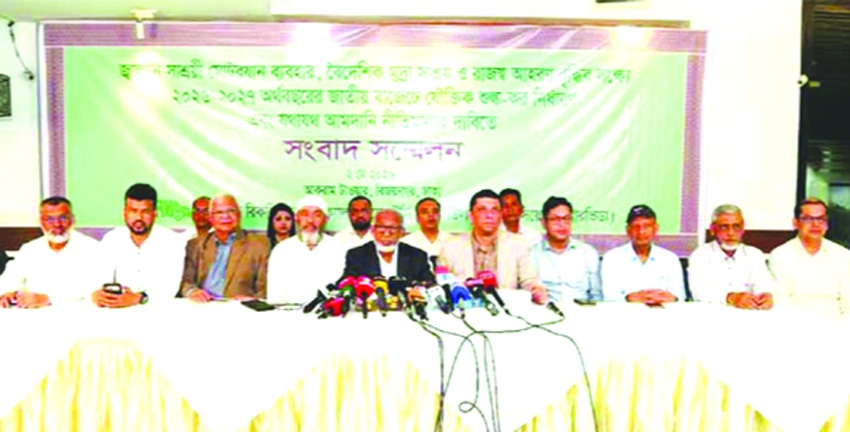
The Bangladesh Reconditioned Vehicles Importers and Dealers Association (Barvida) has called on the government to reduce import duties on hybrid and plug-in hybrid vehicles in the upcoming national budget to promote fuel efficiency and support a more sustainable transport system.
At a press conference held in Dhaka on Saturday, Barvida President Abdul Haque also demanded the withdrawal of supplementary duty on microbuses used in public transport, a reduction in duties on pickup trucks, and an end to tax disparities between new and reconditioned vehicles.
He further proposed extending the permissible age limit for imported reconditioned vehicles from five to eight years, arguing that the change would help ease supply constraints in the market. The association also recommended lowering taxes on reconditioned electric vehicles (EVs) imported from Japan, saying such measures would encourage cleaner transport options while making vehicles more affordable for consumers.
Barvida stated that the reconditioned vehicle import and trading sector has attracted around Tk20,000 crore in domestic investment and generates about Tk6,000 crore in annual revenue. It added that the industry supports several lakh jobs directly and indirectly, including through related service and supply chain activities.
In its written statement, the organisation highlighted that the sector contributes to national revenue through import duties, income tax, VAT, and road tax, while also helping expand business activities in banking, leasing, and insurance. However, Barvida noted that despite some easing in foreign exchange pressure since 2024, unchanged duty structures combined with a depreciation of the taka have significantly increased vehicle prices. As a result, affordability has declined and overall sales have weakened.
According to the association, around 3 lakh people directly or indirectly employed in the sector now face uncertainty over their livelihoods.
Haque said the automobile market has slowed in real terms despite the country’s overall economic progress, and that declining vehicle sales point to weakening purchasing power and reduced government revenue. He said the sector is seeking policy support in the upcoming budget to address these pressures.
Even though the duty on imported microbuses was reduced in the FY2021-22 national budget by recognising those as public transport, Barvida claimed prices of such vehicles are still very high due to the high supplementary duty.
According to them, microbuses are very important in small, medium and large industries for employee transport, student transport, tourism, personal use, airport transportation and as ambulances.
The association said that 90 percent to 95 percent of the microbuses used in the country are converted to compressed natural gas (CNG) and run in an environmentally friendly manner.
Claiming that potential buyers are being discouraged due to high prices, Barvida said that microbus sales are declining, and the government is also losing revenue. Therefore, they have demanded the withdrawal of supplementary duty on microbus imports.
The Barvida president also proposed raising the permissible age limit for imported reconditioned vehicles from five years to eight years. The association also claimed that imports of reconditioned vehicles from Japan fell sharply in January and February this year, with Bangladesh importing fewer vehicles compared to countries such as Kenya, Sri Lanka, and Tanzania.
Citing Bangladesh Road Transport Authority (BRTA) data, Barvida pointed to a steady decline in vehicle registrations over the years. Registrations stood at 21,952 in 2015, 21,029 in 2016, and 20,268 in 2017, before dropping to 10,784 in 2023. The number further fell to 10,499 in 2024 and 9,387 in 2025, reflecting a continued slowdown in the sector.