
Published: 11:24 AM, 19 May 2026
‘Building a sustainable textile industry without nanotechnology is difficult’
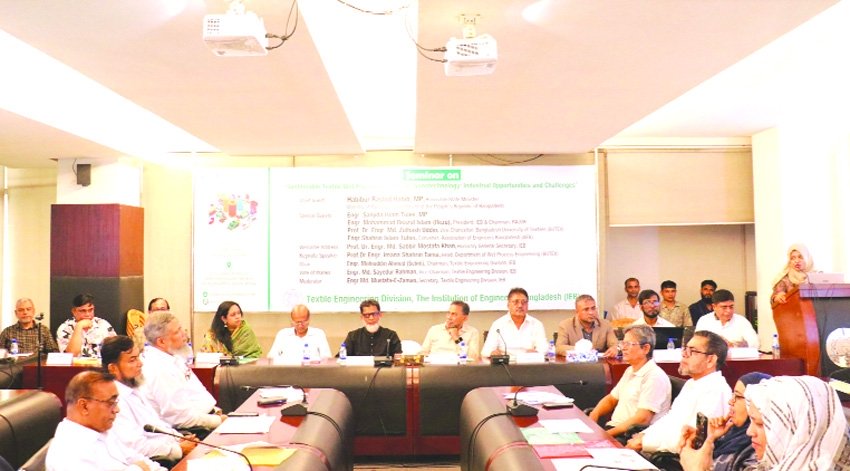
State Minister for Railways Habibur Rashid Habib has stressed the importance of expanding the use of nanotechnology to make Bangladesh’s textile industry more sustainable, environmentally friendly, and globally competitive. He said the excessive use of water and chemicals in textile wet processing is placing enormous pressure on the environment and water resources, and nanotechnology could play a vital role in addressing this challenge. However, he warned that introducing such technology could initially increase production costs by up to 60 percent, making government support for the industry crucial. He made these remarks on Saturday while addressing a seminar titled “Sustainable Textile Wet Processing Through Nanotechnology: Industrial Opportunities and Challenges” as the chief guest. The seminar was organized by the Textile Engineering Division of the Institution of Engineers, Bangladesh (IEB) at the Council Hall of the IEB headquarters in Ramna, Dhaka.
The State Minister said Bangladesh’s textile industry is not limited to garment production alone; rather, it is one of the key driving forces of the national economy. The sector plays a vital role in earning foreign currency, generating employment, and accelerating industrialization. He noted that Bangladesh currently ranks second in the world in textile production, which is a matter of pride for the country.
However, he identified excessive water consumption as one of the sector’s biggest challenges. Huge amounts of water are used during dyeing, washing, and finishing processes, creating serious environmental concerns.
“Expanding the use of nanotechnology can significantly reduce water wastage, minimize chemical use, and make production more eco-friendly,” he said.
Habibur Rashid Habib also emphasized that engineers must move beyond conventional job roles and focus more on research and innovation to keep pace with technological advancements. According to him, research and the development of new technologies are essential to making the industry modern and competitive.
The seminar was chaired by Engineer Mohiuddin Ahmed Selim, Chairman of the Textile Engineering Division of IEB. Speaking as a special guest, Engineer Sanjida Islam Tuli said the extensive use of water and chemicals in the textile industry is increasing the risk of environmental pollution. She suggested that improved waste management, water recycling, and the use of green energy could make the industry more environmentally sustainable.
Engineer Shahreen Islam Tuhin, Convener of the Association of Engineers Bangladesh (AEB), said developed countries invest a significant portion of their textile sector earnings into research and development, enabling them to innovate and reduce production costs. He stressed the need to establish modern textile research centers in Bangladesh as well.
IEB President and RAJUK Chairman Engineer Mohammad Riazul Islam (Riju) said the textile sector must be transformed into a research-based industry. As a first step, he proposed establishing university-based research centers, alongside a modern national textile research institute.
Vice-Chancellor of the Bangladesh University of Textiles (BUTEX), Professor Dr. Engineer Md. Julhas Uddin, warned that untreated chemical waste from textile industries poses a severe threat to rivers, canals, and groundwater. He underscored the importance of ensuring effective Effluent Treatment Plants (ETPs) to protect the environment. He also recalled that the foundation for undergraduate textile education in Bangladesh was established in 1978 under the initiative of late President Ziaur Rahman.
In his welcome speech, IEB Honorary General Secretary Professor Dr. Engineer Md. Sabbir Mostafa Khan noted that although the textile sector earns substantial foreign currency, a large portion of that income flows abroad due to the import of yarn, fabrics, chemicals, and machinery parts. Therefore, he emphasized the need for research and technological advancement to strengthen local raw material production capacity.
The keynote paper at the seminar was presented by Professor Dr. Engineer Imana Shahreen Tania, Head of the Department of Wet Process Engineering at BUTEX. She stated that nanotechnology could play a significant role in ensuring environmentally friendly production by reducing excessive use of water, energy, and chemicals in wet processing.
The event was moderated by Engineer Md. Mustafa-i-Zaman, Secretary of the Textile Engineering Division of IEB, while the vote of thanks was delivered by the division’s Vice Chairman, Engineer Md. Sayedur Rahman.


