Published: 12:12 AM, 03 June 2026
Maltese Speaker calls for tolerance and peace
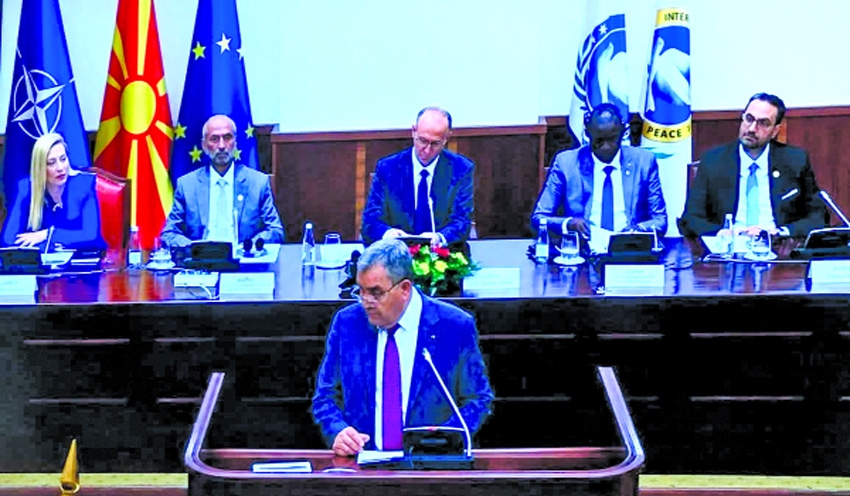
The Speaker of the House of Representatives in Malta addressed the 14th Plenary Session of the International Parliament for Tolerance and Peace held in Skopje - calling for stronger parliamentary action to advance peace, tolerance, and accountability at both national and international levels
Speaking on the theme "Advancing Tolerance and Peace: The Strategic Role of Parliaments in Shaping and Legislating Policies for the Future", Speaker Farrugia stated that parliaments must not remain passive observers of instability but must exercise their constitutional and moral responsibility to keep peace permanently on the national and international agenda.
In his address, the Speaker expressed his gratitude to Afrim Gashi for hosting the plenary session, and thanked Djangrang Epainete Sende together with Ahmed Bin Mohamed Aljarwan for their leadership in organising the forum.
The Speaker emphasised that parliaments are not merely legislative institutions, but "engines of societal transformation" entrusted with safeguarding peace, equality, and human dignity through legislation, oversight, and representation.
He underlined that the duty of legislatures is not only to enact laws after crises arise, but to anticipate danger, prevent division, scrutinise systems of power, and ensure that peace is treated as a permanent public responsibility.
Referring to growing global instability, polarisation, military expenditure, and illicit financial activity, Speaker Farrugia stressed that peace must be based on evidence and proactive action. He warned that wars begin long before armed conflict erupts, noting that "war begins when hatred is normalised, when dialogue is abandoned, and when arms move faster than diplomacy."
In this regard, Dr Farrugia placed before the Plenary recognised international documents as proof of the scale of the challenges facing peace and security, including SIPRI's "Trends in International Arms Transfers, 2025", published on 9 March 2026; SIPRI's "Trends in World Military Expenditure, 2025", published on 27 April 2026, which records that world military expenditure reached 2.887 trillion dollars in 2025; and FATF's "Virtual Assets: Targeted Update", published on 26 June 2025, which calls for stronger global action against illicit-finance risks in virtual assets and virtual asset service providers.
He made clear that these references were not made to accuse one nation, one people, or one sector alone, but to underline that peace must be defended through facts, vigilance, accountability, and timely parliamentary action.
During his intervention, Dr Farrugia highlighted Malta's legislative reforms over the past decade, including measures aimed at strengthening equality, protecting vulnerable groups, safeguarding freedom of expression, criminalising gender-based violence, and promoting inclusion. He stated that such reforms demonstrate how inclusive legislation can strengthen democratic institutions and social cohesion.
The Speaker also referred to further legislative measures concerning the abolition of criminal libel, gender balance, recognition of non-binary individuals, the prohibition of harmful practices such as conversion therapy and forced sterilisation, and the introduction of offences related to cyberstalking and forced marriage, as examples of how values can be translated into concrete legal protection.
The Speaker also underlined Malta's longstanding commitment to international dialogue and peace-building, recalling Malta's role in launching the International Parliament for Tolerance and Peace in 2017.
He stated that Malta speaks on peace not from theory, but from experience, as a small Mediterranean state which has consistently believed in dialogue between peoples, cultures, faiths, and regions, and has never accepted that smallness should mean silence.
A central element of Dr Farrugia's address was his proposal for every parliament represented within the International Parliament for Tolerance and Peace to establish a "Parliamentary Committee for Peace, Tolerance and Conflict Accountability." He proposed that these committees form a global parliamentary network under the auspices of the IPTP and meet regularly on a monthly basis to ensure that peace remains permanently on the parliamentary agenda.
Speaker Farrugia stressed that such a proposal would give peace a permanent parliamentary home, ensuring that peace is not addressed only after tragedy has occurred, or only when cameras and international attention are already focused on crisis.
He further stated that if parliaments can establish committees for finance, health, education, defence, and foreign affairs, then they can also establish a committee for peace, since the value of every other policy is weakened if peace itself collapses.
Dr Farrugia stated that such committees would provide institutional mechanisms dedicated to scrutinising developments, strengthening dialogue, preventing conflict, and promoting accountability, while complementing the work of governments, international organisations, and diplomatic institutions. Concluding his address, the Speaker reaffirmed that the future role of parliaments must continue to be guided by justice, democratic principles, inclusion, and shared global values. He stressed that peace requires continuous commitment and vigilance, stating that "affective blindness is not an option."
>>Agency