
Bangladesh's World Cup FeverBangladesh's World Cup Fever
Published: 08:55 AM, 23 June 2026 Last Update: 08:59 AM, 23 June 2026
Why Brazil and Argentina rule the hearts of a Football-Mad nation
A nation gripped by football fever

From city streets and university campuses to village tea stalls, discussions revolve around football. Jerseys and flags of Brazil, Argentina, Germany, France, Spain and Portugal fill the markets. -Facebook
Football is often described as the world's most popular sport, and the FIFA World Cup is far more than a sporting competition. Held every four years, it is a global celebration of culture, identity, media, economics, and international prestige.
Although Bangladesh is not among the 48 nations competing in the 2026 FIFA World Cup, few countries embrace the tournament with as much passion. As the World Cup unfolds across the United States, Mexico, and Canada, football fever has once again swept through Bangladesh.
From bustling city streets to rural marketplaces, from university campuses to neighborhood tea stalls, discussions revolve around football. Jerseys and flags of Brazil, Argentina, Germany, France, Spain, Portugal, and England are selling rapidly. Social media is alive with debates, statistics, memes, and friendly rivalries. For many Bangladeshis, the World Cup is not merely a tournament-it is a national festival.
This year's edition is historic. For the first time, 48 teams are participating, with a record 104 matches scheduled before the final on July 19.
Any examination of football culture in Bangladesh inevitably leads to one conclusion: no teams command greater support than Brazil and Argentina.
The origins of this phenomenon are deeply rooted in history, culture, and media influence.
Football arrived in the Indian subcontinent through British colonial rule during the nineteenth century. During the 1960s and 1970s, amid political turmoil in what was then East Pakistan, many young people sought inspiration through sport. At that time, Brazil represented football excellence.
The emergence of the legendary Pele captivated football lovers across the region. His brilliance inspired generations of Bangladeshi footballers and supporters, laying the foundation for Brazil's enduring popularity.
The FIFA World Cup was first broadcast on television in Bangladesh in 1982. Veteran football followers often identify that tournament as the beginning of the country's modern World Cup craze.
At the time, domestic football dominated public attention, particularly the fierce rivalry between Mohammedan Sporting Club and Abahani Limited. As television sets gradually entered Bangladeshi homes, global football found a new audience.
How Maradona created a nation of Argentina supporters
If Pele inspired Brazil's followers, Diego Maradona created Argentina's.
For countless Bangladeshis, the 1986 FIFA World Cup was their first experience watching football on color television. Maradona's unforgettable performances-particularly against England-transcended sport. In the eyes of many viewers, his exploits symbolized resistance against a former colonial power and elevated him to near-mythical status.
Argentina's run to the final in 1990 further strengthened the emotional connection.
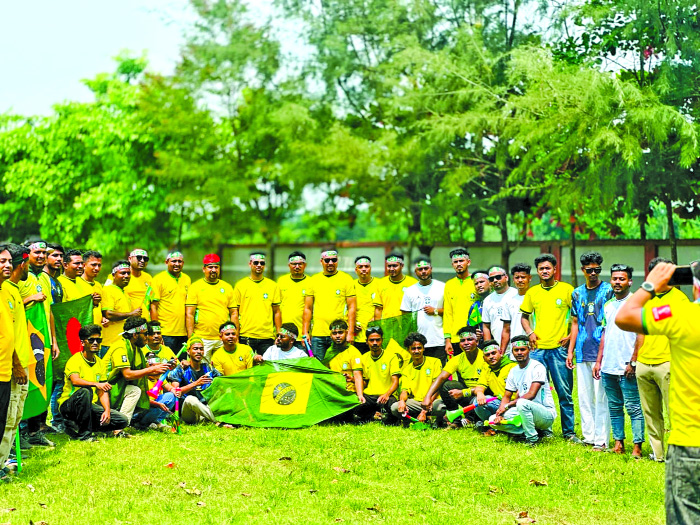
From that point onward, football loyalties in Bangladesh largely divided into two camps. Those inspired by Maradona embraced Argentina, while those enchanted by Pele and Brazil's flair remained loyal to the five-time champions.
Brazil's success during the following decades only intensified this rivalry. The Seleção won the World Cup in 1994, reached the final in 1998, and captured another title in 2002, ensuring that successive generations inherited the tradition of supporting Brazil.
Football support as a family inheritance
In Bangladesh, football allegiance often passes from one generation to the next.
A father's favorite team frequently becomes his son's favorite team. As a result, support for Brazil or Argentina extends beyond the football pitch. It becomes a central topic in family gatherings, classrooms, workplaces, and social circles.
Over time, this rivalry has evolved into a defining feature of Bangladeshi football culture. While usually friendly, it has occasionally turned ugly, with reports of violent clashes and even fatalities linked to World Cup-related disputes.
Nevertheless, for most supporters, the rivalry remains a source of entertainment, bonding, and national conversation.
Voices from Bangladesh's football community
Veteran sports journalist and lifelong Italy supporter Rafiqul Islam recalls how he chose his favorite team.
"I started following the World Cup in 1986. Through newspapers, I learned that Italy had won the 1982 World Cup. I decided to support the champions. Since then, I have remained an Italy supporter. Their defensive style may not appeal to everyone, but there is beauty and elegance in the way they play."
Former Bangladesh national footballer Poniruzzaman believes the Brazil-Argentina phenomenon dates back to a time when football information was scarce.
"When I was young, there was no television or internet. People knew about Pele and Maradona mainly through stories and word of mouth. That is how support for Brazil and Argentina spread throughout the country."
Former national hockey captain ArifulHaque Prince also remembers football's golden era.
"During our time, football was everywhere. Players like MonemMunna, Kaiser Hamid, and Sabbir inspired huge crowds. The popularity of football declined after 2000, but the arrival of players such as Jamal Bhuiyan and HamzaChoudhury has helped revive interest."
Why the World Cup feels different this time
Despite the excitement surrounding the tournament, many observers believe the atmosphere is somewhat subdued compared to previous World Cups.
Large flags are less visible on rooftops. Streets are not as heavily decorated. The intense public celebrations seen during recent tournaments appear less common.
According to Rafiqul Islam, several factors may be responsible.
"The World Cup excitement was much stronger during the last tournament. This time, various regional and international developments have influenced public attention. However, I believe the enthusiasm will increase as the tournament progresses."
Journalist and Brazil supporter MohiuddinTushar agrees that the nature of fandom has changed.
"People may not celebrate with the same intensity as before, but the World Cup still dominates conversations. Whether in tea stalls, offices, or fish markets, people are discussing football. The rivalry between Brazil and Argentina supporters remains one of the most enjoyable aspects of the tournament."
Who will lift the trophy?
As conversations continue across Bangladesh, one question dominates: Who will become world champions in 2026?
Rafiqul Islam believes European teams have a slight advantage.
"France, Spain, England, and Germany are among the strongest contenders. Brazil and Argentina are always favorites, but historically it is difficult for a champion to retain the title."
ArifulHaque Prince also identifies Spain as a strong candidate while expecting Brazil and Argentina to challenge for the trophy.
Poniruzzaman sees a more open tournament.
"Many teams have young squads and exciting talent. Japan has improved significantly, and Morocco remains a strong side. Germany, Ecuador, and Japan could surprise many people. I also believe there will be plenty of goals in this World Cup."
He predicts that several new global stars will emerge before the tournament concludes.
The World Cup and Bangladesh's football reality
Every World Cup reignites Bangladesh's love affair with football.
For one month, football dominates public life. Discussions about tactics, players, and title contenders become part of everyday conversation. Yet amid the celebrations, an uncomfortable question inevitably arises: Why is Bangladesh absent from football's biggest stage?
The contrast is striking. Iceland, a nation of little more than 300,000 people, has competed at major international tournaments. Bangladesh, with a population exceeding 170 million, remains far from qualifying for the World Cup.
The reasons are complex but familiar: inadequate infrastructure, a shortage of quality training facilities, weak grassroots development, and inconsistent long-term planning.
Dhaka lacks sufficient playing fields. Existing facilities require modernization. Clubs need stronger youth development programs and more professional management structures. Football development cannot depend solely on government support; clubs must take greater responsibility for nurturing talent and building sustainable systems.
There was a time when neighborhoods proudly displayed the flags of Mohammedan Sporting Club and Abahani Limited. Local footballers were household names, and domestic football commanded national attention.
The passion for football has never disappeared from Bangladesh. Every World Cup serves as a reminder of that enduring love.
The challenge now is transforming that passion into progress.
If the right investments are made in infrastructure, youth development, and professional club management, Bangladesh may one day move beyond being one of the world's most passionate football audiences and become a genuine footballing nation.
Until then, millions of Bangladeshis will continue to celebrate the World Cup from afar-arguing over Brazil and Argentina, cheering late into the night, and dreaming of the day when their own flag flies among the world's football elite.


