
Published: 12:09 AM, 10 September 2026
Screen content matters more than screen time for children’s language development: DU study

What children watch on digital screens—and how actively they engage with that content—may matter more for their speech and language development than the amount of time they spend in front of screens, a new study by the University of Dhaka has found.
Children learn language in various ways, with factors ranging from family dynamics to broader social elements influencing their language development. In recent years, digital devices, particularly mobile phones, have become increasingly common in children’s hands and now play a significant role in language acquisition.
A study conducted on 50 children aged 3–8 in Bangladesh found that 80 percent of the children watched entertainment content, while only 20 percent of parents were present when their children used screens.
The findings came from an M.Phil. study conducted by the Department of Communication Disorders at the University of Dhaka, titled “Effect of Using Screen Time in Developing Children’s Speech and Language: Bangladesh Context.” Md. Zahid Hossain Khan conducted the research under the supervision of Professor Dr. Hakim Arif.
The study involved 50 children aged 3 to 8, along with an equal number of parents and caregivers, from Dhaka, Chittagong and Tangail.
Using a mixed-method approach, the researchers combined questionnaire surveys with direct observation of each child during 30 minutes of screen use.
The survey found that 40 percent of the children spent three to four hours a day on screens, while 20 percent spent more than four hours.
Mobile phones were the primary screen-based medium for 90 percent of the children, followed by televisions at 70 percent and tablets at 50 percent.
The study also found that 80 percent of the children watched cartoons and entertainment programmes, while 60 percent spent their screen time passively.
The researcher observed two contrasting scenarios. Children aged 3 to 5 who used educational and interactive applications repeated new words, asked questions and demonstrated improvements in sentence construction.
In contrast, children who watched only cartoons or YouTube videos showed a reduced tendency to speak. Many reacted with stubbornness or crying when they were asked to stop watching.
Although children aged 6 to 8 spoke extensively about the content they consumed, their sentence structures were found to be weak.
The study also highlighted a significant gap in the role played by parents and guardians in children’s screen use. Only 20 percent of guardians remained present while their children used screens, while 30 percent actively managed their children’s screen time.
Fifty percent of the survey participants believed that excessive screen use negatively affected language development, while 60 percent reported a reduction in children’s vocabulary.
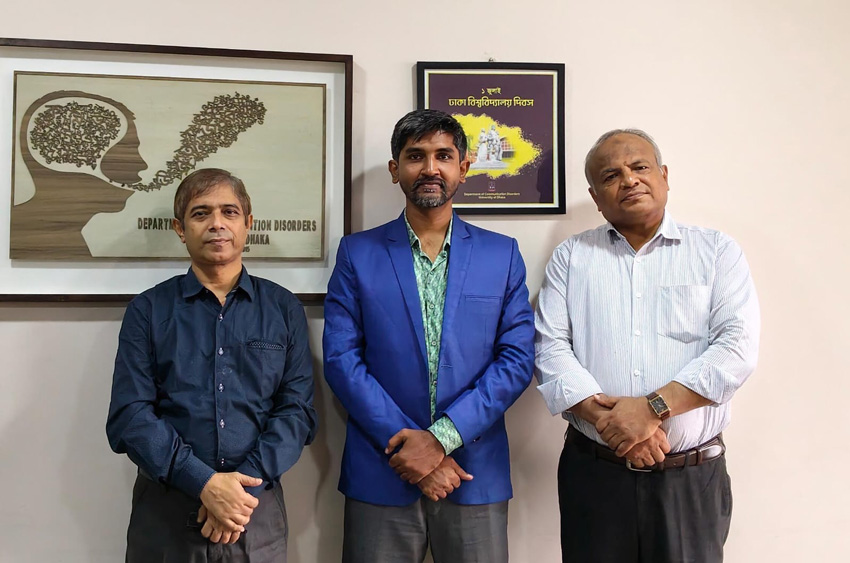
Dr. Hakim Arif on the right, Zahid Hossain Khan in the middle and Professor Saiful Alam Chowdhury of Chittagong University on the left.
At the same time, 60 percent of respondents believed that screen time could contribute to language learning if it was used appropriately.
Researcher Md. Zahid Hossain Khan said two-way conversation is a primary prerequisite for language learning, whereas communication through screens is essentially one-way.
“When a guardian sits with a child and discusses the content being watched, the activity goes beyond mere screen time and becomes a learning process,” he said.
Commenting on the study, Professor Saiful Alam Chowdhury of the University of Chittagong said the research recommends establishing age-appropriate limits on screen use, creating and promoting high-quality educational content in Bangla, training guardians and teachers, and implementing government-level awareness programmes.
Md. Zahid Hossain Khan, a researcher in the Department of Communication Disorders under the Faculty of Social Sciences at the University of Dhaka, conducted and published the paper as part of his M.Phil. research. Formal approval for awarding him the degree was granted at a recent meeting of the university’s syndicate.
Professor Hakim Arif of the Department of Communication Disorders, who supervised the research, said screen time has emerged as a major challenge to the healthy development of the current generation of children.
He said there had been virtually no long-term scientific review of the issue in Bangladeshi society and expressed the belief that the study would play a significant role in addressing the gap.
Details of the research were announced in a notification signed by Dr. Himadri Shekhar Chakraborty, Acting Controller of Examinations at the University of Dhaka.


