
Published: 10:23 PM, 21 November 2026
Britain Pledges £260 Million Aid Package for Ukraine
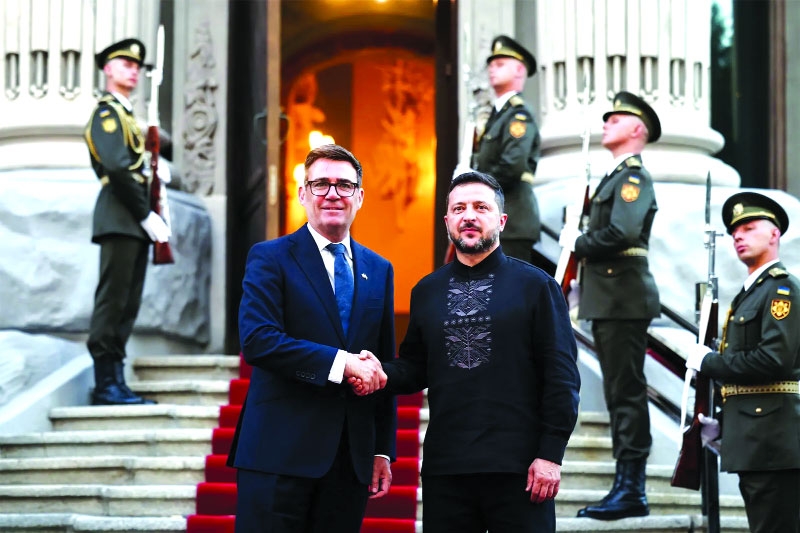
The United Kingdom has announced a new £260 million military assistance package for Ukraine, reaffirming its commitment to supporting Kyiv amid the continuing war with Russia. The latest package, announced by British Prime Minister Andy Burnham during his visit to Berlin on November 19, 2026, includes more than 1,000 long-range strike drones, along with maritime, surveillance, and logistical unmanned aerial vehicles. The move comes at a critical moment as Ukraine faces intensified Russian attacks on its cities, energy infrastructure, and military facilities.
According to the British government, the new assistance is designed to strengthen Ukraine's ability to defend itself and respond to Russian military operations. Some of the drones included in the package will have an operational range of more than 1,000 kilometers, approximately the distance between London and Berlin. They will be capable of carrying heavy warheads and striking targets deep behind enemy lines. These systems are expected to help Ukrainian forces target Russian military production facilities and other legitimate military objectives far from the battlefield.
The announcement was made during a meeting of the Coalition of the Willing in Berlin, where European leaders and international partners discussed continued assistance to Ukraine and the prospects for achieving a sustainable peace. The meeting reflected growing concern among Western governments over the prolonged conflict and its implications for European security. Britain's latest commitment demonstrates that London intends to remain one of Kyiv's strongest international supporters.
Apart from long-range strike drones, the package will include maritime, surveillance, and logistical drones. These systems are expected to improve Ukraine's ability to monitor military developments, protect important maritime interests, and deliver essential supplies to frontline troops. The logistical drones will be particularly useful in transporting medical equipment, blood supplies, and refrigeration units to military positions where conventional transportation is difficult or dangerous.
Prime Minister Burnham emphasized that Britain would continue doing everything possible to help Ukraine defend itself against Russian attacks. He also criticized Moscow's repeated strikes on civilian areas and critical national infrastructure, arguing that attempts to deprive millions of Ukrainians of electricity, heating, and other basic necessities would not weaken Britain's determination to support Kyiv. He further noted that the assistance would create employment opportunities and strengthen the British defense industry.
An important feature of the new package is that more than 80 percent of the funding will be spent within the United Kingdom. British small and medium-sized enterprises, particularly those based in Scotland, Wales, and Northern Ireland, are expected to benefit from the increased demand for defense-related production. This arrangement illustrates how military assistance can also support domestic manufacturing, technological innovation, and employment.
The latest announcement comes amid a worsening humanitarian and energy situation in Ukraine. According to the British government, Russian forces have carried out more than 2,000 attacks against Ukrainian energy infrastructure. Damage to electricity transmission facilities has disrupted power supplies across several regions. In some areas, daily electricity outages have lasted up to 16 hours, while Kyiv has experienced interruptions lasting as long as 22 hours. Prolonged blackouts have affected households, hospitals, businesses, and essential public services, creating additional difficulties as winter approaches.
Britain has also announced a separate £240 million air defense assistance package for Ukraine. This includes more than 1,000 short-range air defense missiles, launchers, and over a dozen radar systems. The equipment is intended to help Ukrainian forces intercept Russian drones and protect civilian populations and critical infrastructure. The United Kingdom has also begun delivering additional Lightweight Multirole Missiles, which have reportedly improved Ukraine's ability to intercept jet-powered drones.
The new military assistance forms part of Britain's broader commitment to Ukraine. In October 2026, the British government announced an additional £10 billion economic and military support package, including financial guarantees and assistance to maintain essential public services. Britain has also maintained its commitment to providing substantial annual military assistance through the 2030-31 financial year.
However, the continuing flow of military assistance raises important questions about the future of the conflict. While Western weapons and financial support have strengthened Ukraine's defense capabilities, they have not yet produced a lasting political settlement. Russia continues to pursue its military objectives, while Ukraine remains determined to defend its sovereignty and territorial integrity. The possibility of further escalation remains a major concern for the international community.
For Bangladesh and other developing countries, the prolonged Russia-Ukraine conflict has significant economic implications. Rising energy prices, disruptions to international trade, and uncertainty in global commodity markets can place additional pressure on import-dependent economies. Bangladesh, in particular, has an interest in the restoration of peace because international instability can affect fuel prices, food security, inflation, and export opportunities.
Ultimately, Britain's £260 million assistance package represents another significant step in its support for Ukraine. Nevertheless, military assistance alone cannot guarantee lasting peace. Diplomatic engagement, international cooperation, and meaningful negotiations must remain central to resolving the conflict. The international community should continue encouraging both sides to seek a peaceful settlement that respects national sovereignty, international law, and human rights. A stable and peaceful Europe is essential not only for the countries directly involved but also for global economic stability and international security.


