
Published: 06:21 PM, 23 November 2026
China’s Record Party Purge Is About Control, Not Corruption
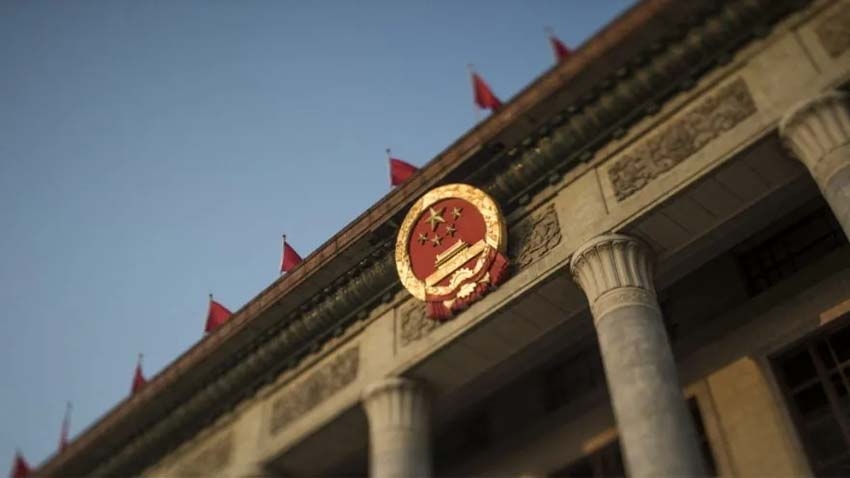 The Great Hall of the People in Beijing, where China’s top party and state meetings are held. File photo. (Fred Dufour/AFP)
In 2022, China’s Communist Party named 376 people to its Central Committee, the group of senior leaders that helps run the country. When the committee met in Beijing in late October, only 279 of them were present. Most of the missing had not retired. They had been removed.
At the meeting, known as a plenum, the party formally expelled 33 officials, a record for such a gathering. They included two former Politburo members: Ma Xingrui, the former party chief of Xinjiang, and General Zhang Youxia, once the country’s most senior uniformed officer. Also on the list were Liu Jianchao, the former head of the party’s International Department, and 16 generals of the People’s Liberation Army (PLA).
Corruption in China is real, and fighting it is legitimate. But the evidence from this plenum points to a campaign that is now mainly about something else: securing loyalty and control ahead of the party’s 2027 congress.
Beijing’s case deserves a fair hearing first. When Xi Jinping took power in 2012, bribery and the sale of promotions were widespread. He promised to catch both “tigers and flies,” meaning senior leaders and junior officials alike. After the plenum, Zhang Fuhai, a deputy head of the party’s anti-graft commission, said the leadership had eliminated “serious hidden dangers” in the party, the state and the military.
The campaign has had public support. A long-running Harvard survey found that approval of the government’s anti-corruption efforts rose from about 36 percent in 2011 to about 72 percent in 2016. Through its Sky Net operation, China says it has brought back more than 14,000 fugitives from over 120 countries and recovered about $9.3 billion in illicit assets. At home, some 26,000 people turned themselves in to investigators in 2025.
The numbers are certainly large. Official data show that more than 7.2 million people have been punished since 2012. That equals roughly one for every 14 of the party’s 101 million members. In 2025 alone, authorities opened 1.012 million cases and punished 983,000 people. Most of these punishments did not mean prison. The party’s own rules say light penalties, such as warnings or small demotions, should be used in most cases.
After 14 years of clean-up, you would expect to find less wrongdoing, but the numbers keep going up. Stricter rules and better detection explain part of this. Outside measures, though, show little change. In its 2025 index, Transparency International gave China a score of 43 out of 100, the same as the year before and close to the world average.
What the campaign now targets is more telling than its size. In 2025, discipline bodies handled 141,000 cases of “formalism and bureaucratism,” the party’s term for red tape and empty box-ticking. Officials accused of inaction or of dodging responsibility now dominate this category. In 2024, such failings made up 87.5 percent of these problems. The plenum itself pledged to go after cautious “nice guy” officials who avoid conflict and turn a blind eye.
This creates a trap. When one mistake can end a career, most officials play it safe, wait for orders and avoid risks. The campaign then punishes them for that caution. This matters because China’s economy is slowing and needs officials willing to act. Punishing people for doing too little is not anti-corruption in any ordinary sense. It is a demand for active compliance.
The timing points the same way. The same plenum announced that the party will hold its 21st National Congress in the second half of 2027, where Xi is widely expected to begin a fourth term. Clearing out the Central Committee now shapes who will be chosen then. And it is not only rivals who are being removed. According to the Center for Strategic and International Studies (CSIS), a Washington think tank, many of the generals Xi personally promoted have also fallen. That suggests a leadership that trusts almost no one, not one that is simply rooting out a corrupt faction.
The military is where the stakes are highest. In 2024, Bloomberg reported U.S. intelligence findings of missiles filled with water instead of fuel and of faulty silo lids. Some experts doubted parts of that story, but serious graft clearly existed. Still, the scale of the purge goes far beyond a clean-up. CSIS counts 36 generals and lieutenant generals officially removed since 2022, with 65 more missing or potentially purged.
The Central Military Commission, which commands China’s armed forces, now reportedly has only two members: Xi and General Zhang Shengmin. The purges have also reached the remaining veterans of the 1979 war with Vietnam, including Zhang Youxia. They were among the PLA’s last officers with combat experience. Even scientists have not been spared. Liu Cangli, an academician and former head of the China Academy of Engineering Physics, the country’s nuclear weapons institute, lost his academic titles and was removed from the national legislature.
For Afghanistan and its neighbours, this is not a distant story. Ma Xingrui, who ran Xinjiang, the region at the heart of Beijing’s security concerns about Afghanistan, was placed under investigation in April 2026. The purges have also reached the Western Theater Command, which covers China’s western frontier.
These are the people and institutions behind China’s growing role in the region. Beijing was the first country to appoint a new ambassador to Kabul after the Taliban takeover. This year, it hosted talks in Urumqi to end fighting between Pakistan and Afghanistan. A new road through the Wakhan Corridor now points towards China.
China’s goals in the region will not change, but its officials may become slower and more cautious. When the people who handled Xinjiang, Pakistan and the western frontier are expelled, their successors have every reason to wait for orders from Beijing rather than take the lead on difficult files.
Openness would settle many doubts, and this is where China falls shortest. Hong Kong’s Independent Commission Against Corruption, set up in 1974, is often held up as a model because its cases ended in open trials and the agency faced outside oversight. China’s Central Commission for Discipline Inspection, by contrast, is itself a party body, and most of its cases are decided behind closed doors. Sky Net raises similar concerns abroad. The rights group Safeguard Defenders has documented covert operations, including kidnappings.
None of this means the people punished are innocent, or that Beijing’s worry about corruption is made up. But look at what the campaign does. It punishes officials for being too careful. It removes people Xi himself promoted. It speeds up just before a major party congress. And after all this, the world sees China as no less corrupt than before.
A campaign like that no longer seems to be mainly about corruption. It is about control. The empty seats in Beijing do not simply show a cleaner party. They show a party being rebuilt so that, by 2027, almost everyone left will owe their job to Xi alone.(By, Sachin Yadav)
**The views expressed in this article are those of the author.**
>>Source: The Khaama Press


