
Published: 12:12 AM, 24 November 2026
EU has no specific position on AL ban: Ambassador
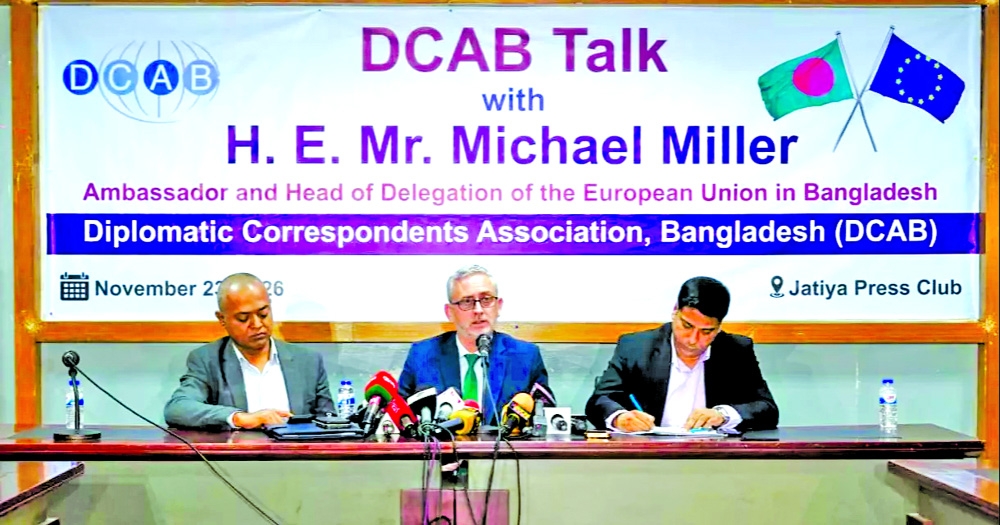
EU Ambassador to Bangladesh Michael Miller speaks at a DCAB Talk at the Jatiya Press Club in Dhaka on Monday, 23 November 2026. -Courtesy
The European Union has no specific position on the restrictions imposed on Awami League activities in Bangladesh, EU Ambassador Michael Miller said on Monday (23 November).
Speaking at the 'DCAB Talk' at the Jatiya Press Club, he said the EU was looking to build stronger strategic cooperation with Bangladesh, with an ambitious agenda for engagement in the coming years.
The event was organised by the Diplomatic Correspondents Association, Bangladesh (DCAB). Its President AKM Moinuddin and General Secretary Emrul Kayesh also spoke, while Deputy Head of the EU Delegation Baiba Zarina was present.
Miller expressed confidence that the government had the security situation under control when asked about recent political violence, while emphasising the need for proportionate responses to unrest.
He also outlined a broad agenda for closer EU-Bangladesh ties, moving beyond the traditional donor-recipient relationship towards cooperation in trade, investment, democratic institutions, migration, connectivity and security.
Ambassador Miller said they have invited Bangladesh for the first in-person discussions in December on a possible Free Trade Agreement (FTA), which is broadly seen as a significant step, for deepening economic and strategic relations.
He said the EU is moving beyond its traditional donor-recipient relationship with Bangladesh towards a broader partnership encompassing trade, investment, democratic institutions, migration, connectivity and security cooperation.
"We are now scoping an FTA," Ambassador Miller said, adding that the EU is ready to match Bangladesh's ambitions for deeper commercial ties, but any future agreement must ensure balanced commitments, reciprocity, mutual benefits and enforceable obligations.
The EU envoy emphasised that labour rights, environmental protection and good governance would remain central to bilateral economic relations.
Miller urged Bangladesh to prepare urgently for changes in preferential market access following graduation from least developed country (LDC) status.
He warned that Bangladesh's competitive advantage, particularly in readymade garments, could diminish as labour costs increased and competitors benefited from FTAs with the EU.
"Six years for the European Union is almost the blink of an eye," he said, underscoring the urgency of preparing for future trade arrangements.
Expressing concern over irregular migration, he called for stricter regulation of recruitment agencies, stronger action against human trafficking and expanded legal migration opportunities.
Asked about recent political violence, Ambassador Miller expressed confidence that the government had the security situation under control while emphasising proportionate responses to unrest.
On the Rohingya crisis, Ambassador Miller reaffirmed EU support for safe, voluntary, dignified and sustainable repatriation to Myanmar.
He said the EU had provided more than half a billion euros in humanitarian assistance since 2017, including 31.5 million euros in 2026, alongside 50 million euros in ongoing development cooperation in Cox's Bazar.
Referring to the recent International Court of Justice judgment, he said the EU had supported accountability efforts, including facilitating Rohingya testimony before the court.
The EU envoy said the EU looked forward to Bangladesh's new Rohingya strategy and continued international responsibility-sharing.
Describing the evolving relationship as increasingly political and strategic, the ambassador said both sides needed dependable partners amid growing global uncertainty.
"The agenda reflects our ambition, which I think is a shared ambition to create a partnership rooted in trust, fairness, and shared purpose," he said.


