
Published: 12:00 AM, 10 September 2016
The City We Built

Ramna Park or Romna Uddyan is a large park and recreation area situated at the heart of Dhaka, the capital city of Bangladesh. It is a traditional and historical park. This park is one of the most beautiful areas in Dhaka with lots of trees and a lake near its center. Every year, the Bengali nation celebrates their Pahela Boishakh, the Bangla New year, here. Everyday, people from all races gather here to escape from the monotony and bustle of life. Many health conscious people also throng at the Park for regular exercise every morning.
The history of Ramna starts about 1610 CE during Mughal rule, when the city of Dhaka was founded by Subehdar Islam Khan under Emperor Jahangir. At that time two beautiful residential areas were developed in the northern suburb of Dhaka city. New residential houses, gardens, mosques, tombs and temples were built in this area during that period. After the fall of the Mughal rule, Ramna gradually lost much of its glory.
Ramna area began to regain its glory since 1825, when Mr. Dowes, a British collector of Dhaka initiated a series of steps for development of the city. Engaging convicts, he cleared up the bushes and demolished most tombs and monuments except the Ramna Kali Mandir. The old mosque and tomb that now stand by the western side of old High Court building were spared. The renovated area was given the name of Ramna Green and was fenced by a boundary for using it as a race course. In 1908 he began the work of a garden that took 20 years to take a shape. The Nawabs of Dhaka developed the racecourse area as a beautiful garden and named a part of it as Shahbagh, the royal garden. The Nawabs also set up a zoo at Ramna. In 1851, the European civil servants established the Dhaka Club on the northern corner of the racecourse and after the Partition a good number of beautiful residential houses were built at Minto road area for the High Court judges and top bureaucrats.
After creation of Pakistan in 1947, Ramna area continued to occupy an important place in the history of Dhaka city. A new road from Shahbagh to the Eden Building was constructed, and the eastern side of the road was developed as the Ramna Park. A miniature zoo with a few animals and different kinds of birds was left there, at the northeastern side of the present Supreme Court of Bangladesh building and was later moved to the present location at Mirpur.
The present landscape of Ramna Park was designed in 1952 by the Public Works Department of Bangladesh (former C&B Department). The lake was excavated deeper and extended in length. Walkways and garden paths were built in phases as, sections were regraded and replanted. Irrigation of the rare variety of tree saplings was done by tree wells, with deep vertical tubes/watering pipes to encourage roots to grow deeply. A bud-shaped water tower to supply them was built on the park's northern side.
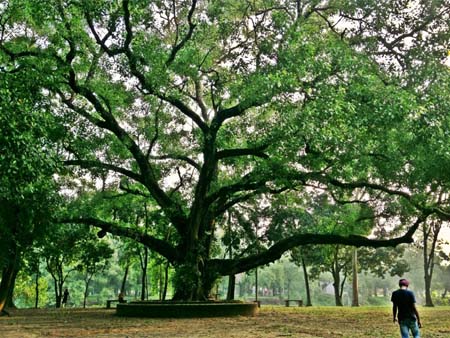
Ramna Park now occupies an area of 68.50 acres, of which the lake covers 8.76 acres. The Park now grows 71 species of flowering trees shrubs, perennials, and annuals, 36 species fruit bearing plant, 33 species medicinal plant and 41 species of forestry and 11 other species. Walkways inside park have been widened and five new gates have been built for entry from different sides. There are sitting places under of this banyan tree of the park. Besides, there are also many sitting places Again, There are also special manages for taking rest. The Park features many beautiful and modern venues for relaxation which is maintained by the PWD. Overall Ramna Park is a very beautiful place and an attraction for visitors.


