Published: 12:14 AM, 28 August 2019
A tribute to Bangabandhu's dearest teacher
 Bangabandhu Sheikh Mujibur Rahman , Syedur Rahman
Since the dawn of civilization the thoughts and visions of human beings have been broadly enhanced by the discourses, reflections and precepts of philosophers from different countries.
While speaking on the history of mankind we all the time have to make references to the dazzling names of immortal philosophers like Aristotle, Plato, Socrates, Jean Paul Sartre, Friedrich Nietzsche and some more think-tank who have illuminated people of the entire globe with their intellectual depth and valuable ideas.
In the same way when we talk about the social and ideological advancement of Bangladesh, names of several towering figures come up with emphatic distinctions.
Syedur Rahman is one of those timeless philosophers and intellectual icons who have shaped up the mindscape of this nation with the precious notions of self-esteem, enlightenment and progressive concepts. People who know about Syedur Rahman's illustrious image often call him "Socrates of Bangladesh".
Syedur Rahman (1909-1987) was an educationist, an enlightened philosopher and a dedicated social reformer. He was born in Nabinagar under Brahmanbaria district on 1st May 1909. He had been a meritorious student throughout his academic career. He achieved first division in secondary school exams.
He acquired first class securing first position both in Bachelor of Arts (Honors) and Master of Arts in Philosophy from Dhaka University respectively in 1931 and 1932. He started his professional career by joining Department of Philosophy in Rajshahi College after completing his academic studies. Philosophy was Syedur Rahman's academic discipline and at the same time he had passionate attachment with philosophic studies throughout his life.
Syedur Rahman's professional life is dotted with a broad spectrum of varieties. He worked as a professor in Calcutta Islamia College which is now known as Abul Kalam Azad University. He also held the post of Superintendent of Baker Hostel, Special Officer of Education Department and some more designations. Bangabandhu Sheikh Mujibur Rahman was his student at Baker Hostel.
Bangabandhu, in his "Unfinished Memoirs", recalled Syedur Rahman and applauded Syedur Rahman's constructive contributions for the academic and personal development of his students.
Syedur Rahman was involved as a teacher in Dhaka College and some more government colleges between the years 1947 to 1952. He left for London in 1957 with Commonwealth Scholarship. After coming back home he served different institutions such as Chittagong College and Eden College as professor and principal.
A special incident from Syedur Rahman's life described by former bureaucrat Siddiqur Rahman in the book "Shotabdir Sriti" on page 171 deserves to be narrated in this write-up. During Pakistan regime, once East Pakistan's governor Monayem Khan held a meeting with principals of different colleges of Dhaka city. At one point during that meeting Monayem Khan said, "I don't understand what you people are doing.
You are even admitting students with third division." Syedur Rahman, being a fearless and upright scholar replied, "Wherefrom will we get future governors if students with third division are not admitted?" This event is a strong instance of Syedur Rahman's straightforward, morally uplifted nature.
Another striking thing happened in Syedur Rahman's life. Once he went to meet Bangabandhu Sheikh Mujibur Rahman while Bangabandhu was President of Bangladesh.
Bangabandhu stood up from his chair as soon as he saw Syedur Rahman. Bangabandhu showed deep honor to Syedur Rahman and seated Syedur Rahman on the President's chair. Bangabandhu's amicable and respectful behavior impressed Syedur Rahman. Bangabandhu further said to Syedur Rahman, "Sir, please call me up over telephone whenever you need to meet me. I will go to meet you myself."
Following the independence of Bangladesh, Syedur Rahman taught in Dhaka University from 1972 till 1981. With the money he received from Dhaka University during those years, Syedur Rahman launched a welfare foundation. This foundation aimed at training up students with oratory skills to deliver speeches on academic matters, scholarships, educational environment and some more similar issues.
Particularly, Syedur Rahman's roles for enhancement of women's education are highly admirable. Tejgaon Women's College was established through his endeavors and he held the post of this college's honorary principal till 1978.
Syedur Rahman was a dynamic organizer of Bangladesh Philosophic Association and he led this platform as its president since 1973 up to 1983. He set up a small medical clinic at his village home during the Liberation War of 1971 for providing medical services to wounded freedom fighters.
Moreover, he helped freedom fighters in many other ways putting his own life at risk. He made vital contributions in his village for establishment of banks, community seed stores, schools and colleges in his own area. These philanthropic activities bear evidences of Syedur Rahman's leaning towards the expansion of enlightenment among his country's people.
Syedur Rahman was well-versed in Holy Quran. But he had a broad-hearted approach to people of all religions. He offered generous cooperation to everyone associated with him. Serving people was the highest form of piety for Syedur Rahman. He was a good tennis player too, as recalled by his contemporaries. He visited several countries including England, France, Russia etc.
Syedur Rahman's son Shafik Rehman is a veteran journalist of Bangladesh. Shafik Rehman was the founding editor of Jay Jay Din magazine which later on became a daily Bengali newspaper.
Syedur Rahman breathed his last on 28th August 1987 at Holy Family Hospital, Dhaka. We hope the present government of Bangladesh under the dedicated leadership of Bangabandhu's daughter Prime Minister Sheikh Hasina will recognize the worth and contributions of Syedur Rahman for the country's progress by conferring a posthumous award to this scintillating educationist.
Syedur Rahman was one of the intellectuals who played a courageous role by demanding to bring Sheikh Hasina back to Bangladesh in 1981 while military rule was going on. Bangabandhu sent Syedur Rahman to Russia for better treatment. Bangabandhu got killed while Syedur Rahman was in Russia. Syedur Rahman was heavily shocked at the death of Bangabandhu.
A great philosopher and teacher of Bangabandhu Sheikh Mujibur Rahman, Professor Syedur Rahman had been treated as lighthouse of Bengali culture, passed on this day in 1987.After a certain period, it is impossible to trust everything except oneself by searching the meaning of life.
And then men become an existentialist and search freedom in their works. French philosopher Jean-Paul Sartre though this theory. This thought was also reflected in the works and thinking of Professor Syedur Rahman. He had a personal thought on existence of almighty God. But he barely used to speak it to others. Prof. Syedur used to say Man has created God as famous writer George Bernard Shaw stated "Man created God after his own image."
Syedur Rahman was born in the village Rasulabad of Brahmanbaria district on 15 May, 1909. During his primary school time, Syedur Rahman was awarded talent pool scholarship. In this period of time, he came under the guidance of Mawlana Abdul Majid, an advocate of Khilafat Movement and turned himself attracted into religious rites and rituals.
Through prayers and fasting, he learned reciting and memorizing Quran. However, he had been affected by black fever during his student life from class eight to ten. Though he was recuperated for a while, unfortunately he had to suffer it for rest of his life.
Despite his physical weakness, he passed matriculation under Kolkata University securing first division in 1926. He had achieved same result in intermediate examination. He got admission in Dhaka University in 1928 and passed BA Honors in Philosophy in 1931.
He stood first class first in both the examinations in BA and MA. In 1941, he was transferred to Kolkata Islamia College. The time was not favorable. The Japanese fighters used to roam in the sky over Kolkata. It was the time of 2nd World War.
In 1943, Syedur Rahman was appointed as Superintendent of famous Baker Hostel. This hostel was especially for the meritorious students. Most of the leaders, who led society before and after 1947 independence, were students of this hostel. One of them was Bangabandhu Sheikh Mujibur Rahman. During the time of tragic food crisis in 1943, in which 5 million people died of starvation, Syedur Rahman supervised the hostel very carefully. For his organizing capability and sense of humanity, he was widely appreciated then.
In 1947, he was sent to Darjeeling after partition to have the dues of East Bengal. Later, in September, he was appointed special officer of Education Department. He was mainly responsible to rehabilitate the teachers who were tilted to get away to West Bengal.
At that time he was also offered drafting education bill and amendment of Dhaka University regulation. Due to that, he was able to bring the colleges under Dhaka University. Dhaka University's Iqbal Hall (now Zahurul Hoq Hall) was established during his time. The then education secretary F A Karim became annoyed to him for his involvement in Language Movement. Consequently, Syedur Rahman was transferred to Dhaka College.
From 1947 to '53, he was part time lecturer in the Department of Philosophy at Dhaka University. He was also a part time lecturer at the same university in the Department of Islamic Study and Culture. In 1952, for his sympathy to Language Movement, the authorities concerned transferred him by a 24-hour notice to Murari Chand College in Sylhet. This year, his famous book 'An Introduction to Islamic Philosophy' was published.
In 1954, after United Front formed government, he was ordered to return to Dhaka. However, the order had been canceled by the impression of Section 92. The principal of Dhaka College noted in a confidential annual report, "He is more of a politician than of a teacher." It proves that his strong character made some bureaucratic characters intolerants to him.
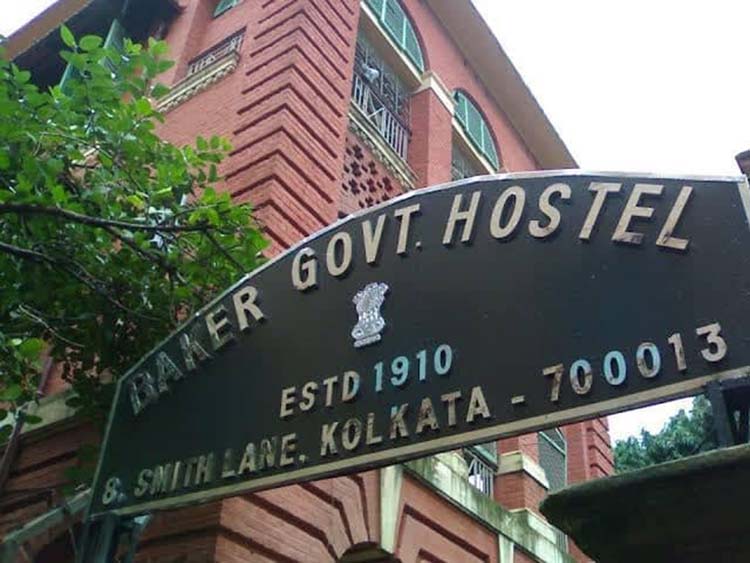
Baker Hostel in which Syedur Rahman was Bangabandhu Sheikh Mujibur Rahman's teacher.
In 1951, he got involved in secular movement. He came in touch with Mawlana Bhasani and gathered knowledge of his ideology. Syedur Rahman was highly influenced by the protesting character of Bhasani. He flew to London with commonwealth scholarship in 1957. He was accused of derailing youths like Socrates, who was labeled for 'corrupting the youth'. He was appointed as a Chittagong Division School Inspector in 1962.
Afterwards, he started encouraging the parents to engage their children in different co-curricular activities side by side with formal education. In 1963, when the bustle and clamour amid the students reached its peak he was transferred to the then Jagannath College, Dhaka.
With his earnest initiative, the college started its activities in a newly made building leaving the old tin-shed one. He created a scope for the poor but intelligent students to work in different positions in the college administration. This type of initiative was commonly known as 'Learning and Earning'.
During the communal riot in 1964, he gave shelter to at least 1,400 people on the college premises. He was massively appreciated at home and abroad due to his initiatives. People criticized and rebuked him harshly tagging him as a communist and atheist.
He theorized that it is never possible to serve God denying our duty to serve people. He opined that the intellectuals must work for the welfare of 'the Have-nots'. They must uphold the ideologies of communism. In 1971, he set up a hospital in his village which was used as a transit camp by the freedom fighters during the liberation war.
In the post-liberation era, he joined Dhaka University as a Professor. He donated all his money, earned from the university as remuneration, to Syedur Rahman Foundation. He was one of the founders of Tejgaon Women's College, Dhaka. He went on a vacation to Moscow in 1975. He was the president of Bangladesh Philosophers' Association.
The following note by Syedur Rahman was written to the publisher of his book reveals glimpses of his ideology: I always tried to dedicate myself for the welfare of the people. I put all my faith on the possibilities of people's enlightenment. I strongly believe that people will be capable of establishing a society free from all kinds of prejudices. I oppose to all kinds of irrational beliefs which have created an obstacle to people's progress.
Any conservative and sectarian belief is tantamount to denial to life. People must search happiness here in this existing world because nothing is in existence beyond this life. Three things must help people go ahead are self-restraint, love and service for the greater humanity.
In Bangaleer Darshan, Professor Aminul Islam said, "Principal Syedur Rahman set a glaring example in establishing the freedom of expression in society; he wholeheartedly worked throughout his life to spread the message of non-communalism among people. He never confined himself in theories rather he always practiced what he theorized. He dedicated his entire life for the welfare of greater humanity.
He opined that the phrase 'welfare philosophy' must be realized deeply to understand what philosophy means and how it works. The philosophical thoughts of Bangalee are confined to mere spiritualism and the idea of hereafter, which Syedur Rahman did not believe in. He emphasized the meditations for science much rather than performing the religious rituals. He said that a non-superstitious and freedom loving mind is essential for establishing an enlightened society."
Syedur Rahman was a philosopher. But in what way do we consider him as a philosopher? Hope you all know that we cannot consider one 'a philosopher' if one studies philosophy. Likewise, we must not consider one 'a litterateur' if one studies literature. In modern times, people generally get influenced by reading books.
Though Syedur Rahman did not write any book on philosophy we consider him a philosopher. But why? In this phase of the discussion, we must consider him a philosopher from a different perspective. We all know though Socrates did not write any book but we consider him the greatest philosopher the world has ever produced. What did Socrates produce?
Socrates gifted us Plato whom we can compare with a lot of books. Readers, you must not forget we are not comparing the theories and philosophical thoughts of Socrates with those of Syedur Rahman. We just would like to say the philosophical thoughts produced by Syedur Rahman for our society and nation need to be reevaluated.
He didn't refuse to leave his real and pragmatic identity. As a result, a rivalry with the society was mandatory for him. Obviously, he was branded as an atheist. A fundamentalist slammed and criticizes him with objectionable words at Baitul Mukarram Mosque in front of hundreds devotees.
But it is noticeable that, the then intellectuals never attacked him as he was open-minded about religion.
We find some reasons for this.
1. He was such a man who used to avoid clash of opinion. He never wants to spread his opinion and ideology to others.
2. He never had engaged in unnecessary war of words with others; rather he was strict on his own belief.
3. He was straightforward and never likes hypocrisy.
4. He always avoided egoism which is very common in so-called intellectuals.
5. He was not like those, who only wish the betterment of the people.
6. He always keeps his words which he promised to others.
7. After all, he got a lot of love from people, which had increased his thinking and works.
If someone got emotional on religion, he said, "You become a perfect Muslim indeed." Sometimes he said, "Are you a human being or Muslim? He often used to speak this "Muslims have a sacrifice and this is only 'leave defecation', they have no other sacrifice."His main philosophical theme was men. And that was from his core of heart. He knew how much impact of religion on men and socio-economy and politics. His mankind mind worked for this.
If someone got emotional on religion, he said, "You become a perfect Muslim indeed." Sometimes he said, "Are you a human being or Muslim? He often used to speak this "Muslims have a sacrifice and this is only 'leave defecation', they have no other sacrifice."His main philosophical theme was men. And that was from his core of heart. He knew how much impact of religion on men and socio-economy and politics. His mankind mind worked for this.
Syedur Rahman thought that careless life makes last stage of life meaningless as over-belief grab men at that time. If someone searches the happiness, he has to find it in this world. Men have to make life meaningful by own works. Men have to make the world as they like by love and service avoiding uncertain way. Syedur Rahman had devoted his life for the well being of mankind.
If his atheist identity carries his real identity, then how he wrote the books about philosophy on Islam and Hazrat Mohammad (PBUH). He never made publicity about atheism in black and white and by speaking to the public. He only spoke his belief to personal level during discussion. And it was not for atheism but anti of religion.
Theist can refuse religion. Atheism is an independent matter. Moreover, if someone doesn't believe in God perfectly, he never becomes an atheist. And in that case, level of belief is not negative fully. We can say about him like this which is related to his thoughts. Sadly, it seems that the most religious among us are often the least spiritual.
Professor Syedur Rahman heard the unfortunate death news of Bangabandhu Sheikh Mujibur Rahman while he had been admitted in a Moscow Hospital. Hearing the killing, he became crestfallen. He wrote in his autobiography: "Sheikh Mujib was dearest to me more than others. It seems to me as if I have lost my son on his death." In a relation between a teacher and student had been so deep and sweet.
The pioneer of open thinking and intelligence died on 28th August in 1987 and was laid to rest at his native village Rasulabad of Nabinagar upazila according to his last wish. Though he physically left us however his ideology, philosophy and creations are still shining with the progressive people.
Syedur Rahman was an illuminated figure during his era and he is still remembered for his knowledge, intellectual dexterity and thinking height. While writing on Syedur Rahman, a few lines from Aristotle can be borrowed, "Be a free thinker and do not accept everything you hear as truth. Be critical and evaluate what you believe in."
The writer is Editor-in-Chief of The Asian Age.
The writer is Editor-in-Chief of The Asian Age.