
Published: 12:32 AM, 07 September 2023
Representation of Economic Individualism in Robinson Crusoe

Sayera Khatun
The title of this article is "Representation of Economic Individualism in Robinson Crusoe." Robinson Crusoe is one of the earliest works of fiction in the history of English literature narrating the ups and downs of a young Englishman's life while he was travelling overseas and this book lays special emphasis on that man's moral regeneration which he came across while living on a solitary island, thousands of miles away from his homeland. It's popular with readers as a book of maritime adventures. However, this book contains a number of educative things for readers of all categories. Robinson Crusoe describes an ordinary man's rediscovery of himself in the middle of troublesome circumstances.
A portrait of the colonial period also comes up vividly in the book by means of the protagonist's ambition to become an international merchant and this dimension of the book includes precise economic implications. The spiritual message of the book is also quite remarkable. In the introduction, I would like to offer some facts and figures about Daniel Defoe, the book's author and briefly highlight the prominent themes of Robinson Crusoe. However, these themes have been elaborately analysed in the following chapters of this paper.
Daniel Defoe was born in London in the year 1660. His father James Foe was a Dissenter from the Church of England. Defoe attended a respected school in Dorking, where he was an excellent student. He was forbidden to attend Oxford or Cambridge as he was a Presbyterian. He entered a dissenting institution called Morton's Academy where he studied science and the humanities and considered becoming a Presbyterian minister. In 1683, Defoe became a travelling hosiery salesman. Visiting Holland, France on business Defoe developed a taste for travel that lasted throughout his life.
Defoe became successful as a merchant. He established his headquarter in a high class neighborhood of London. He married an heiress named Mary Tuffley, who brought him the size able fortune of 3,700 pound as dowry. In 1685 England was ruled by James Stuart, a catholic, who was strongly anti-protestant. Defoe believes in religious freedom and during the next three years, he published several Pamphlets protesting against the king's policies.
In 1692 economic boom suddenly collapsed which was a disaster for Defoe. He became a bankrupt. However, within the next two years, he was able to pay off most of the debt, but he was never again entirely free from debt. And money became a prominent theme in his later novels. Defoe writes a poem name "The True-born Englishman" in 1701 which became popular and earned Defoe some celebrity. He also wrote political pamphlets. He began writing fiction around the age of sixty. His first novel Robinson Crusoe was published in 1719.He also wrote Captain Singleton, Moll Flanders, A Journal of the Plague Year and Roxana. Most of Defoe's work reflects his own life.
Colonization is the most important theme in Robinson Crusoe. Defoe creates Crusoe as a prototype colonizer. The way Crusoe establishes his dominance over the island and the way he treat Friday establish him as a colonizer. Religion is also an interesting theme in Robinson Crusoe. When Crusoe's ship comes under a violent storm he realizes that it is a punishment for him. He suffers for his sin and he is salvaged through his repentance and prayer. Economy is also an excellent theme in Robinson Crusoe. Crusoe is an economic man. He keeps a careful record of his project and crops.
Robinson Crusoe was born in the year 1632 in the city of York, England. His father wanted him to study law but he had a strong desire to travel abroad by ships. Crusoe's father was totally opposed to this desire. One day Crusoe left home to go on a voyage. When the ship sailed out of the harbour a strong wind began to blow. The wind soon grew into a frightful storm, the ship was wrecked but fortunately Crusoe and others were rescued by a boat sent to them by another ship. Crusoe landed upon the shore near Winterton in the company of the others. From Winterton they all walked to Yarmouth where they were received with great kindness by merchants. From there Crusoe went onward to London by road.
From London he sailed to Guinea on the African coast in the company of an English sea captain who had become very friendly with him. Crusoe bought certain goods in London at the advice of this sea captain and sold these goods in Guinea. He made a profit. However in his next voyage, Crusoe's ship was chased by a Turkish vessel, Crusoe and all were captured by the pirates. Crusoe became a miserable slave. After two years of slavery Crusoe got an opportunity to escape accompanied by a young Moorish fellow name Xury. Crusoe and Xury were picked up by a Portuguese ship and taken to Brazil. Crusoe settled in Brazil where he brought a sugar plantation. This business proved quite profitable. After spending four years in Brazil, Crusoe left for his next voyage. The ship faced a violent storm. The ship struck against a sand-bank and got stuck there. All the men perished in the sea except Crusoe. He was carried on an island by several waves. Crusoe soon realized that he is the only survivor of the expedition and he seeks shelter and food for himself. Crusoe makes a survey of the area and finds a pleasant valley abounding in grapes, where he builds a shady retreat.
He trains a pet parrot, takes a goat as a pet. One day Crusoe discover a man's footprint on the beach. Many years later, he had his first encounter with the Cannibals and saved the life of a savage whom the Cannibals wanted to kill in order to eat his flesh. Crusoe named him Friday.Friday became Crusoe's devoted servant. Crusoe begins to feel more optimistic describing himself as a king. On December 19, 1686, Crusoe boards the ship to return to England. He learns from the Portuguese captain that his plantation in Brazil have been highly profitable. Crusoe finally departs for the East Indies as a trader in 1694. He revisited his island. He found that the Spaniards are governing it well and it has become a prosperous colony.
Daniel Defoe idealized colonialism by showing the settlement of Spanish colonial forces on Robinson Crusoe's island. The island looked prosperous and civilized to Crusoe under Spanish governance because Crusoe himself was a spokesman for the white Europeans. Therefore, he appreciated the colonization of the island by the Spaniards.
To work out an economic overview of Robinson Crusoe, it is necessary to take a look into the features of financial individualism portrayed in the character of the book's protagonist. Individualism refers to the concept of a self-constructed vision of life. Robinson Crusoe went on his voyages across seas and oceans with a self-motivated spirit. It was absolutely his own willpower that drove him forward. His vision to become a merchant and his efforts to buy and sell different commodities without monetary or advisory help from anyone else present him to the readers more or less as a self-made entrepreneur. From this angle, the idea of economy gets connected with the thematic streams of Robinson Crusoe. The protagonist of the book spearheaded his economic ventures despite all hurdles and even after being rescued from that island after around 27 years, he embarked on his commercial drive once again. So, it can be stated that Robinson Crusoe firmly established his own approach to colonial economy through his business initiatives and this convinces the readers to view him as an individualistic colonial merchant. A shift in the mindset of Robinson Crusoe also becomes clear through his business enterprises. According to the book, he did not have any determination to become a businessman. Rather his ambition was to travel around the world by ships and to become a navigator but in course of time he picked up business as a career for reasons of his necessity to earn money which gradually becomes something like his career. Despite his spiritual enlightenment, Robinson Crusoe remains a merchant till the last chapter of the book. So, a study of Robinson Crusoe from the viewpoint of economy is vital for a deeper understanding of the story.
Economy became an essential dimension in the Daniel Defoe's Robinson Crusoe. Robinson Crusoe had a commercial purpose while travelling overseas beside his willingness to explore the world. His life begins and ends as a tradesman. Defoe represents Crusoe as a successful businessman. Crusoe chooses a seafaring life to become a wealthy man. The economic implication of the novel will come out, if we discuss the major events of Crusoe's life.
Robinson Crusoe spends money by keeping account of his profit and loss. At the voyage to Guinea Crusoe buy some toys and trifles at the advice of the captain and earn some profits by selling them. This voyage made Crusoe both a sailor and a merchant.
Robinson Crusoe wants to be a prosperous and wealthy man that is why he disobeys his parent's advice and left home for sea. He wants to come out from the middle status of his life. But his father think that "peace and plenty were the Hand- maids of a middle Fortune; that Temperance, Moderation, Quietness, Health, Society, all agreeable Diversions, and all desirable Pleasure, were the Blessing attending the middle station of life(5)." According to Crusoe's father, peace and prosperity attended only upon a middle station in life. According to Ataul Haque's A Study Guide to18th Century Literature, "The novel states the miserable condition of then middle class family of England. Crusoe is trying to be well off in the economic aspect of his life and it is the general tendency of the life of the bourgeois family of England. This is the reason Karl Marx attacks the novel in his Das Kapital (19)."
Crusoe only think about his own benefit. When Crusoe and Xury escape from the Moors; one Portuguese captain helps them. This captain sets him up with a little capital, with which Crusoe start new business. Crusoe only think about profit, that is why he sells Xury to the captain." He offer'd me also 60, pieces of Eight more for my Boy Xury, which I was loath to take, not that I was not willing to let the Captain have him, but I was very loath to sell the poor Boy's Liberty, who had assisted me so faithfully in procuring my own(Defoe 34)." Crusoe wrote that The Captain offered him money to buy Xury, and he also want to sell Xury but he felt sympathy for the boy. He sells Xuryonly when the Captain assured him that, he will free the boy after ten years. He becomes the owner of above 5000 pounds. He acts like a typical merchant.
In Brazil Robinson observes that much wealth comes from plantation. So he became a planter. This plantation proved quite profitable. He found some partners who are very successful in plantation. These men want trade slaves and they want Robinson to be the master of the trade post. Crusoe said that "This was a fair proposal it must be confess'd, had it been made to any one that had not had a settlement and plantation of his own to look after, which was in a fair way of coming to be very considerable and with a good stock upon it(defoe39)."Crusoe knew that he has enough money but for more profit he found this proposal fair enough. They set out for a voyage. This voyage of Crusoe illustrates the economic aspects of colonialism.
In this voyage the ship faced a violent storm, Soon the ship struck against a sand bank. All the men perished in sea except Crusoe. He was carried ashore by several waves one after the other. Crusoe found himself alone on a desolate island. He saw the stranded ship which face the storm, he swam to the ship to obtained food, several weapons, some clothing, some bedding, some money(even though he knew that money was of no use on a desolate island), a bag full of chicken feed etc. On this island, Crusoe enjoys absolute economic freedom. "The island gives Crusoe that laissez-faire which the economic man needs to realize his aims. In England, the market conditions, the taxation, and the problems of the availability of labour would make it impossible for an individual to control every aspect of production, distribution and exchange. The inference from this is obvious. Let the individual go to a place where there are no owners and no competitions and let him build there his personal empire with the help of a man Friday who needs no wages. This is the positive and prophetic side of Defoe's story, that side which makes Crusoe a source of inspiration to economists and to empire-builders (Lall 185-186)."
On the island Crusoe did not depend on nature, he invent all the necessary things to survive on this uncivilized island. According to RamjiLall'sA Critical Study of Daniel Defoe's Robinson Crusoe "The economic theme of Crusoe's life on his island is that labour and invention create useful things and that the value of things depends on their usefulness. When placed in a condition of necessity, Crusoe uses his ingenuity to perform all those tasks which are necessary to sustain a civilized life. Though his prudence, inherited from his early life as the son of a wealthy tradesman, Crusoe succeeds in creating capital." From these lines we can say that Crusoe's life on the island was tough yet he invents all the necessity things to lead laborious life. He grows crops, makes a boat, built a hut and so on for his own advantages. He finds money is useless on the island. In this connection, we recall his famous speech in which he addresses money thus: "O Drug! What art thou good for, thou art not worth to me, no not the taking off of the Ground, one of those Knives is worth all this Heap, I have no Manner of use for thee, e'en remain where thou art, and go to the bottom as a Creature whose life is not worth saving(57)." Crusoe knew that money is useless in this island yet he puts it in his safe keeping and later it prove very useful to him.
On the desolate island, Crusoe does not forget his monetary consideration. He regards himself as the king of the island and a rich man. He says "My Island was now peopled, and I thought myself very rich in subjects (241)." He views the island as his mere property over which he has an undoubted right of dominion.
When Crusoe reaches Lisbon and meets the captain of the ship, he takes all the account of his property from him. He finds that his plantations have done well and he is very rich. He gives money to the Portuguese captain and the widow who were so kind to him.
Robinson Crusoe represents the economic imperialism of 18th century England. He visited Africa, South America, Caribbean Islands and some other places in a quest for economic advancement of his own and his economic progress is certainly a part of the commercial ventures mobilized by the English colonial authority of that time, to judge from a wider point of view. Through the details offered by the narration of Robinson Crusoe, we catch an expanded glimpse of the supremacy the British colonial forces exercised on different parts of the world during the 18th century. So, the text Robinson Crusoe is not just one man's whims about travelling overseas. Rather it exposes England's widespread exertion of colonialism during Daniel Defoe's time.
In this novel colonialism is found when Crusoe sells Xury to the captain. The captain offered money to buy Xury, but Crusoe didn't agree to sell Xury because this boy helped him to escape from slavery. However, he accepted the proposition when the captain promised that he would release Xury from slavery if he served him faithfully for ten years and if he turned Christian. Crusoe said "However when I let him know my reason, he own'd it to be just, and offer'd me this medium, that he would give the Boy an obligation to set him free in ten years, if he turn'd Christian; upon this, and Xury saying he was willing to go to him, I let the captain have him(Defoe 34)." By selling Xury, Crusoe shows that he is greater than Xury. It's not right to sell a human. The captain makes a deal with Crusoe, but they didn't ask the boy whether he wants to turn into Christianity. They decide the fate of this boy. By doing this Crusoe gives us the proof that he is a colonizer by birth.
On the island Crusoe suffers from physical and mental pain.He finds himself on a landscape that could easily overpower him. But Crusoe determines to impose his dominance on that island. He makes a lot of efforts to discover things on the island. He prepared all the necessary things to stay comfortably on the island. He has pets whom he treats as subjects. Crusoe has a plenty of food to eat. He killed a she-goat for food. He caught a young parrot and teaches it to talk. He had everything which can give him happiness. After a lot of hard work he built his power over this remote island. By reading Bible he acquired a new outlook upon things of this world. By reading this Holy Scripture he found mental comfort. Crusoe called himself the lord of the entire estate. In the text Crusoe said that "There was my Majesty the prince and Lord of the whole Island; I had the Lives of all my subjects at my absolute command. I could hang, draw, give Liberty and take it away, and no rebels among all my subjects (Defoe 148)." Here Crusoe called himself the king or the emperor. He can give punishment, can give freedom but no one can rebel against him.
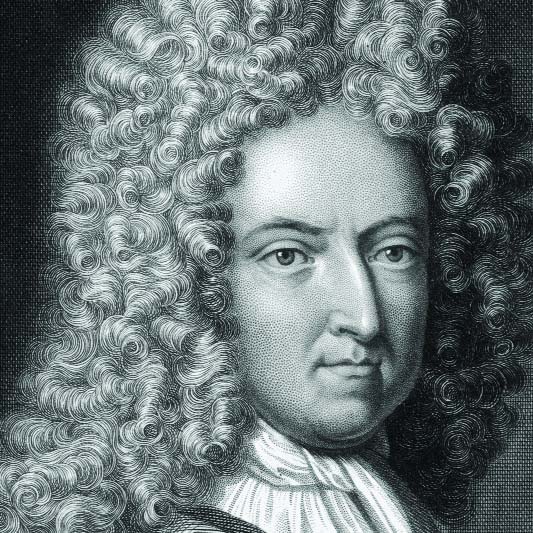
Daniel Defoe, the auhtor of Robinson Cursoe.
Crusoe's relationship with his servant Friday serves as an example of British colonial history, who dominated people of other lands and cultures and governed and exploited them. The relationship between a colonizer and a colonized is illustrated when Robinson Crusoe first saves Friday. In the text Crusoe said "At last he lays his Head flat upon the Ground, close to my Foot, and sets my other foot upon his Head (Defoe 206)." In these lines Crusoe wrote how this savage bowed down before him and made him his master. It's a proof that the white man keeps the minority group down. He accepts him as his servant but not as a human equal to him.
Crusoe chooses to name his servant as Friday. He said "I made him know his Name should be Friday, Which was the Day I sav'd his life(Defoe 206)." By give him this name Crusoe show his authority over him. "Friday" is belong to English culture, and by choosing this name Crusoe show his eagerness to rub English habits and norms on his servant. At first he thought him to say master. He said "I likewise taught him to say master, and then let him know, that was to be my Name (Defoe 206)." Crusoe thought himself superior than Friday that is why he teach Friday to called him as master. He also thought him to say "yes" and "Not".
He colonized Friday by teaching him to eat Bread, milk instead of human flesh. He also teaches him to wear cloths. Friday wants to eat human flesh, in the text Crusoe said "At this I appear'd very angry, express'd my Abhorrence of it, made as if I would vomit at the thought of it(Defoe 206)." The words in these lines such as "Abhorrence" and "vomit" display his immense hatred for the customs of the indigenous people. Friday's conversion to Christianity is another important aspect of colonization. Crusoe most of the time said "My Man Friday (Defoe 207)." This is a proved that Crusoe is a colonizer.
After some year some savage come to the island with three prisoners. Crusoe and Friday killed the savage and save these prisoners. Among these three prisoners one was Friday's father other two was Spaniard. He took them to his habitation. Crusoe said "My Island was now peopled, and I thought myself very rich in subjects; and it was a merry Reflection which I frequently made, How like a king I look'd. First of all, the whole country was my own mere property; so that I had an undoubted Right of Dominion. 2dly, my people were perfectly subjected: I was absolute Lord and Law-giver; they all owned their lives to me, and were ready to lay down their lives, if there had been occasion of it, for me (Defoe241)." Crusoe said that his island was now peopled and he thought himself very rich in subjects. He now felt like a king. He was an absolute law giver. His all subjects owed their lives to him, and they were ready to sacrifice their lives for his sake if necessary.
Crusoe asked the Spaniard to go over to the mainland and bring his countrymen(The sixteen white men). Crusoe also told him that he should make all of the white men swear an oath of loyalty to him. He doesn't want to lose the authority over the island. Some days later few Englishmen come ashore with three prisoners. Crusoe makes a conversation with one of the prisoners, and find out that he was the commander of the English ship, which stood at anchor in the sea and that his men had mutinied against him. The man said to Crusoe if he helps him to free his ship, he will place the ship under Crusoe's command. He also said that if his ship could not be recovered, he would yet live and die with Crusoe in any part of the world. The other two prisoners also said the same thing. But Crusoe gave two conditions. One of those is "That while you stay on this Island with me, you will not pretend to any Authority here; and if I put Arms into your Hands, you will upon all occasions give them up to me, and do no prejudice to me or mine, upon this Island, and in the meantime be govern'd by my orders (Defoe 256)." Crusoe imposed this condition because he wanted to govern this island and the people who stayed here. The words "governed" and "orders" are direct implications of Robinson Crusoe's colonial approach to the island on which he lived for so many years.
Robinson Crusoe said about the Portuguese captain that rescued him from that island, "He embrac'd me in his arms, My dear Friend and Deliverer, says he, there's your ship, for she is all yours, and so are we and all that belong to her (Defoe 272)."Robinson Crusoe was a white westerner. The Portuguese captain was a white European too. So, they came on friendly terms very quickly and they did not try to dominate one another. But Robinson Crusoe's approach to Friday was not like that of a friend. Rather Robinson Crusoe kept Friday in the status of a slave and did not intend to upgrade the relationship to the level of friendship or equity. All these things are clear reflections of Crusoe's colonial viewpoint.
One of the latest theories related to postcolonial studies of the colonial period is known as "Stranger King Theory". According to an essay on postcolonial studies, this theory was developed by Professor Marshall Sahlins, an anthropologist working for University of Chicago, United States of America. The Stranger King Theory propounds an innovative superstructure to comprehend global colonialism, which is rather different from most of the conventional notions about the colonial era. It aims to point out the apparent indolence with which many indigenous tribes endorsed colonial authoritarianism at the very beginning without vehement expostulations. In other words, the Stranger King Theory unveils the way the colonial pranksters from the west took advantage of the credulity of the native people whom they fooled and exploited with humbugs and mendacity. In some parts of the world, tribal clans had factional rifts with each other which aided the external powers to colonize their territories and to govern them capitalizing on their deconsolidated posture (Chowdhury 33). The clashes between the cannibals in Robinson Crusoe as a result of which the book's white protagonist appeared like a savior and rescued Friday is an ideal instance of Stranger King Theory. Robinson Crusoe became a god-like figure to Friday after he was saved by Crusoe from getting killed by his opponents in the clan. In this way the native people of some landscapes had disputes within themselves which facilitated the colonial forces to occupy their land and to enforce colonial regulations on the local inhabitants. We find a similar phenomenon if the rescue of Friday by Robinson Crusoe and Friday's deliberate submission to slavery to Crusoe are deeply examined.
We find Robinson Crusoe utilizing all the colonial instruments-guns, language, Christianity and occupation. As he came to identify that Friday was a cannibal, he scared Friday with guns and by means of guns Robinson Crusoe showed his supremacy over Friday. He taught his own language English to Friday instead of giving Friday the freedom to use his own language or showing interest to learn Friday's language. He also converted Friday to Christianity which most of the colonial forces used to do during the past centuries. Daniel Defoe served the imperial interest of the British colonial rulers in a literary way by characterizing the protagonist of Robinson Crusoe with all the typical aspects of a colonist and he justified the theme of colonial expansion by adding a spiritual message to the book.
"Self-exploration" is a popular theme in literature. It stands for a character's experience under unfamiliar circumstances and the challenges faced by him/her while facing hostile incidents which initially seems unpleasant but turns out to be educative at the end of the story and at the same time the concerned character gets to know a lot of unexplored powers of his/her own. To some extent it may be called "epiphany" as there is an undertone of sudden realization of certain things. It's like stepping into some unknown episodes of life and gathering deeper knowledge on selfhood in a new light. A man's deepest mysteries are all related to his own life and thoughts-that's the focal point of self-exploration.
Theme of "self-exploration" is remarkably found in Daniel Defoe's book Robinson Crusoe. Robinson Crusoe was lonely on the uninhabited island but he did not give up, rather he instinctively starts taking steps to save himself. His first and main concern was survival. At first he made a tent for the night's lodging, a storehouse to keep all goods which he brings from the stranded ship. Crusoe has no idea how to make things on his own. In the text he said "I had never handled a tool in my life, and yet in time by Labour, Application and Contrivance, I found at last that I wanted nothing but I could have made it, especially if I had tools; however I made abundance of things, even without tools, and some with no more tools than an Adze and a Hatchet, which perhaps were never made that way before, and that with infinite Labour (Defoe 68)." In these lines Crusoe said that he had never handled tools in his life. But for necessity he starts making things with his bare hands and a couple of hatchets. Now he is confident that he can make anything if necessary.
Crusoe made a table and a chair from the small pieces of boards which he had brought from the ship. Then he made a number of shelves, so that he could arrange some goods. He also began to keep a regular journal or diary of his daily life. In his journal he writes that "I call'd the island of Despair (Defoe 70)." Crusoe called this an island of despair because all his companions were drowned and he also almost dead. In his journal he wrote how he collects several goods from the stranded ship. He went out into the island with gun to look for some food. He killed animal and birds for food. He said "Every creature I kill'd I took off the skins and preserv'd them (Defoe 72)." In these lines Crusoe said he preserved the skins of every creature he killed so that later he could use them.
While searching the woods he found a tree which in Brazil was called the "iron tree" (Defoe 73)." He cut a piece of the wood of this tree with his axe and brought it home. He worked hard to make his cave spacious enough to serve as a warehouse, as a kitchen, as a dining-room and as a cellar. Crusoe killed a young goat and lamed another. He nursed the injured goat to health. He said "I took such care of it, that it liv'd and the leg grew well, and as strong as ever; but by my nursing it so long it grew tame, and fed upon the little green at my door, and would not go away: This was the first time that I entertain'd a Thought of breeding up some tame creatures, that I might have Food when my powder and show was all spent (Defoe 75)." Crusoe nursed the injured goat so that it would become a tamed animal. He thought of breeding some tame creature so that he can have food when his gun powder and ammunition will finished.
On the island he had no candles, so he made a little dish of clay and baked it in the sun. He added to it a wick of some oakum. This lamp gave him enough light. Like a farmer he starts raising crops like: corn, barley. He found an abundance of cocoa trees as well as orange, lemon and citron trees. He dried the grapes and made raisins. He observed that the rainy season and dry season appear regularly. So he decided to divide the seasons into rainy and dry season not into summer and winter as in Europe.
Crusoe felt the necessity of baskets. So he made efforts to make baskets. He fails to make baskets perfectly but they were sufficiently serviceable. He also tried to make some earthen pots. He succeeds in making a number of earthen pots and jars. He also made a few smaller utensils such as flat dishes, pitchers and cups.
Crusoe wants to visit the other side of the island. To visit the land, he needed a boat. He decided to make a boat. After a lot of hard work he made a boat, but this boat was heavy so he fails to take it to sea. Some days later he makes a canoe which was considerably smaller than the first boat. He made a few little lockers or boxes at either end of the boat, to store provisions, ammunition and other necessaries so as to keep them safe. Crusoe tried to make every necessary thing. He was not expert in making all these things, but still he makes these for his survival. He also felt the need of clothes to save his skin from the hit of sun. He starts making cloths from the skins of animals. In the text he said "The first thing I made of these was a great cap for my Head, with the Hair on the outside to shoo off the Rain; and this I performed so well, that after this I made me a suit of clothes wholly of these skins, that is to say, a waistcoat, and Breeches open at knees (Defoe 135)." From these lines we find that Crusoe at first saved himself from the heat of sun. Next he made a suit of clothes wholly of these skins: a waistcoat and a pair of breeches open at the knees. After that he spent a good deal of time and pains to make an umbrella.
To quote a few sentences from an article, "Robinson Crusoe's struggle for survival continued through hunting goats and birds and gathering foodstuff from trees and plants. He also learnt to make fire which gave him a little light to read verses from the Bible inside his small hut which he had made with branches and planks of wood by cutting down trees (Chowdhury 7)." Out of necessity Crusoe became a carpenter, a tailor, a boatman, a hunter, a potter and so on. He had never done these things before. His lonely combat for remaining alive on that island forced him to explore these qualities hidden inside himself. This is another form of enlightenment for Robinson Crusoe because by generating his dormant qualities, Robinson Crusoe found a totally new meaning of life and that was life does not become meaningful without a man's understanding of the value of hard work.
It made Robinson Crusoe overwhelmingly glad as he came across a great deal of fruits in one part of that island and he expressed his pleasure through the following lines:
I found melons upon the ground in great abundance and grapes upon the trees……… the clusters of grapes were just now in their prime, very ripe and rich (109).
The trees on that island not just yielded edible fruits to Robinson Crusoe; they proved highly essential to him as he chopped down wood from those trees for making fire, for securing his hut and also for making a boat. He built a bower in a particular part of the island surrounded by hills and woods which he found beautiful and at times he stayed there to delight himself with the pristine natural glamour of the island.
With the passage of time, Robinson Crusoe started to love that island. To cite some more words, "He built a bower in a particular part of the island surrounded by hills and woods which he found beautiful and at times he stayed there to delight himself with the pristine natural glamour of the island (Chowdhury 7)". The natural resources of the island proved to be highly beneficial in keeping Robinson Crusoe alive and in changing his approach to life. He started to envision his solitary plight on that island from a positive angle and regarded himself as the monarch of that place.
Robinson Crusoe ploughed the uncultivated pastures of that island. He grew different sorts of vegetables. He also found lots of fruits like water melons and grapes on that island and these things made him hopeful about remaining alive. Moreover, through the discovery of the environmental resources of the island, Robinson Crusoe came to learn the lesson that life is not all the time an expedition to embark on. Life is full of hurdles and at the same time life offers valuable instructions on how to cross those hurdles successfully. Almost the same thing happened in case of Robinson Crusoe. He acquired various survival strategies which taught him to face the adversities of life with courage and confidence.
The spiritual trait of Robinson Crusoe is another vital thing to look at for a better understanding of the theme of "self-exploration". Robinson Crusoe had never been pious in his past life. But he became pious and inclined to theology as survival became a challenge for him on that island. He found a copy of the Bible in the relics of his ship. As he read some verses from the Bible, he found some consolation and gradually he started to believe God is omnipresent and God had deliberately sent him to that island for spiritual development. His sufferings through shipwreck are all preordained and only God has the power to save him from all sorts of crisis.
As Robinson Crusoe found out the environmental affluence of the uninhabited island, much of his worries about himself evaporated and he thanked God for his deliverance from hunger and indefensibility. The feelings that dawned in his mind at that stage remind us of a line form Walden by Henry David Thoreau that states:
Glorify God and enjoy him forever (82).
Henry David Thoreau was one of the phenomenal figures that ushered in the American Age of Enlightenment during 19th century. Walden is Thoreau's best-known book that exquisitely mirrors his idealistic approach to natural environment. In Walden Thoreau gave details of the joyous and blithe experience that he gathered while living in the middle of a forest for more than two years, far from urban din and bustle. By the words "Glorify God and enjoy him forever" Thoreau spoke of admiring God loftily and gratifying one's body and mind with God's peerless creations that relentlessly beautify and enrich the natural circumference around us and through these environmental boons, God is omnipresent and is always dwelling very close to humans to liberate them from pains and perils. The same view is reflected through Robinson Crusoe's allusion to a Biblical verse that says: "Call upon me in the day of trouble, and I will deliver, and thou shall glorify me (103)".
The above Biblical quote conveys the message that when people are in distress, their prayers to God will never return unanswered and when divine salvation dispels their woes, they should eulogize the magnanimity of God. Moreover, Robinson Crusoe extends the message that human beings get invaluable benefits from ecological resources in times of agonies and destitution. This is how Daniel Defoe illustrated the value and indispensible preponderance of natural environment as far as the survival of human race is concerned on this planet.
Sayera Khatun is a student of Metropolitan University, Sylhet.
Sayera Khatun is a student of Metropolitan University, Sylhet.


