Published: 12:38 AM, 07 February 2026
The Sartorial Legacy of Tagore’s Women
Anika Tanzim
Rabindranath Tagore is an unparalleled name in Bengali literature. Yet, is his influence confined to literature alone? The characters he created have profoundly shaped the Bengali way of life, and nowhere is this influence more visible than in fashion. Though conceived nearly a century ago, Tagore’s women continue to embody modernity. Blending diverse cultural influences, they carry a distinctive and enduring identity.
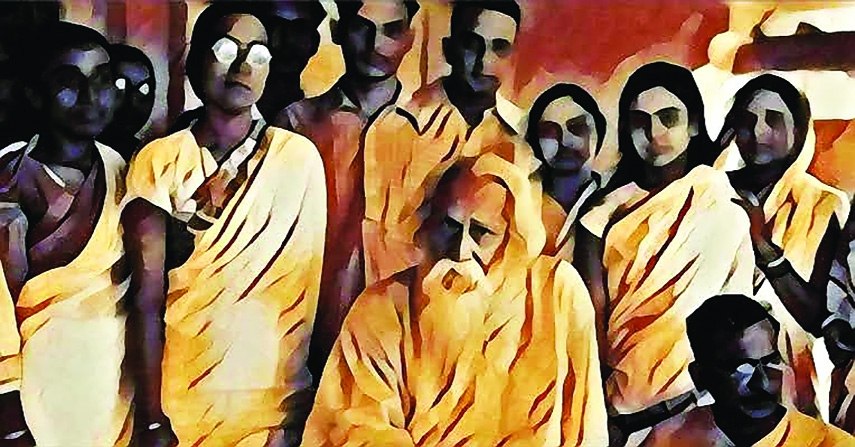
For a long time, Bengali women wore sarees without blouses, and the draping style was markedly different from what we see today. Rabindranath Tagore’s sister-in-law, Jnanadanandini Devi, encountered the Bombay lifestyle during her stay there. Inspired by the Parsi method of saree draping, she developed her own unique style. Her manner of wearing the saree gained popularity through Bamabodhini Patrika. Known initially as the Brahmika saree and later as the Bombay Dastur, it eventually came to be called the Thakurbarir saree. This style of draping had a clear influence on the female protagonists of Tagore’s novels.
Similarly, although Kadambari Devi—Rabindranath Tagore’s sister-in-law—came from a relatively ordinary background, her clothing, footwear, and jewellery reflected refined taste. It can therefore be said that the attire of Tagore’s heroines mirrors the fashion sensibilities of the women of the Tagore household.
When discussing Tagore’s heroines, characters such as Labanya and Ketaki from Shesher Kobita, Ashalata from Chokher Bali, and Charulata from Nastanirh inevitably come to mind. Ashalata wore muslin sarees paired with pleated, three-quarter-sleeve blouses. Muslin, a symbol of elegance, enhanced her refined appearance. Her high bun was distinctive, reminiscent of the Tagore family’s Ban Khopa. These buns were often adorned with silver hairpins. Even today, during Bengali celebrations—particularly Pahela Boishakh and Durga Puja—Ashalata’s fashion frequently serves as inspiration.
Bimala Devi, the protagonist of Ghare Baire, who believed deeply in women’s freedom, possessed a striking aesthetic of her own. Her traditional saree draping reflected confidence and independence. The novel portrays her wearing a white Madras saree with a zari border, paired with a sleeveless jacket—an unconventional choice for women of that era. The modern trend of wearing jackets over sarees was thus envisioned by Rabindranath long before it became fashionable.
Labanya and Ketaki in Shesher Kobita represent two contrasting fashion sensibilities. Though both embody elegance, Ketaki fully embraces Western culture, while Labanya symbolizes Bengali tradition. Labanya’s style is complemented by long black hair worn in buns or braids. It is often assumed that Ketaki did not have long hair but instead wore a distinctive haircut. As Amit observes, “Fashion is a mask, and style is the face.” Ketaki’s use of makeup signals a trendy appearance that continues to resonate with women today. In contrast, Labanya expresses her individuality through soft cotton sarees and minimal jewellery, without Western influence.
When it comes to Charulata from Nastanirh, a recent example vividly illustrates her enduring fashion legacy. Kolkata actress Debleena Dutta appeared in a Charulata-inspired ensemble at the Filmfare Awards Bangla 2025, presenting a special “old Bengali” (Bengali-coded) look. This moment reaffirmed the character’s lasting sartorial significance. Although Charulata spent much of her time indoors, her elegance was defined by broad-bordered sarees, lace-detailed blouses, and light yet tasteful jewellery, never excessive. Other actresses have also been widely praised for portraying Tagore’s heroines on screen. Konkona Sen Sharma’s portrayal of Kadambari Devi was described by netizens as “ethereal.” Madhabi Mukherjee’s interpretation of Charulata became a timeless and refined classic, while Aishwarya Rai’s portrayal of Binodini remains equally memorable.
Thus, despite being over a hundred years old, each of these characters has added a new dimension to how Bengali women drape sarees, choose jewellery, and style their hair. This is not merely a fusion of the past with the West, but a deeply rooted cultural synthesis that continues to make the fashion of the Tagore household profoundly appealing to women today.
Anika Tanzim is a student, Department of English,
University of Chittagong.