Published: 12:38 AM, 07 February 2026
Observance of Rules
Maisha Farzana Raka
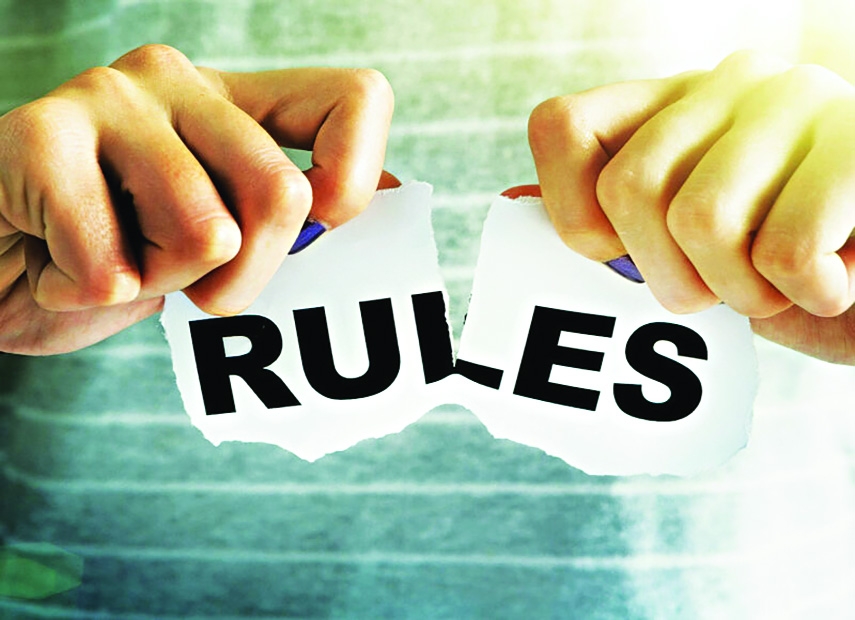
Who wants to observe rules? “Rules are for fools,” as the popular saying goes. However, Douglas Bader opines, “Rules are for the obedience of fools and the guidance of wise men.” Anacharsis points out the loopholes in rule compliance by stating, “Written laws are like spiders’ webs; they entangle and hold only the poor and weak, while the rich and powerful easily break through them.” Thus, it is not merely the existence of rules that matters, but rather who is subjected to those rules. Nevertheless, rules are formulated for the greater good of human beings and are generally associated with reward and punishment.
In general, breaking rules is an inherent tendency of human beings. The free mind often perceives rules as chains and aspires to transcend them. However, people observe rules either under compulsion or spontaneously. Spontaneous observance of rules arises from self-motivation and can be tested in the absence of any monitoring mechanism. In most cases, however, human beings follow rules due to imposed authority, often for their own greater good. Excessive enforcement of rules through compulsion, however, creates resentment and reduces individuals to mechanical obedience, making them resemble robots. Therefore, there must be a proper balance between individual freedom and the formulation and enforcement of rules, because rules exist for human beings, not human beings for rules.
Well-formulated and properly observed rules help modify human behavior effectively, motivate individuals, and establish peace, stability, good order, and discipline. Human societies adopt diverse and varied rules, encompassing different codes of conduct and actions, to regulate behavior and fulfill their needs across time and space. Most human beings are rule-abiding and tend to follow prescribed “dos” and “don’ts” unquestioningly. Generally, rules are created with good intentions and for the greater benefit of society and the state. Conversely, the impacts of unjust and unethical rules can be categorized into three major consequences: discrimination, oppression, and deprivation. Discriminatory application of rules leads to ambiguity, confusion, disrespect, resentment, non-observance, and even rebellion against both the ill-motivated rules and their enforcers. Furthermore, freedom-loving individuals often perceive rigid rules as constraints on freedom of choice, freedom of action, and freedom of expression, as well as obstacles to creativity.
Rules can be compared to fair weather, making life easier and more comfortable, whereas the non-observance of rules resembles stormy weather, where life itself may be at risk. Waldo Emerson remarked, “In every society some men are born to rule.” However, a true ruler governs himself before governing others. Rulers must also be humane and empathetic, serving the greater good of the people rather than their own interests.
Spontaneous observance of rules yields far greater benefits than forced compliance. Autocratic rules, often formulated for personal gain or for the benefit of a particular group while ignoring the majority, usually fail to gain acceptance and tend to be short-lived. Therefore, due emphasis must be placed on the careful formulation and fair implementation of rules. At the same time, citizens must willingly and sportingly abide by rules in order to secure the greater welfare of society and the state.
Maisha Farzana Raka is currently
pursuing an M.Phil in English
Language and Literature.
Maisha Farzana Raka is currently
pursuing an M.Phil in English
Language and Literature.