
Published: 12:50 AM, 10 February 2026 Last Update: 12:55 AM, 10 February 2026
Are Bangladeshis an Ungrateful Nation? 1971, Memory and the Moral Test of Our Time

K N Ahad
Bangladesh was not born through negotiation or compromise. It was born through blood, resistance, and one of the most violent liberation wars of the twentieth century. In 1971, millions were killed, hundreds of thousands of women raped, and over ten million people displaced across borders. Beyond the immediate physical destruction, entire communities and cultural institutions were devastated, leaving scars that continue to shape the moral and social fabric of the nation. International powers observed the crisis unfold, but the responsibility for the crimes lay squarely with the Pakistani military and their local collaborators. The sheer scale of human suffering, including the targeted violence against women and children, underscores the magnitude of the debt owed to those who fought and died for independence.
More than five decades later, as the nation approaches another election, a painful question confronts us once again: are Bangladeshis an ungrateful nation—one willing to forget, deny, or remain silent as the very foundations of the Republic are dismantled? This is not a question aimed at any one party or generation. It is a question of national conscience.
1971 and Bangabandhu: National Truths, Not Political Property
The Liberation War of 1971 is not a narrative open to reinterpretation or convenience. It is a historical fact, recognized by international scholarship, documented by survivors, and enshrined in the constitutional and moral foundation of the Republic. The genocide committed by the Pakistani army is established history. The role of local collaborators—rajakars, al-Badr, and al-Shams—in enabling those crimes is equally undeniable.
Likewise, Bangabandhu Sheikh Mujibur Rahman’s role as the central political leader of the independence movement and the Father of the Nation is beyond dispute. Acknowledging this does not require blind loyalty to any political party, nor does it deny that serious mistakes were made after independence. It is recognition of historical reality, not partisan allegiance.
1971 and Bangabandhu do not belong to Awami League, nor to any individual or family. They belong to the nation. And precisely because they belong to the nation, no political authority— elected or unelected—has the right to deny, erase, or relativize them, regardless of how these truths may have been politically used or misused over time. To attack 1971 is to attack the birth certificate of Bangladesh itself.
From Debate to Erasure: Crossing a Dangerous Line
Political disagreement is natural in any democracy. Historical erasure is not.
In recent times, Bangladesh has witnessed a disturbing shift from debate to symbolic violence: the destruction of memorials, vandalizing of statues, demolition of murals, burning of historical residences, and open rejection of the Liberation War narrative. These are not acts of reform. They are acts of humiliation and erasure.
A nation may criticize leaders. It may reject parties. It may demand accountability. But when it allows the destruction of its founding symbols without lawful process or national consensus, it signals a deeper crisis: the collapse of shared historical ground. History offers a clear warning. Societies that permit the desecration of their origins do not emerge renewed. They unravel.
The False Claim of a “Second Independence”
The claim that recent political upheavals represent a “second independence” is not only historically false; it is morally reckless. Independence is not a slogan to be reset with each change of power. Bangladesh achieved independence once—through a nine-month war marked by genocide, rape, sacrifice, and collective resistance in 1971.
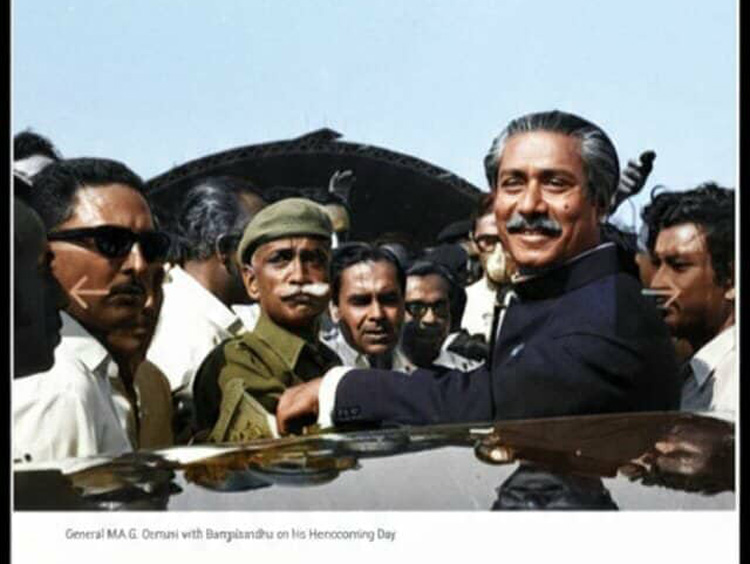
This picture shows Bangabandhu Sheikh Mujibur Rahman and General MAG Osmani in the wake of the liberation of Bangladesh. File Photo
To equate political movements or regime changes with the Liberation War trivializes the suffering of millions and dishonours the martyrs who paid the ultimate price. Worse, it opens the door for forces that never accepted independence to recast themselves as its heirs. A nation that forgets the cost of its freedom eventually loses respect for freedom itself.
Jamaat-e-Islami and the Unresolved Contradiction
There is an unavoidable contradiction at the heart of the present political moment. Jamaat-E- Islami opposed the independence of Bangladesh in 1971. This is not an allegation; it is documented history.
In any post-conflict society, political forces that opposed the birth of the state face a moral obligation: acknowledgement of history, acceptance of responsibility, and reconciliation with the founding truth. Without that reckoning, their claim to govern remains fundamentally illegitimate.
This is not a call for revenge or exclusion. It is a matter of constitutional morality. A state born through a liberation war cannot be governed—morally or legitimately—by denial of that war.
The Election and the Crisis of Inclusiveness
As Bangladesh approaches the upcoming election, the central issue is not simply who will win, but whether the process itself meets the minimum standards of democratic inclusiveness and constitutional legitimacy.
An election that excludes the Awami League—the party that led the Liberation War, formed the first government of independent Bangladesh, and remains the largest political force in the country—cannot credibly claim to represent the full political will of the nation. One may oppose Awami League leadership, criticize its governance, or demand accountability. But administrative or political exclusion denies citizens their fundamental right to choose.
Democracy does not mean selecting which voices are permitted to compete. It means trusting the people to decide.
Why Boycott Is Constitutional Resistance, Not Apathy
Under these conditions, the call for non-participation is not a rejection of democracy. It is a
refusal to legitimize a process that negates the Constitution’s foundational principles.
Participation in such an election would risk endorsing:
• The exclusion of a major political force,
• The normalization of anti-1971 narratives,
• And a governance structure detached from the origin of the Republic.
Boycott, in this context, is not silence. It is constitutional resistance. However, resistance carries responsibility. It must be declared, explained, and documented. Otherwise, it risks being misrepresented as indifference rather than protest.
Silence, Fear, and the Burden of Gratitude
Perhaps the most unsettling aspect of the present moment is not the actions of political actors, but the silence of ordinary citizens who believe in 1971, honour the Liberation War, and respect its martyrs.
That silence often arises from fear, exhaustion, and disillusionment—not betrayal. Yet silence has consequences. When historical truth is attacked without resistance, denial grows bolder. When injustice proceeds unchallenged, it becomes normalized.
Gratitude at the national level does not mean unquestioning loyalty to leaders. It means defending the truth that made the nation possible. A people who enjoy the fruits of independence but refuse to protect its memory risk becoming beneficiaries without guardians.
Ungrateful—or Unfinished?
So, are Bangladeshis an ungrateful nation?
The answer is more complex than accusation or denial. Bangladesh is not uniformly ungrateful. It is divided, wounded, and struggling with an unfinished liberation. The failure has not been of courage alone, but of institutions—institutions strong enough to protect history from politics and democracy from manipulation.
Ungratefulness is not disagreement. Ungratefulness is forgetting. Ungratefulness is allowing those who opposed independence to redefine it. Ungratefulness is watching the foundations of the Republic erode and calling it neutrality.
The struggle to uphold the memory of 1971 is not solely a task for politicians or historians. Every generation of Bangladeshis carries a moral duty to educate, remember, and transmit the truth of independence to the youth, who will shape the future of the nation. Civil society,
schools, cultural institutions, and the diaspora all play a critical role in preserving the legacy of 1971. A society that fails to do so risks becoming a nation of passive beneficiaries rather than active custodians of its freedom.
A Line That Must Not Be Crossed
Bangladesh can tolerate many political visions. What it cannot survive is ambiguity about its birth. 1971 is non-negotiable.
Any political order that denies it, diminishes it, or treats it as optional stands outside the moral framework of the Republic. Boycotting an election that contradicts this truth is not rejection of democracy. It is a demand that democracy return to its constitutional roots.
Conclusion: The Test Before the Nation
This election is more than a contest for power. It is a test of memory, gratitude, and national maturity. Bangladesh does not need another independence. It needs the courage to defend the one it already achieved.
Beyond the immediate context of elections, the nation must cultivate a culture that actively protects historical truth, honors the sacrifices of its people, and fosters moral courage across generations. Vigilance, education, public commemoration, and civic engagement are essential to ensuring that Bangladesh remains conscious of its past, steadfast in its principles, and united in its commitment to liberty and justice. Only by embracing this responsibility can the promise of 1971 be fully realized and preserved for future generations.
If those who believe in 1971 can boycott without disappearing, resist without violence, and remember without hatred, they will prove that Bangladesh is not an ungrateful nation—but a nation still struggling to complete the promise of its birth. History is watching. And history is unforgiving to those who forget.
K N Ahad is a columnist based in Ukraine. Views expressed in the article are the writer’s personal opinions.


