
Published: 03:00 PM, 18 February 2026 Last Update: 03:06 PM, 18 February 2026
Oval Office Can’t Persuade Europe to Gulp Down Far Right Sentiments

Mahfuz Ul Hasib Chowdhury
US President Donald Trump has significantly shifted US politics by mainstreaming far-right ideologies, characterized by populist nationalism, stricter immigration policies, and an "America First" foreign policy. His movement MAGA (Make America Great Again) merges conservative populism, the Christian rights, and disharmonious sentiments, often challenging democratic norms, institutions and international alliances.
As of 2026, the second Trump administration has been described as a blend of far-right populist, reactionary Christian and libertarian ideologies, focusing on consolidating presidential power and reducing institutional checks and balances.
The growing willingness of the White House — amid new Trump claims that the US election system is plagued by fraud ahead of the midterm elections — to insert itself into the domestic politics of foreign countries.
An implausible attempt is being made by the United States government to indoctrinate western societies with far-right ideologies.
Donald Trump often seems frustrated that many Americans don’t appreciate that they are living in his “golden age.”
But that’s not stopping him from trying to export his ideology by intervening in politics and elections abroad to promote or preserve right-wing populist leaders, different news agencies have reported. This explains US Secretary of State Marco Rubio’s mission this week to bolster Hungary’s pro-Russia Prime Minister Viktor Orbán ahead of April’s general elections.
Viktor Orbán, a populist strongman, was a MAGA bailiff before MAGA existed. His politicizing of the justice system, hardline immigration policies, empowerment of sympathetic oligarchs and attacks on the press are a blueprint for Trump’s second term. But he’s facing his biggest political challenge in 15 years of uninterrupted power.
Rubio’s visit to Orbán — who often seeks to undermine European Union or EU policy on Ukraine, regulating US tech giants and energy policy — is a rebuke to those Europeans who tried to convince themselves that his respectful tone at the Munich Security Conference at the weekend represented a taming of transatlantic tensions.
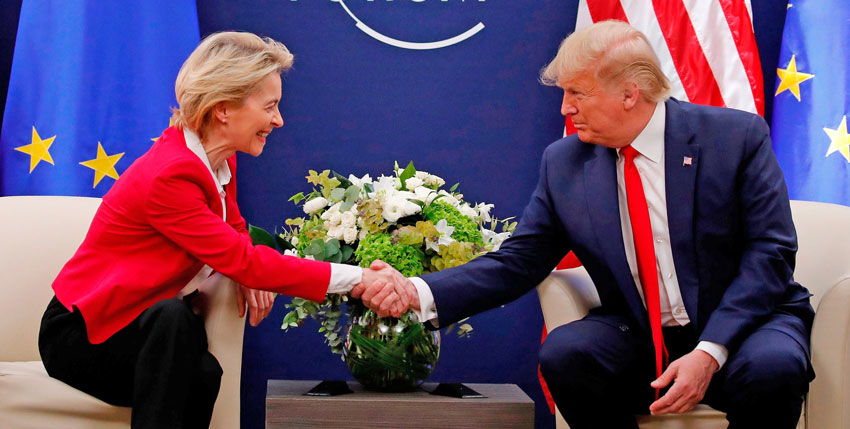
It is also the latest step in a personal evolution important to Marco Rubio’s job security in the Trump administration and future political prospects in a changed GOP. In 2019, the then-Florida senator joined bipartisan colleagues in bemoaning “significantly eroded” democracy under Viktor Orbán. But on 15 February 2026, Marco Rubio told Viktor Orbán, “We are entering this golden era of relations between our countries – and not simply because of the alignment of our peoples, but because of the relationship that you have with the President of the United States.”
But more than Marco Rubio’s personal ambition is at stake. The Trump administration’s backing of Viktor Orbán in Hungary’s election is the latest sign of an institutionalized shift to the right in US foreign policy, and a rejection of traditional stances. Some Europeans now regard the US top brass as a growing political threat to the liberal humanism Europe has been practicing for hundreds of years.
In stark contrast to US Secretary of State Marco Rubio's insistence on greater national sovereignty, British Prime Minister Sir Keir Starmer spoke in favour of greater integration between the UK and Europe on defence - to curtail rearmament costs, though, he emphasized this did not mean the UK turning its back on the United States.
Nordic and Baltic nations are geographically close to Russia, and also Germany and the Netherlands, which are all big defence spenders, geopolitical scholar Rachel Ellehuus says, whereas in southern Europe, there's Spain, for example, that is absolutely unapologetic about refusing to increase defence budgets to the levels demanded by Donald Trump.
Last week, U.S. Undersecretary of Defence Elbridge Colby couldn't have been more undetoured in his address at a meeting of NATO defence ministers he attended in Brussels in which Elbridge Colby said “Europe was no longer a US priority, the Indo-Pacific was”.
Sophia Gaston, who teaches security studies at King’s College in London, told reporters that in Munich, Keir Starmer was able to better articulate the nuance of Britain's strategic outlook categorically enclosing the shifts in the implications coming from the Oval Office.
"Other allies in Europe may be more willing to speak of divergence from Washington", Sophia Gaston says, "but for Britain it remains a strategic imperative to triangulate within the Transatlantic relationship. There will also be times when Britain will have to make hard choices, and Keir Starmer appeared more confident in confronting that reality.
It would be an improvident bid by the United States to try to compel Europe to gobble up Donald Trump’s parochial precepts regarding EU domestic legalities and international affairs comportment.
Mahfuz Ul Hasib Chowdhury is a contributor to different English newspapers and magazines.


