
Published: 12:00 AM, 17 April 2026 Last Update: 12:00 AM, 17 April 2026
Mujibnagar Day: The Birth of a Nation’s Soul Amid Fire and Resolve
The 17th of April stands as a day of profound solemnity in Bangladesh!
History does not merely unfold—it is seized, often in moments of unbearable peril. Nations are not born in comfort; they are forged in fire, sanctified by sacrifice, and legitimized by courage. For Bangladesh, few dates embody this truth with greater clarity and moral force than the 17th of April 1971—immortalized as Mujibnagar Day. It is not simply a ceremonial milestone; it is the definitive moment when a dispossessed people, ravaged by brutality of the Pakistani army, stood upright before history and declared their sovereign will to exist as an independent country in the name of Bangladesh severing all colonial clutches from the brutal Pakistani regime.
The road to Mujibnagar was drenched in blood. In the wake of the genocidal onslaught unleashed by the ‘Operation Searchlight’ by the roughshod Pakistani army on the night of March 25, 1971, the land of Bengal was transformed into a vast theatre of horror. Cities burned, villages were razed, and the intelligentsia—those luminous beacons of a nation’s conscience—were systematically annihilated. The Pakistani military junta sought not merely to suppress a political movement, but to extinguish the very idea of Bangladesh.
Yet from this abyss of terror emerged an unyielding resolve. On April 10, 1971, the glorified Awami League’s rightful leadership of the Bengali people took a decisive and historic step: the formation of the provisional Government of Bangladesh in exile. This was not an act of desperation; it was an assertion of constitutional legitimacy, a declaration that the spirit of a nation cannot be crushed by bullets and bayonets.
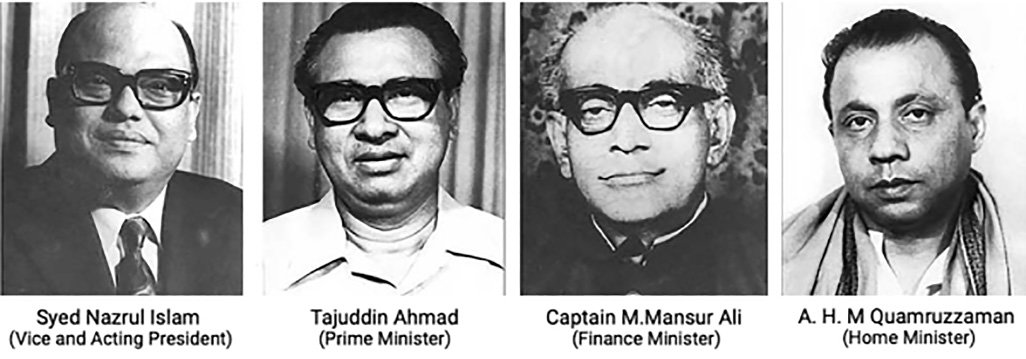
At its helm stood towering figures of vision and courage. Syed Nazrul Islam assumed the role of Acting President, embodying the continuity of legitimate authority in the enforced absence of Bangabandhu Sheikh Mujibur Rahman. Tajuddin Ahmad, as Prime Minister, brought clarity of purpose and indomitable resolve to the leadership of a nation in exile. And M. A. G. Osmani, as Chief of the liberation forces, became the military architect of resistance.
But it was on April 17, 1971, in the quiet village of Baidyanathtala, a town in the Mujibnagar Upazila of Meherpur District, the-then East Pakistan (now Bangladesh) —thereafter consecrated as Mujibnagar—that history found its voice. Beneath the open sky, amid the rustling leaves and the watchful silence of a wounded land, the provisional government took its solemn oath in front of countless foreign journalists across the word and countless people of Bangladesh. This was no ordinary ceremony. It was an act of defiance against tyranny, a proclamation to the world that Bangladesh was not merely a dream—it was a living, breathing reality.
In his epochal address, Tajuddin Ahmad articulated with searing clarity the moral and political death of Pakistan’s claim over Bengal. His words—resonant with grief, anger, and unshakable conviction—captured the irreversible rupture that had already occurred. Pakistan, as an idea binding two wings across a thousand miles of hostility and injustice, had collapsed under the weight of its own brutality. He declared “Pakistan is dead and buried under the corpse of the mountain.”
The significance of Mujibnagar lies not only in its symbolism but in its strategic brilliance. By establishing a formal government, the leaders of Bangladesh transformed a spontaneous uprising into an organized war of liberation. They provided the resistance with structure, legitimacy, and a coherent command. They spoke not as rebels, but as representatives of a sovereign people temporarily dispossessed of their land.
Equally important was the government’s appeal to the conscience of the international community. As the genocide intensified, urgent calls were made to global institutions, including the International Committee of the Red Cross, urging intervention and recognition. Though the response of the world powers was often hesitant, even complicit in silence, the moral clarity of Bangladesh’s cause could not be indefinitely ignored.
Yet, while the nation fought an external enemy, it was also betrayed from within. Local collaborators—most notably elements aligned with Jamaat-e-Islami—sided with the occupying forces with all brutalities, forming auxiliary militias and committees to suppress the liberation struggle of Bangladesh. Their complicity added a tragic dimension to an already harrowing conflict, reminding us that the gravest threats to a nation’s freedom often arise not only from foreign aggression but from internal treachery.
The months that followed Mujibnagar were marked by relentless scale of struggle. The war escalated into a full-scale conflict, drawing in millions of ordinary men and women who transformed themselves into freedom fighters. Villages became battlegrounds, rivers carried whispers of resistance, and across the border, in India, millions sought refuge from the carnage.
By the time victory was finally secured on December 16, 1971, Bangladesh had paid an immeasurable price. Hundreds of thousands had perished; countless families were shattered; the land lay in ruins. Yet from that devastation arose a nation reborn—tempered by sacrifice, united by suffering, and inspired by an unquenchable aspiration for justice and dignity.
Mujibnagar Day, therefore, is not merely a commemoration of the past. It is a mirror held up to the present. It compels us to ask uncomfortable yet necessary questions: Have we remained faithful to the ideals for which so many laid down their lives in the present political landscape? Do we honour their sacrifice through our actions, or do we allow their memory to fade into ceremonial rhetoric?
Freedom, as history repeatedly teaches us, is neither free nor self-sustaining. It demands vigilance, integrity, and an unwavering commitment to truth. Those who witnessed the horrors of 1971—who saw their loved ones taken, their homes destroyed, their dignity assaulted—understand this truth in ways that cannot be taught, only lived.
For the families of the martyrs, freedom is not an abstract concept. It is the echo of a voice that will never return, the silence of a chair that remains forever empty. It is the unbearable knowledge that their sacrifice was both the price and the foundation of our freedom—our independence.
How, then, do we repay such a debt?
We cannot. But we must honour it.
We honour it by preserving the truth of our history against distortion and denial. We honour it by upholding the principles of justice, equality, and secularism that formed the bedrock of our liberation struggle. We honour it by resisting all enemy forces—internal or external—that seek to undermine the sovereignty and identity of Bangladesh.
Above all, we honour it by remembering that the spirit of 1971 was not one of division, but of unity; not of hatred, but of humanity in the truest sense.
Mujibnagar was the crucible in which this spirit was forged into statehood. It marked the moment when a people ceased to be victims of history and became its authors. It was, in every sense, the real birth of Bangladesh.
Today, as we stand at another horrid crossroads in our national journey, the lessons of Mujibnagar resonate with renewed urgency. The challenges may differ in form, but the stakes remain the same: the preservation of our independence, our dignity, and our soul—our national soul.
Let us, therefore, remember Mujibnagar not as a distant chapter in a history book, but as a living testament to what we can achieve when courage triumphs over fear, when unity overcomes division, and when a people dare to dream of freedom—and fights to make that dream a reality. For in the end, nations endure not because of their power, but because of their principles.
And on that fateful April day in 1971, at Mujibnagar, Bangladesh chose its principles—and, in doing so, claimed its destiny.
Anwar A. Khan is a freedom
fighter and a columnist. Views
expressed in the article are the
writer's personal opinions.


