Published: 12:20 AM, 19 April 2026
Growth on The Brink: Bangladesh on Economic Crossroads
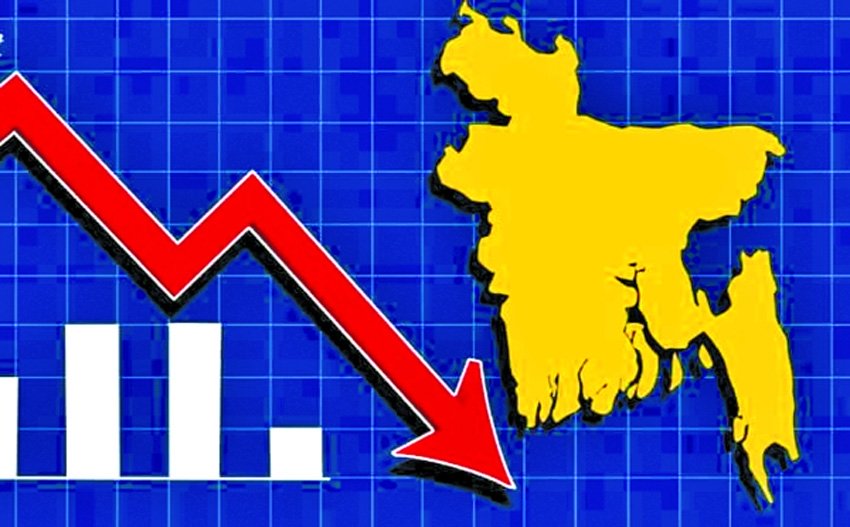
Bangladesh's economy has been swirling in the middle of a whirlwind for last around two years. Recklessly poor foreign direct investment (FDI), devastated law and order status, intensified liquidity crisis in banks and the reinstatement of vindictive politics have by far darkened the country's economic potentialities. The government, which has been just two months old, has been devising one strategy after another in order to restore speed and vivacity in economic indexes but things are taking a long time to yield any outcomes.
One of the latest events is that the government plans to withdraw existing value added tax (VAT) exemptions on most goods and services, sparing only those used by low-income groups and people living below the poverty line, a move experts said will be difficult to implement and could widen the tax net, raise effective rates, and push up consumer costs.
The proposal was discussed at an 8 April 2026 meeting on macroeconomic challenges amid current global and domestic conditions. The meeting, attended by senior officials from the National Board of Revenue (NBR), including its chairman, outlined reform priorities for the new government to stabilize the economy.
A senior official who attended the meeting told The Asian Age that a new plan was discussed to withdraw all VAT exemptions, except those benefiting the bottom 40% of the population. According to Bangladesh Bureau of Statistics (BBS) data, the bottom 40% accounts for roughly 6.8 crore people.
Although NBR has yet to specify affected sectors, officials said the move could strip exemptions from goods and services, including internet services, furniture, jewelry, English medium schools, home appliances, electronics, mobile phones, computer goods, and parts of trading and manufacturing.
On the other hand, existing exemptions may be retained for essential food items such as rice and pulses, agricultural products, and basic services including education and healthcare, they added.
However, experts warned that limiting exemptions only to the bottom 40% may prove difficult in practice, as wealthier groups could still benefit from the same provisions. They argued that it would be challenging to ensure that VAT exemptions are strictly targeted at lower-income groups without clear segregation mechanisms.
Meanwhile, finance officials said that during the recent Annual and Spring Meetings of the International Monetary Fund (IMF) and the World Bank Group held in Washington, DC, the IMF pressured Bangladesh to withdraw all forms of tax exemptions starting from the next budget.
A senior NBR official who attended the 8 April meeting, speaking to The Asian Age on condition of anonymity, said, "We have received this plan from the finance ministry and are now assessing how feasible it is to implement."
"It may not be possible to implement it fully in the next fiscal year. It can be introduced gradually," he added, underscoring the fact that some preparatory work would be required.
But, the tax official declined to specify which sectors might see exemptions withdrawn in the upcoming budget.
Another NBR official marked that the proposal to limit exemptions to the bottom 40% was initially suggested by the World Bank and later incorporated into the finance ministry's plan.
When contacted, NBR Chairman Abdur Rahman Khan acknowledged that Bangladesh has a long list of tax exemptions. However, regarding the proposed reforms, he said, "It is not yet time to comment. We will sit on these issues in May and then decide what can be done."
Meanwhile, the meeting also discussed a plan to introduce a "proof of submission of VAT return" (PSVR) system, similar to the requirement of showing proof of income tax return submission when availing certain services, with the aim of increasing VAT collection.
In addition, authorities are considering making online submission of tax and VAT returns mandatory, alongside introducing a unique taxpayer identification number to monitor tax, VAT and customs activities - meaning the unification of the existing TIN and BIN.
On the other hand, Dr. Debapriya Bhattacharya, Distinguished Fellow of Center for Policy Dialogue (CPD) has urged the government to thoroughly review the pacts the immediate past interim government signed with the United States. Dr. Debapriya Bhattacharya termed these pacts as big hurdles for Bangladesh's efforts to become self-sufficient in economic terms. He made these comments on Saturday (18 April 2026) while addressing an event in Dhaka city.
Referring to broader energy issues, he said policy decisions taken during the fallen government's tenure were "misleading and controversial", adding that import dependence was prioritized over domestic production due to vested interests.
He said institutions such as Bangladesh Petroleum Exploration and Production Company Limited had been weakened, while investment in local energy production was neglected in favour of importing liquefied natural gas (LNG).
He also suggested that Bangladesh should utilize the one-month waiver reportedly granted by the US to import oil from Russia.
Debapriya called for transparency regarding the activities of the cabinet sub-committee on energy security, saying its work should be made public and discussed in Parliament.
He added that despite commitments, visible progress on forming reform commissions remains unclear.
He urged the government to disclose its plans for reforms in public financial management, revenue mobilization and incentives.
In his presidential address, Debate for Democracy Chairman Hasan Ahmed Chowdhury Kiron said corruption and increasing dependence on imports had prevented the country from achieving energy self-sufficiency.
He said ensuring energy security would be a major challenge in the upcoming budget, particularly amid ongoing economic pressures.
Kiron also expressed concern over the suspension of the next installment of an International Monetary Fund (IMF) loan, noting that Bangladesh is not expected to receive $1.3 billion in June, which could create additional challenges for the economy.
It can be said for sure that now the ruling authorities should realize the need for a people-friendly and business-friendly economic ambience that reduces pressure on lower- and middle-income groups while supporting investment and creating jobs. It should be noted that more than 1.5 million people became unemployed during the interim government's tenure of 19 months and over 400 factories were laid off.
Dr. Jesmin Chowdhury is Editor-in-Chief of The Asian Age and an eminent physician.