Published: 12:22 AM, 22 April 2026
Foreign debt stands at US $78 billion: Khosru
Govt has specific plan to restore stability in financial sector
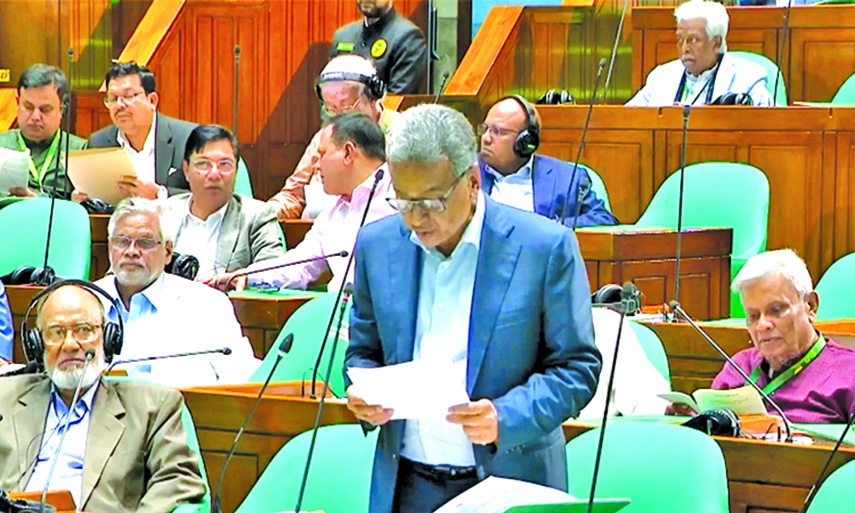
Finance Minister Amir Khosru Mahmud Chowdhury speaks during yesterday's parliament session. -Agency
Finance Minister Amir Khosru Mahmud Chowdhury on Tuesday informed the Jatiya Sangsad that Bangladesh's outstanding foreign debt stood at around US$78 billion as of February 2026.
"According to the account up to February 2026, the outstanding foreign debt of the Bangladesh government amounts to US$78,067.20 million," he said, while replying to a starred question from independent lawmaker Rumeen Farhana (Brahmanbaria-2).
Earlier, the day's sitting of parliament started at 3:00 pm with Speaker Hafiz Uddin Ahmad, Bir Bikram, in the chair.
The finance minister said the Economic Relations Division (ERD) repays foreign loans on behalf of the government, reports BSS.
Each fiscal year, he said, a projection is prepared to estimate the total expenditure for servicing foreign debt, including both principal and interest, and necessary allocations are kept in the national budget.
Loan repayments are being made from the budgetary allocation throughout the year following a scheduled plan, he said.
In reply to a scripted question from treasury bench member Md Shamsur Rahman Simul Biswas (Pabna-5), Khosru said the government received a total of US$85,992.64 million (nearly $86 billion) in foreign loans from 2008-09 fiscal year to 2025-26 fiscal year.
During the same period, the government repaid US$22,328.47 million in principal and US$8,696.82 million in interest, he said.
As of December 30, 2025, the outstanding foreign debt stood at US$77,279.12 million ($77 billion), said Amir Khosru.
He also informed the House that from the 2007-08 fiscal year to February of 2025-26, the government borrowed a total of US$87,396.03 million and repaid US$22,050.79 million in principal.
"As a result, the country's foreign debt amount increased by US$65,346.24 million during this period," the minister added.
Meanwhile, the Finance Minister informed Parliament that the government has a specific, comprehensive and coordinated plan to restore stability, rebuild confidence, and gradually strengthen the country's fragile financial sector.
Responding to a starred question from BNP lawmaker Mohammed Fakrul Islam (Noakhali-5) in the House yesterday, the minister said a set of integrated strategies-covering monetary policy, fiscal policy, exchange rate management, and a medium-term macroeconomic framework-has already been approved at a Coordination Council meeting held on April 10, 2026.
The framework outlines policy directions for the fiscal years 2026-27 to 2028-29, he added.
Khosru said the government is prioritizing macroeconomic stability to reduce vulnerabilities in the financial sector. "As part of this effort, the policy interest rate has been maintained at 10 percent to contain inflation. Food inflation, which stood at 14.10 percent in July 2024, has significantly declined to 8.24 percent in March 2026," he added.
The minister further noted that a market-based exchange rate system is currently in operation. He said foreign exchange reserves have increased to US$34.87 billion as of April 15, 2026, while reserves calculated under the IMF's BPM-6 methodology stand at US$30.20 billion.
To support distressed productive and financial activities, he said Bangladesh Bank has introduced special support measures. "The central bank has also taken initiatives to ease the pressure on businesses caused by currency depreciation," he said.
Highlighting reforms in the capital market, the minister said restoring transparency and investors' confidence remains a top priority.
In this regard, he said the government plans to establish a Capital Market Reform Commission, strengthen the bond and equity markets, introduce blockchain technology, launch an investment gateway for expatriates, and enhance legal and administrative protections for investors.
Khosru added that to ensure sustainable recovery, the government has set medium-term targets for key macroeconomic indicators, including inflation, broad money supply (M2), and private sector credit growth, in line with projected economic growth.
"The government believes that such a coordinated policy framework will help restore discipline, confidence, and effective financing mechanisms in the financial sector." the minister told the House.