Iran war
Published: 12:25 AM, 22 April 2026
Trump says bombing to resume if there's no deal
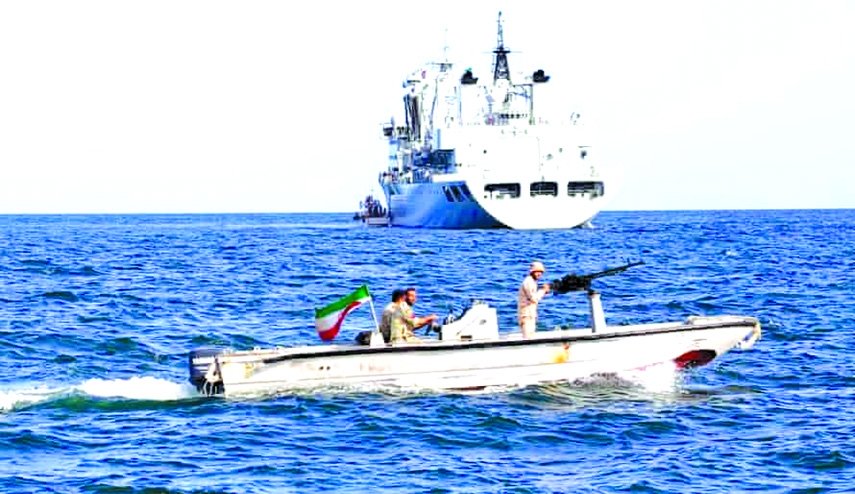
An Iranian military boat patrols as a warship enters Iranian waters before a joint naval drill of Iran, Russia and China in the Indian Ocean. - AP
US President Donald Trump has said taht he "expects to be bombing" if progress is not made in Iran peace talks.
However, he is, it seems, so far optimistic about the prospect of negotiations in Iran, telling CNBC there's still time to reach a "great" deal that can be acceptable to the US and help Iran in the future.
But still, Trump is using a carrot-and-stick approach with regards to Iran. While a deal is still on the table, Trump noted that the US has used the two-week ceasefire to replenish its forces in the region, and that he is prepared to continue strikes if need be.
Notably absent from his comments, however, is what concessions he is willing to make in the negotiations. We also don't know the deal he hopes for, other than his red line of Iran "never" being able to manufacture or possess a nuclear weapon.
We still have no official confirmation that Vice President JD Vance and the rest of the negotiating team has left for Pakistan.
But Trump has put something of a ticking clock on those talks by suggesting he does not want to extend the ceasefire.
TRUMP SAYS IRAN HAS 'NO CHOICE BUT TO SEND' DELEGATES TO ISLAMABAD TALKS:
Donald Trump says Iran has "no choice but to send" delegates to Pakistan for talks with the US.
In an interview with CNBC, the president says he is confident the US will "end up with a great deal".
He says that the US is "not dealing with the nicest people" but are doing so "successfully", before calling the US naval blockade a "tremendous success".
Asked if he would extend the ceasefire if negotiations seemingly progress, the US president says: "I don't want to do that".
Trump later says: "I expect to be bombing 'cause that would be a better attitude."
He says there is not "much time" to reach a deal, and that Iran can get themselves on "a very good footing" if they reach one with the US.
IRAN ALSO ACCUSES WASHINGTON OF BREACHING TRUCE:
Trump is not the first to make the accusation of a ceasefire breach during this two-week period.
On Sunday, Iran's military vowed to retaliate against what it called the US's "act of armed piracy". A US destroyer fired on an Iranian-flagged cargo ship in the Gulf of Oman. Washington said the ship was trying to evade its naval blockade.
In response, Iran's military headquarters said the US operation was a "violation of the ceasefire".
WHAT WERE THE TERMS OF THE US-IRAN CEASEFIRE?
Donald Trump earlier accused Iran of violating the ceasefire between itself and the US multiple times.
As a reminder, Iran and the US agreed to a conditional two-week ceasefire on 8 April, which is due to expire on Wednesday.
US President Donald Trump said the deal was agreed on the condition that Tehran reopens the Strait of Hormuz, a vital shipping route for oil and other exports from the Gulf.
Tehran said at the time it agreed to allow vessels through the Hormuz Strait for two weeks, with their passage coordinated by the Iranian military.
IRAN STILL UNDER NEAR-TOTAL INTERNET BLACKOUT:
Iran is still under a near-total internet blackout, which started on the first day of the war in February.
While Iranian officials have cited reasons such as "protecting cyberspace" for restricting online access, even with the ceasefire, limitations on the internet have not been lifted.
Domestic messaging apps and websites are available, but the BBC understands that there have been disruptions and crashes.
Two main groups now have access to the internet. Some officials, pro-establishment users, journalists and academics, as well as some business owners.
Some Iranian officials have rejected this so-called "tiered" access to the internet, but they have not specified when restrictions might be lifted.
The other group are ordinary people who are paying a lot to stay connected, mainly via connections routed through satellite internet provider Starlink.
Using or possessing Starlink in Iran can lead to up to two years in prison, and Iranian authorities have confiscated hundreds of Starlink devices since the war started.
The BBC understands that the second group, when buying expensive internet connections, have sometimes been scammed on messaging app Telegram.
There is also the fear among ordinary Iranians that the BBC talks to is that internet access might never go back to the situation before the war, even though it was restricted then as well. But many circumvented the restrictions to access Western websites and social media apps.
It is still not clear when ordinary Iranians will be able to access the internet, but what is clear is that not everyone in Iran can afford to access at the moment.
WAR AND INTERNET RESTRICTIONS AFFECTING LIVELIHOODS OF IRAN'S MOST VULNERABLE:
Many inside Iran, including defenders of the Islamic Republic, are urging people to tighten their belts and prepare for even greater economic hardship.
The question is can the Iranian government pay its employees if the blockade of the Strait of Hormuz continues? Can Tehran afford to abandon negotiations?
Before the conflict, sanctions, inflation, and currency depreciation had driven many households into an economy of survival, with families spending only on essential needs.
Now, shuttered businesses and bounced cheques, along with damaged petrochemical, steel and aluminium industries have intensified recessionary pressures.
With food prices doubling over the last year and exports declining, the rial, Iran's currency, faces further erosion, driving even higher inflation.
Iranian officials estimating economic damage reaching $270bn (£200bn) reflect the scale of the shock.
The impact has been especially severe for women running small online businesses. Internet blockades and disruptions have cut off many women who sold handicrafts through social media and online marketplaces, wiping out vital income streams for families overnight.
Their losses reflect a broader reality: war and internet restrictions are not only damaging infrastructure but affecting livelihoods across Iran's most vulnerable communities.
CHINA EXPRESSES 'FULL SUPPORT' FOR PAKISTAN FACILITATING US-IRAN TALKS:
China's ambassador to Pakistan has expressed Beijing's "full support" for Islamabad's efforts to facilitate peace talks between the US and Iran.
Pakistan's foreign ministry says that Deputy Prime Minister Ishaq Dar - who also serves as foreign minister - met with Jiang Zaidong to discuss developments in the region.
During the meeting, Zaidong expressed "appreciation of Pakistan's continued efforts to facilitate engagement" between the US and Iran "for sustained peace and stability in the region and beyond", the foreign ministry says.
PAKISTAN IS IN A UNIQUE POSITION TO HOST TALKS, BUT THERE ARE SIGNIFICANT RISKS FOR THE COUNTRY:
As Pakistan prepares to host a second round of peace talks - despite uncertainty over whether they will go ahead - security is being ramped up in Islamabad, and posters reading "Islamabad Talks" are lining the streets of the capital.
The country is in a unique position as it is trusted by the US, Iran and the Gulf countries.
But close ties with America didn't stop Pakistan officially condemning the first US-Israeli attacks on Iran. And when Iran bombed the oil fields of Saudi Arabia, a military ally, Pakistan also issued a strongly worded statement against Tehran.
If negotiations collapse, Pakistan could get dragged into fighting with its neighbour Iran. Pakistan signed a mutual defence pact with Saudi Arabia last year, one of the Gulf countries that has been victim to Iranian drone strikes before the current ceasefire, which is due to expire tomorrow.
The stakes for the world are high, but they are especially significant for Pakistan in many ways.
>>Agency