Published: 12:39 AM, 23 April 2026
Democracy's Fourth Pillar in Perils: Restoring Press Freedom in Bangladesh
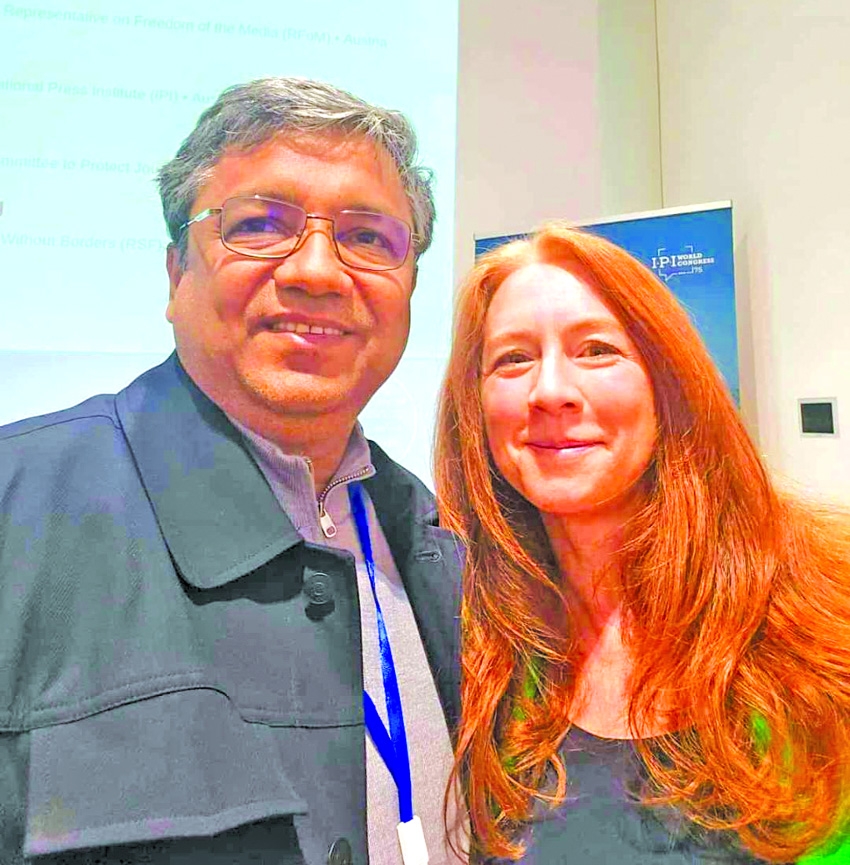
Editorial Board Chairman of The Asian Age Shoeb Chowdhury with Chief Executive of the Committee to Protect Journalists (CPJ) Ms. Jodie Ginsberg. -AA
The Press is more than a profession. It is the fourth pillar of democracy, its very lifeblood sustained by the twin pulses of free expression and a liberated press. For over twenty-five years, I have stood at the front lines of this landscape, witnessing its most triumphant rises and its most harrowing descents. In the 1990s, an era defined by the twin hurdles of prohibitive costs and agonizingly slow connectivity, I sought to pioneer the synergy between information technology and journalism. It was a journey born of hope. But history warns us that while the media often suffers under autocracy, the systematic, cold-blooded vengeance unleashed upon the press in Bangladesh over the last two decades has been nothing short of a generational catastrophe. During this dark chapter, the very organs of the state were weaponized to settle scores, often with opportunistic editors and media owners pulling the strings from the shadows.
The collapse of governance in Bangladesh was not an accident; it was engineered by the double standards of a privileged few. Under their patronage, a corrupt bureaucracy has flourished, cloaking itself in a culture of absolute impunity. The veteran business leader and current minister, Abdul Awal Mintoo, once famously noted that most of our state officials have become wealthier than our entrepreneurs. To see the physical manifestation of this truth, one need only look at the sprawling luxury estates in Dhaka's most exclusive corridors. It is a cruel irony: while the Fourth Estate teeters on the brink of financial ruin and journalists face existential threats, the interim government has remained fixated on retribution. From the chaos of "mob violence" to the calculated pressure of the Central Bank's BFIU ,Anti Corruption Commission and law enforcement, every lever of power has been pulled to stifle the voice of the people.
Today, hundreds of journalists are being ensnared in fabricated murder charges, and many journalists have been stripped of their professional accreditations. As the government abandoned international norms, they were egged on by "Rasputins" in the media-figures who, in a classic historical arc, are now being consumed by the very fires they helped ignite.
In October 2025, while addressing the International Press Institute (IPI) World Congress in Vienna, I laid bare this reality. I reminded the global audience of a fundamental democratic contrast: in the United States, despite 99% of the media being vocally opposed to President Donald Trump, not a single journalist was met with state-sponsored vengeance. In a true democracy, the response to a pen is a pen; the answer to a word is a word. You do not answer an idea with the brute force of state machinery. The global community of media moguls and editors was visibly stunned. They found it inconceivable that in this civilized age, the judicial process could be so brazenly used as a noose to throttle the free press. I stated with heavy-hearted clarity: the immense dreams we once projected onto Dr. Muhammad Yunus have collapsed into failure.
While Nobel laureate Joseph Stiglitz offered a masterful defense of press freedom at that same summit, his words were tactfully avoided by government & leading media at home. Yet, as the heat of public outcry rises, those who suppressed the truth are beginning to hear the footsteps of accountability. The path to restoration, despite the shadows, my resolve remains unshaken. Through my ongoing coordination with the Committee to Protect Journalists (CPJ), Reporters Without Borders (RSF), International Press Institute (IPI), UNESCO, European Union (EU) and the Commonwealth, a global consensus for change is forming. I am firmly convinced that the leadership of Tarique Rahman, following the recent democratic mandate, represents the turning of the tide. His administration carries the promise of restoring the dignity of the press and ending the era of state-sponsored harassment. Much like Shaheed President Ziaur Rahman, who salvaged Bangladesh's international image in a time of fragility, the current leadership is poised to pierce this darkness.
A healthy society thrives on open dialogue and the free exchange of ideas. Media acts as a conduit for the dissemination of diverse viewpoints, promoting informed discussions that empower citizens to engage actively in political life.
A free press acts as a watchdog, scrutinizing the actions and decisions of the government. By reporting on both successes and failures, it keeps leaders accountable to the electorate.
Media serves as a voice for the marginalized and empowers them to express their opinions and concerns. In doing so, it ensures that the broader spectrum of society's needs and desires are heard and considered.
Often referred to as the fourth pillar of democracy, alongside the legislative, executive, and judicial branches, media plays a pivotal role in upholding democratic principles.
While concluding, a few words from former US President and the author of the American Declaration of Independence Thomas Jefferson can be quoted who said during 1786 "Our liberty depends on the freedom of the press, and that cannot be limited without being lost."
Shoeb Chowdhury is Chairman, Editorial Board of The Asian Age.