Published: 12:36 AM, 28 April 2026
US–Israel vs Iran War: The Remaking of Gulf Power Algorithm
Between Fire and Fragile Equilibrium!
US–Israel war on Iran reshapes Gulf power, redrawing alliances, disrupting energy routes, and transforming regional security into a fragile, shifting geopolitical landscape.
Between fire and fragile equilibrium lies a world suspended in uncertainty, where tension simmers beneath a thin crust of stability. Power rivalries, regional fault lines, and strategic mistrust continually threaten to ignite wider conflagrations, even as diplomacy struggles to preserve balance. It is an age defined by volatility, where peace is provisional, and order rests on delicate restraint, forever exposed to the sparks of ambition and miscalculation.
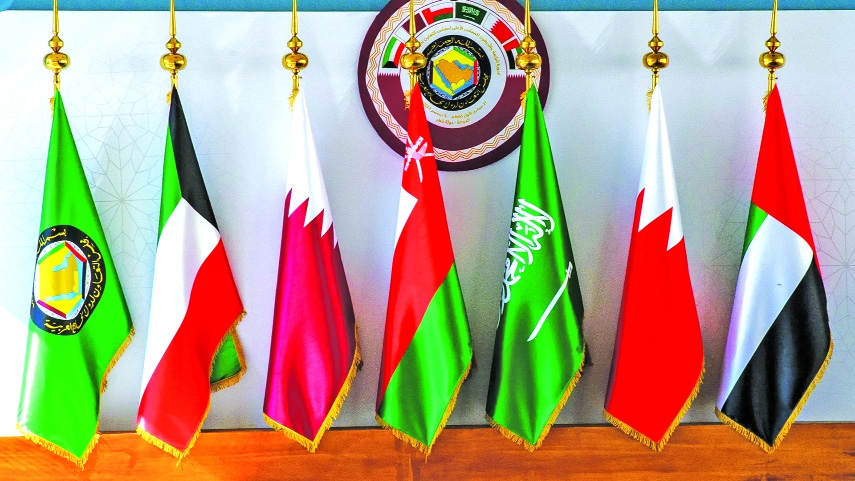
The war involving Iran is no longer a contained regional confrontation; it has become a stress test for the entire strategic architecture of the Middle East and beyond. Its shockwaves are being felt most acutely across the Gulf—Saudi Arabia, the United Arab Emirates, Qatar, Oman, Bahrain, and Kuwait—states that are not formal belligerents, yet find themselves unavoidably inside the blast radius of escalation.
Israel-US strikes and threats against civilian infrastructure, airports, and energy assets have shattered any illusion of insulation. As Winston Churchill once warned, “You cannot reason with a tiger when your head is in its mouth.” The Gulf now understands that geography offers no immunity.
Paradoxically, these states are rushing into open alignment against Iran. They are navigating a precarious middle path—one defined by caution, ambiguity, and strategic hedging. This is not hesitation born of indecision, but calculation shaped by two profound uncertainties: the reliability of American power and the ambiguity of Iranian intent.
The first concern lies in Washington. Gulf capitals increasingly question whether the United States remains a permanently committed security guarantor or a transactional actor driven by shifting domestic politics. The fear is not abstract.
A sudden declaration of “mission accomplished,” particularly under an unpredictable American administration, could leave regional partners exposed to Iranian retaliation without sustained Western backing. For Gulf leaders, this raises an uncomfortable question: what is the value of visible alignment if it leads to strategic abandonment once the crisis narrative changes in Washington?
Consequently, Gulf states are calibrating their responses below the threshold of overt confrontation. Support for containment efforts exists, but it is deliberately discreet. Public alignment is avoided, not because either America or Israel or Iran is trusted, but because escalation without guaranteed protection is viewed as strategically reckless. This is the essence of modern Gulf diplomacy: engagement without entrapment.
The second layer of uncertainty originates in Tehran itself. Iranian messaging is fragmented—at times diplomatic through the presidency and foreign ministry, at others confrontational through the Islamic Revolutionary Guard Corps. One channel signals de-escalation; another signals escalation. This duality may reflect internal damage to command structures, but its effect is strategic confusion. Gulf governments are left asking a critical question: which Iran is the real Iran?
Underlying this behavior is a structural vulnerability. The Gulf is economically exposed and militarily constrained. Its wealth depends on energy infrastructure that is increasingly within reach of modern missile and drone systems. At the same time, its security umbrella remains externally provided. This dual dependency creates a persistent state of strategic anxiety.
The Abraham Accords introduced a new layer into this equation, opening pathways for quiet cooperation with Israel in technology, intelligence, and air defense. Iranian attacks have only reinforced the logic of such cooperation, particularly in missile interception and early warning systems. Cooperation deepens quietly, even as public diplomacy pauses under regional pressure.
Saudi Arabia sits at the center of this balancing act. It views Iran as a long-term structural threat but remains wary of being drawn into direct confrontation. Its strategy is therefore one of controlled engagement: deterrence without escalation, dialogue without dependency, and diversification of partnerships without formal rupture.
Beyond the region, the implications extend into Europe. The European Union’s growing reliance on Gulf energy exports means regional instability translates directly into European economic vulnerability. Supply disruptions or maritime insecurity in the Strait of Hormuz would reverberate through inflation, industrial output, and energy markets. Europe thus finds itself indirectly bound to the outcome of a conflict far from its borders.
At the same time, new opportunities could emerge. Regional integration projects linking the Gulf, the Eastern Mediterranean, and Europe could reshape trade and energy corridors. But such visions depend entirely on de-escalation and political stability—conditions that remain uncertain.
The broader strategic reality is therefore paradoxical. The war is simultaneously fragmenting old certainties and incentivizing new alignments, yet it has not produced a decisive realignment. Instead, it has reinforced a fluid, multipolar balancing act.
As Sun Tzu reminds us, “He who is prudent and lies in wait for an enemy who is not, will be victorious.” The Gulf states are practicing precisely this form of prudence—not choosing sides definitively, but positioning themselves for multiple futures.
Ultimately, the trajectory of the region will depend on three variables: the duration of the war, the durability of Iranian political cohesion, and the consistency of American commitment. Should Iran weaken significantly, deeper normalization and integration may accelerate. Should it endure, the region will likely return to a fragmented equilibrium defined by hedging and cautious engagement.
What is emerging is not a clear victor, but a reconfigured strategic landscape—one in which survival, not dominance, defines state behavior. In this unstable balance lies both the danger and the possibility of a new regional order, still unformed, still contested, and still deeply uncertain.
Yet within chaos, quiet chances awaken; as Sun Tzu reminds us, hidden paths emerge, where turmoil yields possibility, and courage shapes destiny from uncertainty.
Anwar A. Khan is a freedom fighter and
a columnist on contemporary issues.