
Published: 12:51 AM, 30 April 2026 Last Update: 12:54 AM, 30 April 2026
English Language Teaching Under AI-Fuelled Circumstances

Mahfuz Ul Hasib Chowdhury
The rapid rise of artificial intelligence (AI) has begun to reshape nearly every aspect of modern life, and education is no exception. Among its most profound impacts is its influence on English Language Teaching (ELT), a field that has traditionally relied on human interaction, cultural exchange, and pedagogical intuition. Under AI-fuelled circumstances, ELT is undergoing a transformation that challenges long-held assumptions about how languages are learned, taught, and assessed. While AI introduces unprecedented opportunities for personalization and efficiency, it also raises important questions about the role of teachers, authenticity in communication, and the nature of learning itself.
One of the most significant advantages of AI in ELT is its ability to provide personalized learning experiences. Traditional classrooms often struggle to cater to diverse learner needs due to time constraints and standardized curricula. AI-powered tools, however, can analyze learners’ performance in real time, identifying strengths, weaknesses, and learning patterns. Based on this data, they can adapt content, pace, and feedback to suit individual learners. For example, a student struggling with pronunciation can receive targeted exercises and instant corrective feedback, while another learner excelling in grammar can move ahead without unnecessary repetition. This level of customization was previously difficult to achieve at scale.
Moreover, AI enables continuous and accessible learning beyond the classroom. Language learning apps, chatbots, and virtual tutors are available 24/7, allowing learners to practice English anytime and anywhere. This flexibility is especially beneficial in contexts where access to qualified teachers is limited. Learners in remote or under-resourced areas can now interact with AI-driven systems that simulate conversation, provide explanations, and even assess writing. As a result, the traditional boundaries of classroom-based learning are dissolving, giving rise to a more autonomous and learner-centered model.
Another key development is the enhancement of feedback mechanisms. In conventional ELT settings, feedback is often delayed due to the teacher’s workload, particularly in large classes. AI systems can instantly evaluate grammar, vocabulary usage, coherence, and even tone in written texts. In speaking practice, speech recognition technologies can assess pronunciation, fluency, and intonation. Immediate feedback not only accelerates learning but also allows learners to self-correct and reflect more effectively. This contributes to a more dynamic and responsive learning process.
However, the integration of AI into ELT is not without its challenges. One major concern is the potential reduction of human interaction, which is central to language learning. Language is inherently social; it involves not just linguistic competence but also cultural nuances, emotional expression, and pragmatic understanding. While AI can simulate conversations, it cannot fully replicate the depth and unpredictability of human communication. Over-reliance on AI tools may lead to a form of learning that is technically accurate but socially limited.
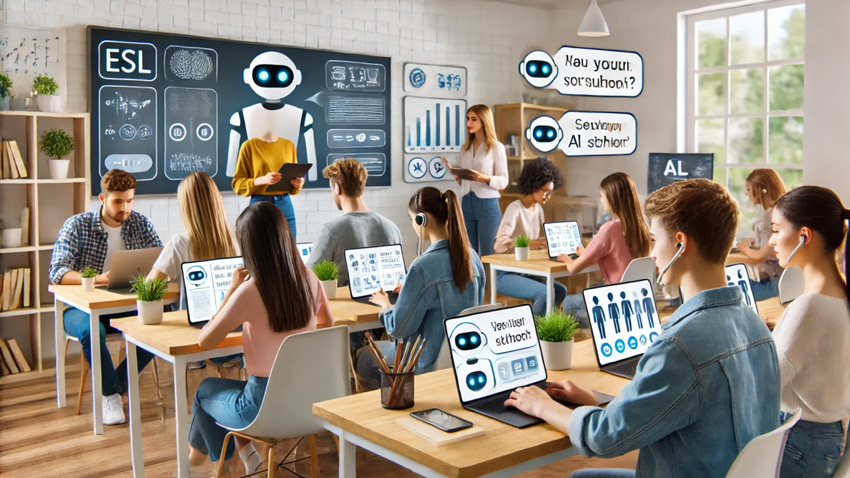
The role of teachers is also evolving under AI-fuelled circumstances. Rather than being the primary source of knowledge, teachers are increasingly becoming facilitators, guides, and critical mediators of technology. They must learn to integrate AI tools effectively into their teaching practices, selecting appropriate resources and ensuring that technology enhances rather than replaces meaningful learning experiences. This shift requires new competencies, including digital literacy, data interpretation, and ethical awareness. Teachers must also address issues such as academic integrity, as AI-generated content can blur the line between original work and assisted production.
Assessment practices in ELT are likewise being transformed. AI can automate grading and provide detailed analytics on learner performance, but it also raises questions about validity and fairness. For instance, can an AI system accurately assess creativity, cultural appropriateness, or persuasive ability? There is a risk that assessment may become overly focused on measurable features, neglecting the more nuanced aspects of language use. Educators must therefore strike a balance between efficiency and holistic evaluation.
Ethical considerations are another critical dimension. The use of AI in ELT involves the collection and analysis of large amounts of learner data, including personal information and learning behaviors. Ensuring data privacy and security is essential, particularly when working with minors. Additionally, there is the issue of algorithmic bias. If AI systems are trained on limited or unrepresentative data, they may reinforce certain linguistic norms while marginalizing others. This could have implications for learners from diverse linguistic and cultural backgrounds, potentially affecting their confidence and identity.
Despite these challenges, AI also opens up new possibilities for creativity and engagement in ELT. Interactive storytelling, gamified learning environments, and immersive simulations can make language learning more enjoyable and meaningful. Virtual reality (VR) and augmented reality (AR), when combined with AI, can create realistic scenarios where learners use English in context, such as ordering food in a restaurant or participating in a job interview. These experiences can enhance motivation and help learners develop practical communication skills.
Furthermore, AI can support teachers in lesson planning and resource development. By generating exercises, quizzes, and teaching materials, AI can reduce the time teachers spend on routine tasks, allowing them to focus more on student interaction and pedagogical innovation. It can also provide insights into class performance trends, helping teachers make informed decisions about instruction.
In the broader context, AI-driven ELT reflects a shift towards lifelong learning. As the global demand for English continues to grow, individuals increasingly need flexible and adaptive learning solutions. AI can support learners at different stages of life, from school students to working professionals, offering tailored content that aligns with their goals. This democratization of learning has the potential to make English education more inclusive and accessible.
Nevertheless, it is important to approach AI in ELT with a critical and balanced perspective. Technology should be seen as a tool, not a replacement for human teaching. The most effective learning environments are likely to be those that combine the strengths of AI—such as efficiency, personalization, and scalability—with the uniquely human qualities of empathy, creativity, and cultural understanding. Teachers and institutions must actively shape how AI is used, rather than passively adopting it.
In conclusion, English Language Teaching under AI-fuelled circumstances is at a pivotal moment. The integration of AI offers transformative benefits, including personalized learning, instant feedback, and expanded access. At the same time, it challenges educators to rethink their roles, address ethical concerns, and preserve the human elements of language learning. As AI continues to evolve, the future of ELT will depend on how effectively educators, learners, and policymakers navigate this complex landscape. By embracing innovation while maintaining a commitment to meaningful communication and inclusive practices, ELT can thrive in the age of artificial intelligence.
Mahfuz Ul Hasib Chowdhury is a contributor to different English newspapers and magazines.


