
Published: 12:34 AM, 07 May 2026
The Master Strategist: Analyzing Salahuddin Ahmed’s Role as the Architect of Sovereignty
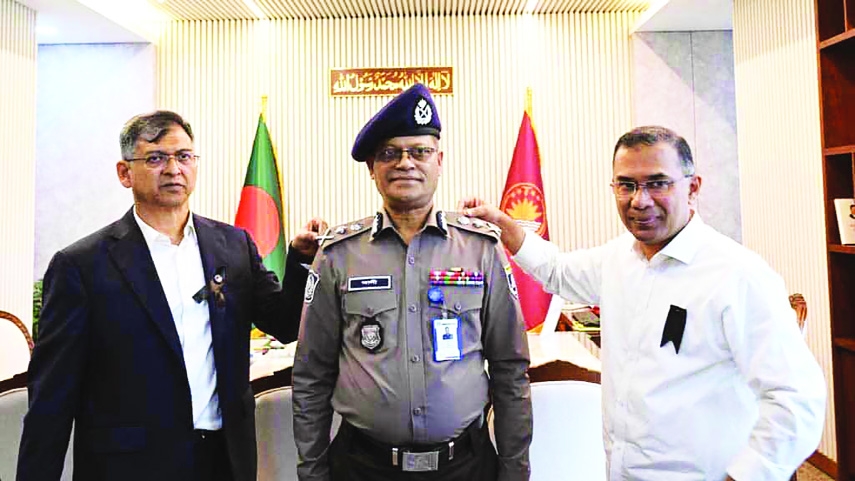
Prime Minister Tarique Rahman pins ranks and badges on newly appointed Inspector General of Police (IGP), Md. Ali Hossain Fakir, during a ceremony. Home Minister Salahuddin Ahmed is also seen in the picture. - File Photo
In the high-stakes landscape of contemporary Bangladeshi politics, Salahuddin Ahmed has solidified his position as an indispensable "second wheel" of the state. He is not merely a formidable ally but a long-term practitioner of electoral strategy and a primary architect of the political successes associated with Prime Minister Tarique Rahman, often characterized as the nation’s "second most powerful figure."
Ahmed lacks the traditional populist "star power" or public charisma of the Prime Minister. However, he effectively bridges up this gap with a sharp, Chanakya-like intellect and a level of organizational discipline which is largely unparalleled in the region.
A masterclass in political engineering, according to party insiders and veteran political observers, Salahuddin Ahmed was the strategic mastermind behind the Bangladesh Nationalist Party’s (BNP) historic victory in the 2026 parliamentary elections—a result that once seemed improbable. While Prime Minister Tarique Rahman acted as the charismatic public face, galvanizing the masses, Ahmed operated in the shadows. He meticulously constructed the party’s grassroots foundation and methodically neutralized electoral challenges through cool-headed, calculated maneuvering. One close associate remarked, "Salahuddin Ahmed possesses a rare strategic brilliance. He functions as the 'road roller' of the administration, systematically crushing obstacles in the Prime Minister’s path to ensure good governance remains unimpeded." A Foundation in Law and Civil Administration, Ahmed’s ascent is rooted in a robust administrative and legal pedigree. Born on June 30, 1962, in Pekua, Cox's Bazar, he entered the civil service after earning a law degree from Dhaka University. This technical background distinguishes him from traditional career politicians. His transition into the political sphere accelerated in the 1990s while serving as the Assistant Private Secretary to then-Prime Minister Begum Khaleda Zia. This unique synthesis of administrative efficiency and political foresight allowed him to achieve a historic record: being elected as a Member of Parliament (MP) for the Cox's Bazar-1 constituency for three consecutive terms. The ultimate Crisis Manager, historians are likely to view Ahmed’s contributions through the lens of crisis management. Following the 2014 election boycott, he served as the party's primary spokesperson while in hiding—a role frequently compared to the historic 'Chorompotra' broadcasts of 1971 due to its psychological impact on the movement. Even during his periods abroad, his seamless coordination with the party leadership reinforced the public perception of the administration as a unified, dual-engine entity.
Senior Editor and geopolitical analyst M.S. Chowdhury notes that the two leaders are fundamentally complementary: "He is the definitive crisis manager. He executes complex logistical and political maneuvers that many cannot carry out. While the Prime Minister represents the public mandate, Ahmed is the kinetic energy behind the curtain, ensuring that strategic objectives are realized." An Enigmatic Commander of Statecraft despite his profound influence, Ahmed remains an enigmatic and somewhat stoic figure. Bureaucrats often describe his gaze and appearance demeanor as an outstanding attribute that commands a mixture of deep professional respect and caution.
While his recent public commentary regarding the historical narrative of March 7th has drawn scrutiny from critics, his supporters believe his oratory prowess and political gravity will ultimately reconcile any friction. In the current landscape, Ahmed is navigating the complexities of governance and international diplomacy to safeguard national sovereignty through what observers call an "unprecedented diplomatic maneuver."
Salahuddin Ahmed stands today as one of the most steadfast and visionary leaders shaping the internal security and administrative resilience of Bangladesh. In a time when nations across the globe grapple with complex challenges—ranging from public safety to technological threats—Salahuddin Ahmed’s leadership has brought a sense of stability, confidence, and forward momentum to the country’s home affairs.
From the outset of his tenure, Salahuddin Ahmed has demonstrated a clear understanding that national security is not merely about enforcement, but about trust, coordination, and modernization. His approach reflects a careful balance between firmness and integrity, ensuring that law enforcement agencies operate with both efficiency and accountability. Under his stewardship, Bangladesh has witnessed a strengthening of institutional frameworks that prioritize both citizens’ safety and human dignity.
One of his most notable qualities is his commitment to sophistication. Recognizing the evolving nature of crime and security threats, he has championed the integration of technology within law enforcement agencies. From digital monitoring systems to improved data coordination between departments, his initiatives have enabled authorities to respond more swiftly and effectively. This forward-looking mindset ensures that Bangladesh is not only reacting to challenges but proactively preparing for the future.
Equally impressive is his emphasis on coordination among various security forces rather than allowing bureaucratic silos to hinder progress, Salahuddin Ahmed has encouraged a culture of collaboration. Police Department, border security forces, and intelligence agencies now operate with a higher degree of synchronization, which has significantly improved operational outcomes. This cohesive approach has been instrumental in maintaining internal stability, especially during periods of heightened tension.
Beyond structural improvements, Salahuddin Ahmed’s leadership is marked by a deep concern for public welfare. He understands that security is not solely about preventing crime—it is also about fostering an environment where citizens feel safe, heard, and respected. His policies often reflect a people-centric approach, aiming to bridge up the gap between law enforcement and the communities they serve. Community engagement initiatives and awareness programs have grown under his guidance, helping to build trust and cooperation at the grassroots level.
Salahuddin Ahmed’s administrative style is also characterized by decisiveness. In moments of crisis, he has shown the ability to act swiftly while maintaining clarity of purpose. This determination reassures both citizens and officials, reinforcing confidence in the government’s capacity to manage difficult situations. At the same time, he remains open to dialogue, demonstrating that strong leadership does not exclude listening to diverse perspectives.
Another admirable aspect that makes him exceptional is his focus on professionalism within the ranks of law enforcement. Training programs, capacity-building initiatives, and welfare measures for security personnel have received increased attention. By investing in those who serve on the front lines, Ahmed ensures that the system remains robust and motivated. This not only enhances operational efficiency but also uplifts moral strength, which is essential for sustained excellence.
His contributions also extend to maintaining social harmony. In a diverse nation like Bangladesh, preserving unity is crucial. Salahuddin Ahmed has consistently emphasized the necessity of tolerance and peaceful coexistence. His efforts to fortify interreligious harmony and promote inclusivity highlight his understanding that true security encompasses social cohesion as much as physical safety.
Ahmed’s leadership reflects a blend of pragmatism and vision. While he addresses immediate concerns with diligence, he also keeps an eye on long-term national interests. This dual focus allows policies to remain relevant and adaptable, ensuring that progress is steady, sound and solid. It is this rare combination of qualities that sets him apart as a leader of substance.
In conclusion, Salahuddin Ahmed exemplifies what effective leadership in home affairs should look like. Through modernization, coordination, public engagement, and a steadfast commitment to national stability, he has made a significant impact on Bangladesh’s internal landscape. His performance serves as a compelling example of how thoughtful governance can inspire confidence and drive meaningful progress.
Unfazed by opposition narratives, he appears to embody the Tagore philosophy: "If no one responds to your call, then go ahead alone." For now, the Master Strategist remains focused on the "long race," positioning himself in the archives of history as the silent, driving force behind the nation's current trajectory towards stability and progress.
Simanto Chowdhury is a
columnist writing on
contemporary issues.


