Published: 01:02 AM, 13 May 2026
Rice Fields Water and the Future of the Haor Delta
Dr. Shahrina Akhtar
A stark and unsettling paradox emerged in the haor wetlands of Itna, Mithamoin, and Austagram in Kishoreganj, where apparent agricultural abundance masks a deeply fragile environmental reality. Between 1 to 4 May, field-based observations revealed that from a distance the haor stretched like an uninterrupted golden expanse of boro rice, yet this visual prosperity quickly unraveled through closer engagement with farmers and fields. What became evident was not merely the consequence of a sudden flash flood or intense rainfall, but a manifestation of entrenched structural vulnerabilities shaped by climatic uncertainty, infrastructural deficits, and persistent policy disconnects. Boro cultivation in these wetlands depends critically on precise seasonal timing, which this year was disrupted by upstream hill torrents and prolonged rainfall just weeks before harvest. Farmers described water arriving “without warning,” submerging nearly mature crops, leaving fields of golden rice half-drowned, a powerful image of productivity turning into loss before their eyes.
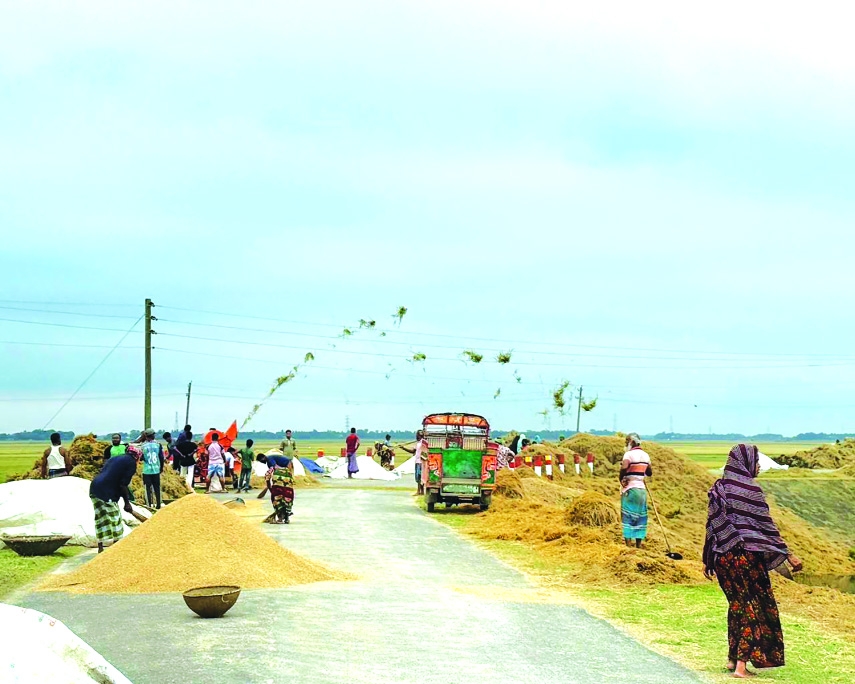
Interrupted Harvest, Broken Recovery: In relatively elevated areas where partial harvesting remained possible, a second, less visible crisis unfolded, post-harvest failure. Although some farmers managed to cut portions of their boro crop under difficult and time-sensitive conditions, the absence of adequate drying space, combined with continuous rainfall, turned recovery into yet another form of loss. Traditionally, harvested paddy is sun-dried in courtyards or designated open spaces, but this year those options were either unavailable or ineffective. Roadsides, school grounds, and narrow embankments were repurposed as improvised drying zones, where freshly cut rice lay exposed under persistent cloud cover. High humidity and intermittent rain prevented proper drying, causing grains to ferment, sprout, or rot within hours. Farmers expressed frustration that harvesting no longer ensured food security, as losses continued beyond the field stage. In several locations, bundles of paddy had begun to germinate, indicating irreversible damage. Beyond physical loss, the psychological toll was profound, farmers described it as “losing food twice,” first in the field and again after harvest. Women and children worked tirelessly to salvage what they could, yet their efforts often proved insufficient. This underscores a critical gap in rural systems, where production is prioritized but post-harvest resilience remains neglected.
Debt, Distress, Social Survival: Beyond the visible crop losses, the field visit exposed a deeper layer of socio-economic distress rooted in debt dependency and fragile rural livelihoods. Conversations with farmers such as Umar Ali and Abdullah reflected a shared sense of uncertainty and eroding trust in external support systems. Most operate within sharecropping or seasonal credit arrangements, investing borrowed capital in seeds, fertilizer, and irrigation. In a typical year, harvest ensures loan repayment with modest returns, but this season the entire financial cycle has collapsed. Even partial recovery, many noted, will not be enough to cover outstanding debts, pushing households toward prolonged financial vulnerability. A recurring sentiment was being trapped between nature and finance, both unpredictable and unforgiving. Farmers also questioned institutional response mechanisms, particularly the accuracy of damage assessments and fairness in relief distribution. In remote haor pockets, delayed reporting often results in underestimation of losses, widening the gap between lived realities and administrative recognition. This disconnect has weakened trust in governance, leaving farmers feeling isolated, with assistance arriving late or unevenly across communities.
Roads as Fields, Institutional Absence: One of the most visually and symbolically striking observations during the field visit was the transformation of the Itna-Mithamoin-Austagram paved road into an extensive drying ground for harvested rice. Under normal circumstances, using a public road for agricultural drying would be considered a violation of usage norms. However, in the present context, this adaptation reflects a breakdown of available space and institutional flexibility. The road, typically a symbol of connectivity and development, had effectively become a substitute for lost agricultural infrastructure. From a distance, the long stretch of rice spread across the asphalt created an almost surreal golden pattern, but closer observation revealed its deeper meaning as an emergency survival strategy. Farmers described this as the “last available surface,” emphasizing that when fields are submerged and courtyards saturated, even transportation infrastructure must be repurposed to prevent total loss. This phenomenon raises important questions about rural infrastructure planning in climate-vulnerable regions, where multiple functions of space often overlap under crisis conditions. The absence of dedicated drying platforms or sheltered storage facilities forces communities into improvisational adaptation, which, while innovative, is inherently unstable and insufficient for long-term resilience.
Climate Timing, Infrastructure, Policy Gaps: A key analytical insight from this field engagement is that the haor crisis cannot be attributed to extreme weather alone; it is the product of climatic unpredictability intersecting with systemic unpreparedness. The region operates within a highly compressed agricultural calendar, where boro rice must be harvested within a narrow window before pre-monsoon flooding. This limited timeframe leaves virtually no margin for disruption, early rainfall or upstream flows can trigger disproportionate losses. Discussions with local stakeholders revealed that early warning systems exist in principle but often fail to translate into timely, actionable guidance for farmers. Likewise, embankment infrastructure, though visible, remains constrained by design flaws, weak maintenance, and limited enforcement. Farmers emphasized that even when warnings are issued, the absence of coordinated harvesting support renders preparedness largely theoretical. This disconnects between policy intent and field-level execution represents a critical structural weakness. It underscores a broader governance challenge, where institutional responses lag behind rapidly evolving climate realities, turning the haor into a recurring site of exposure and systemic failure.
Structural Reimagining, Key Insights: Leaving the haor after four days of field immersion, what lingered most was not only the imagery of submerged fields or rice drying on roadsides, but a deeper awareness of systemic fragility embedded in everyday agricultural life. The haor is widely recognized as a productive wetland ecosystem, contributing significantly to national rice supply, fisheries, and rural livelihoods. Yet its current trajectory reveals a system repeatedly exposed to climatic shocks without sufficient structural buffering. This experience underscored that resilience in such landscapes cannot be achieved through fragmented interventions or seasonal relief alone. It demands a fundamental rethinking of agricultural planning, water governance, infrastructure design, and post-harvest systems in an integrated framework. Most importantly, farmers must be recognized not merely as beneficiaries of policy, but as central knowledge actors in climate adaptation. The silence of submerged fields is not absence, but warning. Without systemic change, the haor risks remaining trapped in cycles of seasonal abundance followed by recurrent collapse, underscoring the urgent need for reimagining agriculture-climate-governance linkages.
The experience from the haor region strongly reflects the relevance of the Bangladesh Delta Plan 2100, which identifies the haor basin as one of the country’s most climate-sensitive ecological and agricultural zones. The Delta Plan recognizes risks associated with flash floods, water management failures, wetland degradation, and livelihood vulnerability, while emphasizing integrated water governance, climate-resilient infrastructure, and adaptive agricultural systems. However, the field realities observed in Itna, Mithamoin, and Austagram reveal that several critical gaps remain insufficiently addressed at the implementation level. Most notably, there is still inadequate investment in community-based early warning dissemination, climate-resilient post-harvest infrastructure, elevated drying and storage facilities, and coordinated emergency harvesting mechanisms. The continued dependence on roadsides for drying rice demonstrates the absence of locally adapted resilience infrastructure. Immediate policy attention is also needed to strengthen embankment maintenance, improve local institutional coordination, and integrate farmers’ lived experiences into climate adaptation planning, ensuring that resilience strategies move beyond policy documents into practical protection for vulnerable haor communities.
Dr. Shahrina Akhtar is a
Research Coordinator and
Assistant Professor at the Institute
of Development Studies and Sustainability (IDSS), United International University (UIU), Dhaka.