Published: 01:50 AM, 19 May 2026 Last Update: 12:04 AM, 20 May 2026
Do Media Syndicates Subvert Democracy?
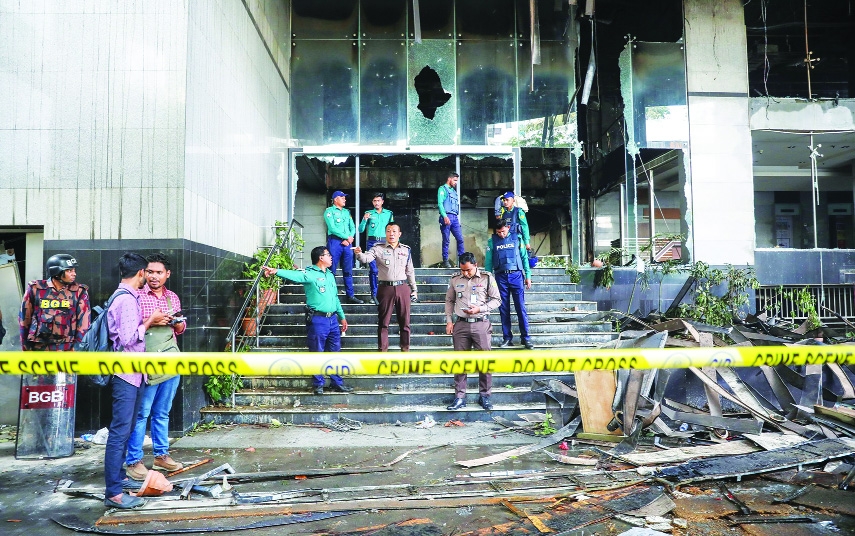
Security personnel stand guard in front of the burnt office of The Daily Star newspaper that was vandalized in mob violence following the death of a political activist in Dhaka, Bangladesh on 19 December 2025. File Photo
The role of journalism in a democratic society is both sanctified and demanding. Journalists are expected to hold power accountable, protect the public’s right to know, and create a platform where truth can prevail over propaganda. In Bangladesh, however, the relationship between the state and the media has long been marked by tension, mistrust, intimidation, and political influence. During the immediate past interim government led by Dr. Muhammad Yunus, concerns surrounding press freedom, intimidation of journalists, and politically motivated legal actions against media professionals intensified public debate regarding the condition of democracy and the future of independent journalism in the country.
Bangladesh has a rich history of courageous journalism. From the Liberation War of 1971 to modern democratic movements, journalists have often stood at the frontline of political transformation. Yet the profession today faces enormous pressure from political authorities, corporate interests, digital intimidation, and internal divisions within the media industry itself. The recent experiences during the interim administration further exposed the vulnerabilities of the country’s media landscape and highlighted the urgent need for unity, ethical responsibility, and professional solidarity among journalists and media owners.
One of the most alarming concerns during the interim government period was the filing of false police cases against journalists. Many reporters, editors, and media workers alleged that fabricated charges were used as tools of harassment and intimidation. These cases often included accusations under cybercrime laws, defamation provisions, or allegations linked to public disorder and political conspiracy. In many instances, journalists claimed they were targeted merely for publishing investigative reports, exposing corruption, or criticizing state policies. Even fictitious murder cases were also stamped on journalists and academic scholars during the interim government’s tenure.
False legal cases create a climate of fear. A journalist who must spend time in courts, seek bail repeatedly, or face threats of arrest cannot work freely and independently. The burden is not only psychological but also financial and professional. Smaller newspapers and local reporters are especially vulnerable because they lack institutional protection or access to legal support. When journalists are threatened through misuse of law enforcement and judicial processes, democracy itself suffers because the free flow of information becomes restricted.
The interim government under Dr. Muhammad Yunus came to power amid promises of reforms, accountability, and national stability. Many citizens hoped the administration would create an atmosphere where democratic institutions could flourish freely. Yet several media observers argued that the period witnessed increased pressure on dissenting voices. Instead of ensuring stronger protections for media freedom, critics complained that certain authorities became intolerant toward uncomfortable reporting and investigative journalism. Roles of different journalists organizations like Newspaper Owners Association of Bangladesh (NOAB), Editors’ Council, Bangladesh Shangbadpatra Parishad and Editors’ Guild are not beyond questioning. These platforms are not inclusive. These organizations represent a very few number of newspapers and their senior officials.
Editors from The Asian Age, Dinkal, Amader Shomoy, Jai Jai Din, Naya Diganta, Sangram etcetera are not frequently seen in the above media assemblages. This sounds like a syndicate where newspaper officials and entrepreneurs from all the mainstream news outlets are not welcomed. The Asian Age published reports on veteran journalists like Shafik Rehman, Mahmudur Rahman and Abul Asad when they were attacked but these reports were skipped by most of the frontline newspapers. The Asian Age published a report on the front page on 26 February 2017 titled, “Tk 30, 000 crore vanishing trick: 60% of defaulted loans from public banks written off.” Taking this report into cognizance, the High Court ordered Bangladesh Bank to furnish full facts and figures related to the persons and amounts with reference to defaulted loans. The Asian Age was the pioneer in unveiling investigative reports and write-ups about corruption in banks and financial sector which angered fraudsters and oligarchs who were mainly responsible for gobbling up banks and illegal money transfer when the ousted authoritarian government was in power from 2009 to 2024. False defamation cases were filed against The Asian Age Chairman and Publisher and attempt was made to shut down The Asian Age press in November 2019.
Shafik Rehman worked tirelessly against the autocracy of former President Hussain Muhammad Ershad and unseated Prime Minister Sheikh Hasina. Shafik Rehman was subjected to immense harassment and he was hammered with fabricated cases. The Asian Age categorically published these reports but most of the top-ranking newspapers did not do enough to cover the maltreatment that Shafik Rehman was repressed with.
At the same time, it is also important to recognize that the media industry in Bangladesh carries its own internal weaknesses. A significant number of newspapers and television outlets are influenced by political affiliation, corporate dependency, or personal interests of ownership groups. Many newspapers have drifted away from their democratic responsibilities and increasingly function as instruments for political propaganda, commercial gain, or factional battles. Exploiting media entrepreneurs leads to wider vulnerability of the news industry and it endangers the survival and livelihoods of thousands of employees working for news outlets. The overall economic and political standings of a country also pay the price in this way.
The press is not merely a business enterprise; it is a democratic institution. Newspapers have a moral obligation to educate citizens, encourage critical debate, defend constitutional rights, and amplify marginalized voices. Unfortunately, many media organizations have become deeply polarized. Editorial independence is often compromised by the interests of owners who prioritize political proximity over journalistic ethics. As a result, balanced reporting suffers, and public trust in the media gradually declines.
Another major issue is the lack of unity among newspaper owners and media entrepreneurs. In moments when journalists face attacks, intimidation, or politically motivated cases, the response from media ownership groups has often been fragmented and inconsistent. Some owners remain silent out of fear of losing business advantages or government favour, while others avoid taking collective positions due to competition and rivalry within the industry.
This lack of unity weakens the entire media sector. Governments and powerful actors can more easily pressure individual organizations when the industry itself remains divided. In democratic societies, press freedom survives not only through brave reporters but also through strong institutional solidarity. Media owners must understand that defending the rights of one newspaper ultimately protects the future of all newspapers.
The fragmentation within media ownership structures also contributes to self-censorship. Editors and reporters frequently avoid sensitive investigations because they fear isolation from their peers or lack confidence that their organizations will defend them during political confrontation. Such conditions gradually destroy investigative journalism and reduce journalism to passive reporting.
The crisis became more visible following the publication of reports on corruption during 2019. Several journalists and editors who pursued investigative reporting on financial irregularities, political influence, and institutional corruption reportedly faced intense pressure. According to concerns expressed by media professionals, some intelligence divisions allegedly attempted to subdue editors’ organizations and weaken collective resistance within the press community.
When institutions responsible for national security or intelligence become involved in influencing media bodies, democratic accountability is endangered. Editors’ organizations are meant to protect professional standards, advocate for press freedom, and create a united voice against repression. If such organizations are weakened through intimidation, surveillance, or political manipulation, the entire journalistic ecosystem becomes fragile.
The weakening of professional associations also creates mistrust among journalists themselves. Younger reporters begin to feel abandoned, while senior editors become cautious about taking principled positions. Over time, fear replaces solidarity, and silence becomes normalized. This environment benefits corrupt networks because investigative journalism loses its institutional backbone.
Corruption remains one of the most important areas where journalism serves the public interest. Investigative reports uncover misuse of public funds, abuse of authority, bribery, and exploitation. Therefore, any attempt to suppress corruption reporting directly harms democratic governance. Journalists who investigate corruption should receive legal protection and institutional support rather than threats or fabricated criminal charges.
Despite these challenges, Bangladesh still possesses a large community of courageous journalists committed to truth and democratic values. Across national newspapers, regional publications, television channels, and digital platforms, many reporters continue to work under difficult conditions to inform the public honestly. Their resilience demonstrates that journalism in Bangladesh has not lost its spirit, even though it operates under immense pressure.
However, courage alone is not enough. Prominent journalists must now take greater responsibility in rebuilding unity within the media profession. Senior editors, respected columnists, television anchors, and media entrepreneurs should work together with solidarity, reciprocal honour, and fraternity. The profession can survive only if journalists defend one another regardless of ideological differences or organizational affiliations.
Reciprocal honour is especially important in a polarized environment. Journalists may disagree politically or professionally, but they must still respect each other’s rights to report freely and express opinions without fear. Democracy depends on the existence of multiple viewpoints. If journalists begin celebrating repression against rival media organizations, they ultimately contribute to the destruction of press freedom for everyone.
Fraternity within the media sector should extend beyond symbolic statements. Journalists’ unions, editors’ councils, and newspaper owners’ associations need to create effective mechanisms for legal support, emergency protection, and professional advocacy. When a reporter faces a false police case, the response should be collective and immediate. When a newspaper faces intimidation for publishing corruption reports, the wider media community should defend the principle of press freedom irrespective of commercial competition.
Media entrepreneurs also have a critical role to play. Owners should invest in ethical journalism, legal protection systems, journalist training, and editorial independence. Too often, journalists are expected to defend democracy while working under insecure employment conditions and inadequate institutional support. A healthy democratic media environment requires both courageous journalism and responsible ownership.
The digital era has further complicated the struggle for press freedom. Online harassment, misinformation campaigns, cyber surveillance, and politically coordinated attacks against journalists have become common. Female journalists are particularly vulnerable to online abuse and intimidation. Therefore, protecting media freedom today requires not only legal reform but also technological safeguards and stronger ethical standards within digital communication.
Bangladesh stands at an important crossroads in its democratic journey. The future of journalism will significantly influence the future of democracy itself. If journalists continue to face false cases, intimidation, and institutional pressure, public trust in democratic institutions will weaken further. Citizens cannot make informed political choices without access to independent and fearless reporting.
At the same time, the media industry must also engage in self-reflection. Newspapers and television channels cannot demand democratic accountability from governments while ignoring ethical failures within their own institutions. Professional integrity, factual accuracy, editorial independence, and public responsibility must remain central principles of journalism.
The immediate past interim government period under Dr. Muhammad Yunus will likely remain a subject of political and historical debate for years to come. Different political groups will interpret the period differently according to their perspectives and interests. Yet one lesson remains clear: democracy cannot function without a free, united, and responsible press.
Bangladesh needs journalism that serves citizens rather than political masters. It needs editors who protect truth even under pressure. It needs media owners who value democratic responsibility above temporary political benefits. Most importantly, it needs journalists who stand beside one another with courage, honour, and fraternity.
The future of democratic journalism in Bangladesh depends not only on constitutional guarantees or legal reforms but also on the collective conscience of the media community itself. When journalists remain united, corruption fears exposure, authoritarianism faces resistance, and democracy gains strength. But when division, fear, and silence dominate the profession, the public loses one of its most essential democratic safeguards.
Newspaper owners and editors who are now in driving seats should work with full devotion for unity and fraternity within the whole journalist community. Ideologies might be different but to stand by one another under troublesome circumstances with rock-hard solidarity is an obligation to sustain freedom of press and people’s rights to speak out independently. We know two famous newspaper offices were burned in December 2025 by mob gangsters. Prime Minister Tarique Rahman’s motto “Bangladesh First” shows a way of light and liberty for the whole nation. Dr. Iftekharuzzaman, Executive Director of Transparency International Bangladesh (TIB) said that the continuation of vengeance in politics is very much harmful for the prevalence of democracy, equal rights and socioeconomic justice. Dr. Iftekharuzzaman added that all politically motivated cases against journalists should be withdrawn and all media workers inside jail should be released immediately. However, these demands and comments should have been made long ago when biased and defiled state machineries detained journalists and academic scholars one after another. Most of the leading editors did not speak against the jackboots that trampled media houses and newspaper owners on the basis of false allegations. This sort of silence is suicidal for mass media.
US President Donald Trump has been heavily criticized by a broad number of newspapers and media agencies but Donald Trump did nothing vindictive to persecute any journalists.
In this challenging time, solidarity among journalists and media entrepreneurs is no longer optional; it is a democratic necessity. Last but not least, we must not forget about how graves were vandalized and set on fire by mob outfits. If newspapers cannot work hand in hand, very tough time is waiting for us like Martin Luther King once said “We must learn to live together as brothers or perish together as fools”.
Nasir Uddin Shah is Chief Reporter at The Asian Age.