Published: 12:21 AM, 21 May 2026
Tara Mosque: The Star-Studded Jewel of Old Dhaka
Mosques have always stood at the center of Muslim civilization. Wherever Muslims settled across the world, mosques emerged not only as places of worship but also as symbols of culture, heritage, and community life.
Bangladesh, often regarded as a land of mosques, proudly carries this legacy. The capital city, Dhaka, is famously known as the “City of Mosques” for its thousands of historic and modern mosques, remarkable architectural styles, and rich Islamic heritage. Among the many historic mosques scattered throughout Old Dhaka, one of the most extraordinary is the renowned Tara Mosque.
Located in the historic neighborhood of Armanitola, Tara Mosque stands as one of the finest surviving examples of Mughal-era mosque architecture in Bangladesh. With its dazzling mosaics, intricate porcelain decorations, and star-studded motifs, the mosque continues to captivate worshippers, historians, architects, and tourists alike.
A Mosque Famous for Its Starry Beauty
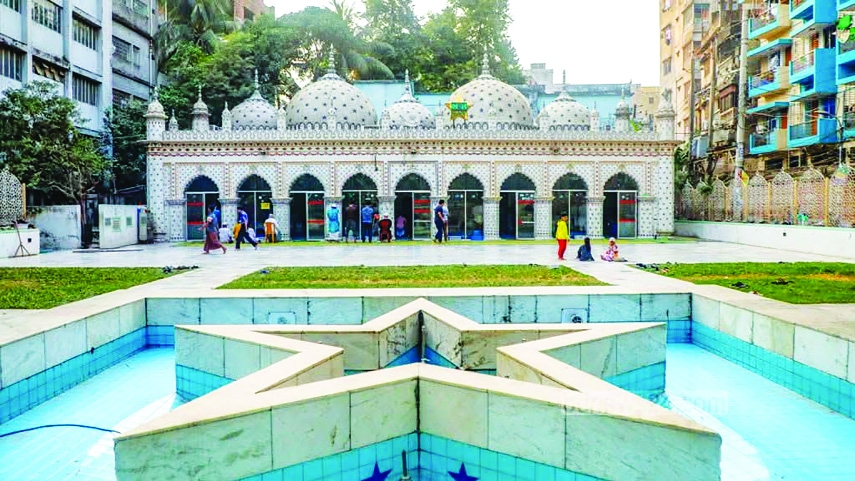
Although originally known as MirzaGhulamPir’s Mosque or Sitara Mosque, the mosque gradually became famous among locals as “Tara Mosque.” The word Tara means “star,” a name inspired by the blue star motifs set against the mosque’s white walls. These decorative stars became the defining identity of the structure over time.
The mosque’s walls, floors, domes, and arches are adorned with exquisite mosaic artwork made from colorful glass pieces, porcelain plaques, and decorative tiles. One of its most notable artistic features is the use of ChiniTikri—a traditional mosaic technique composed of tiny fragments of porcelain and glass originating from China.
The artistic sophistication of the mosque makes it unlike most traditional mosques in Bangladesh. Even after centuries, its decorative elegance continues to astonish visitors.
According to the mosque’s Pesh-Imam, Shahidul Islam, Tara Mosque was built in the 18th century during the Mughal period by a wealthy merchant named MirzaGhulamPir.
Initially, the mosque was relatively simple in appearance. It was a modest three-domed Mughal-style mosque without the lavish ornamentation visible today. Over time, however, several renovations transformed it into one of the most decorative mosques in the country.
Shahidul Islam explained that a major turning point came in 1950 when local businessman AlijanBepari became the mosque’s Mutawalli (caretaker). He financed an extensive renovation project and imported valuable construction materials, including high-quality tiles and marble from countries such as Japan.
During this renovation, the mosque’s inner and outer walls, domes, and arches were decorated with intricate floral patterns, vines, stars, and geometric motifs. A veranda was also added to the original structure, significantly enhancing its architectural beauty.
It was during this phase that the iconic star decorations were introduced, leading people to popularly refer to the mosque as Tara Mosque or Sitara Masjid.
Another major expansion took place during the presidency of Hussain Muhammad Ershad.
According to mosque authorities, Ershad visited the mosque to offer prayers on March 8, 1985. At that time, the mosque measured only 30 feet in length and 12 feet in width. Impressed by its historical importance, he ordered its expansion while attempting to preserve its original architectural style.
Under the supervision of the Ministry of Religious Affairs, architects GiasulHuque and Zahiruddin carried out the extension work. Two additional domes were added to the prayer hall, increasing the mosque’s size to approximately 70 feet in length and 26 feet in width.
Although the renovation expanded the mosque’s capacity, some architectural historians believe that the additions did not fully respect the mosque’s original Mughal design and antique character.
The mosque officially came under government management in 1987 and is currently administered through the Waqf administration.
Present Appearance and Facilities
Today, Tara Mosque remains both an active place of worship and a major tourist attraction.
Inside the mosque, there are four rows for worshippers, while the veranda accommodates three additional rows. Approximately 285 worshippers can pray inside the main structure at a time.
In front of the mosque lies a beautifully maintained green courtyard with a star-shaped fountain at its center. Marble walkways surround the fountain, while ornate iron grills enclose the entire complex.
Additional prayer arrangements were also added during later renovations. During Friday prayers and Eid congregations, large canopies are installed in the open courtyard, allowing nearly 1,500 worshippers to offer prayers together.
Besides regular congregational prayers, the mosque also operates a Hefzkhana, Maktab, and Lillah boarding facilities supported through government grants and local donations. During Ramadan, iftar is arranged daily for around 100 fasting people.
A National Symbol on Banknotes and Fashion
The architectural beauty of Tara Mosque has earned it national recognition beyond religious significance.
In 1976, the Government of Bangladesh featured the mosque on a series of banknotes ranging from Tk 5 to Tk 500. Later, the revised design of the Tk 100 note also prominently displayed the mosque’s image. Even today, the current Bangladesh Bank Tk 100 note carries the iconic image of Tara Mosque.
Its artistic influence has also extended into fashion and culture. In 2016, the Fashion Design Council of Bangladesh organized a Khadi Fashion Show at the Radisson Blu Dhaka Water Garden, where designers showcased khadi fabrics inspired by the mosque’s decorative motifs.
Surrounded by the narrow lanes, bustling markets, and crowded buildings of Old Dhaka, Tara Mosque continues to stand as a timeless architectural jewel.
Every day, countless worshippers gather there for prayers, while visitors from across Bangladesh and abroad come to admire its artistic brilliance and historical significance. Foreign tourists, diplomats, researchers, and architecture enthusiasts frequently visit the mosque, making it one of the most celebrated heritage sites in the country.
More than just a place of worship, Tara Mosque represents the artistic excellence, cultural richness, and enduring heritage of Mughal architecture in Bangladesh. Its star-studded beauty remains a shining symbol of Old Dhaka’s glorious past.
Adnan Hadi is a senior journalist
mainly writing on archeological
sites and sports. He can be reached at [email protected]