
Published: 12:58 AM, 23 May 2026
The Phrase That Outlived Its Government
Dr. Mohammed A Rab
Professor Dr. Muhammad Yunus is gone. His “Second Independence” is still here, and Bangladesh is paying a price for it. Almost two years after Sheik Hasina fled the country, the most important thing Professor Dr. Muhammad Yunus did as her unelected successor was not a commission, an ordinance, or a referendum. It was a phrase. He called the July 2024 uprising a “Second Independence.” He has since left office. The phrase has not. It now shapes how this country argues about itself, and, more dangerously, how it argues about what it owes the martyrs of 1971.
To call something ‘an independence’ is not merely to describe it. It is to make a claim to reach into the country’s deepest source of legitimacy, the three million dead, the women subjected to sexual violence, the millions driven across the border, and to draw on that moral weight for a present political purpose. Hasina drew on it heavily for fifteen years, often to wrap her own party’s authority in the colours of 1971. Yet she never questioned the legacy itself; she insisted on its singular, sacred status, even as she claimed disproportionate ownership of it. Professor Yunus did something different. By calling July 2024 a “Second Independence,” he did not borrow from the legacy of 1971 so much as diminish it, recasting the founding war as the first installment of a series rather than the unrepeatable event on which the nation rests. That is not the same offense; it is a graver one.
The protest that followed was not, as some of his supporters suggested, the usual complaining of BNP workers looking for an excuse. It was a serious objection from people who understood what founding stories are for. National founding milestones have power precisely because they happen only once; as Halbwachs and Connerton argued, every nation knows this in its bones. The moment you declare a second independence, the first no longer becomes a single, unique event. It becomes the first chapter in a series; its weight is divided, its martyrs joined by a longer line. The historical cost is borne by those who can least afford it: the families whose losses are now treated as the first of several.
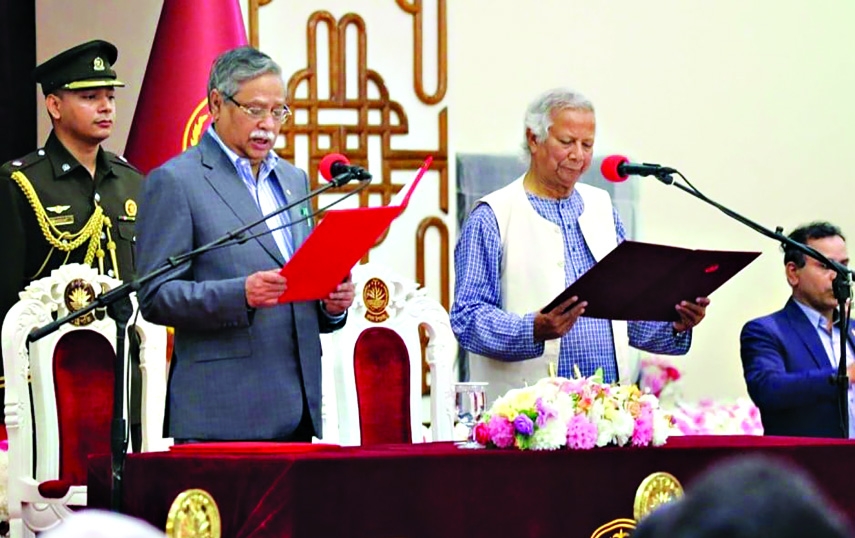
There was also a more immediate problem. Professor Yunus made the claim before he had even been sworn in; no election, no parliamentary vote, had granted him authority. By invoking the language of “independence,” he was asserting a legitimacy more potent than the electoral kind: that of revolutionary inheritance. The impulse may have been practical, but the effect was corrosive. It reduced democratic legitimacy to an ornament rather than a foundation. If the country had supposedly been waiting for its “real” independence until he and his allies arrived, then everything between 1971 and 2024 was implicitly dismissed as counterfeit. That is no small claim to be released into public life.
He paired it, almost immediately, with another declaration: restoring law and order would be his first priority. The juxtaposition was revealing. The students who had brought Hasina down had not marched for administrative stability; they had marched for justice, accountability, and political change. To answer a revolutionary uprising with the language of bureaucratic restoration was to signal, from the very beginning, that the new government would speak in the rhetoric of rupture while relying, in practice, on the familiar instruments of control.
The reform agenda was ambitious. Six commissions — on the Constitution, Elections, the Judiciary, the Police, Public Administration, and Anti-Corruption, later expanded to eleven, suggested a serious attempt at institutional reconstruction. Yet the rhetoric surrounding them was oddly mismatched to the work they required. Structural reform is slow, technical, and dependent on compromise. Revolutionary language can ignite political energy, but it is poorly suited to the patient, procedural labour of institution-building.
Worse, the rhetoric implied a division. If this was the “new Bangladesh,” then anyone associated with the previous order, whether they had supported it, voted within it, or simply lived under it without open opposition, was implicitly cast as part of the old order. Reform movements survive by expanding their coalition, not by suggesting that large parts of the country belong to a discredited past. A government that begins by sorting its citizens into the politically awakened and the politically obsolete is not building a national consensus. It is deciding, from the outset, who truly counts as part of the project.
Defenders of the interim period will argue, with some justification, that its institutional record was not insignificant. The Commission on Enforced Disappearances documented 287 still-missing victims out of 1,569 complaints; the Cyber Security Act was amended; and the July National Charter, signed by twenty-six parties, was approved in a referendum with 68.59 percent of the valid vote. These were tangible achievements. The difficulty lies elsewhere. Reforms endure when rooted in broad political agreement and embedded in democratic culture. Here, many rested instead on a claim of moral exceptionalism: that the interim authority represented a uniquely legitimate break from the past. What is proclaimed from above, rather than negotiated across society, can just as easily be revised, diluted, or undone by the government that follows.
We are now seeing the consequences. Three months into office, Prime Minister Tarique Rahman’s government has indicated it may allow the ordinances on Enforced Disappearances and the National Human Rights Commission to expire. Four social media users have been arrested under the Cyber Security Ordinance, which the interim administration declined to fully repeal. The Constitutional Reform Council promised that, after the referendum stalled because BNP MPs refused to take the second oath. The interim government built the framework for reform; its durability now depends on a successor with little incentive to preserve arrangements it did not create.
None of these required Professor Yunus to describe the uprising as a new independence. He could have called it what it plainly was: the largest mass political movement since 1990, one that toppled an authoritarian government and opened the way for a democratic transition. That description would have been accurate and would have carried political force. Most importantly, it would have left the legacy of 1971 intact rather than pitting it against the present.
What Bangladesh needed in August 2024 was not a second founding myth but a genuine second chance to fulfill the promises of the first republic. The institutions envisioned in 1972 have never fully materialized: an independent judiciary, a police force accountable to law rather than power, a parliament not subordinate to the executive. These remain the unfinished tasks of the original independence settlement. Framing the uprising as part of that long democratic struggle could have invited every political tradition into a common national project. Calling it a “new independence” implied instead that many of those traditions belonged to a past that had to be discarded.
Bangladesh now has an elected government, a referendum that has passed, and a parliament still divided over what that referendum authorized. It possesses the most extensive reform blueprint in its history, alongside an institutional framework that may not survive its first year after the interim period. Mob violence continues at levels the police appear either unable or unwilling to contain. Minorities, women, indigenous communities, and the Rohingya remain broadly as vulnerable as they were under Hasina, even as the specific threats have changed. The state’s security machinery, including the Rapid Action Battalion, remains fundamentally intact.
The phrase that helped produce this confusion is now embedded in public life. Student activists repeat it, party workers invoke it, and commentators across the spectrum find themselves writing around it. Professor Yunus may no longer hold office, but his framing continues to shape the political language of the transition. That is the lasting cost of the “Second Independence” formulation: not merely that it was questionable when first deployed, but that it altered the country’s public vocabulary in ways that may take years to reverse.
There is, however, one encouraging fact: political language can be changed. The next time a Bangladeshi prime minister speaks about July 2024, the wiser formulation would not be to declare a second independence, but to say the country was given a second chance to fulfill the promise of the first. That phrasing asks no faction to surrender its history. It diminishes no sacrifice. It invites consensus rather than exclusion and directs attention toward the task that still matters most: finally building the institutions that the independence of 1971 was meant to make possible.
If democracy in Bangladesh is to become more than a recurring interruption between crises, it will have to begin there: with more careful language, and with the patience to undertake the slower, less romantic work of building the first republic at last.
Dr. Mohammed A Rab writes on
contemporary issues. He is
based in the United States
of America.


