
Measles Outbreak
Published: 12:21 AM, 24 May 2026
Govt requests WHO to conduct independent investigation
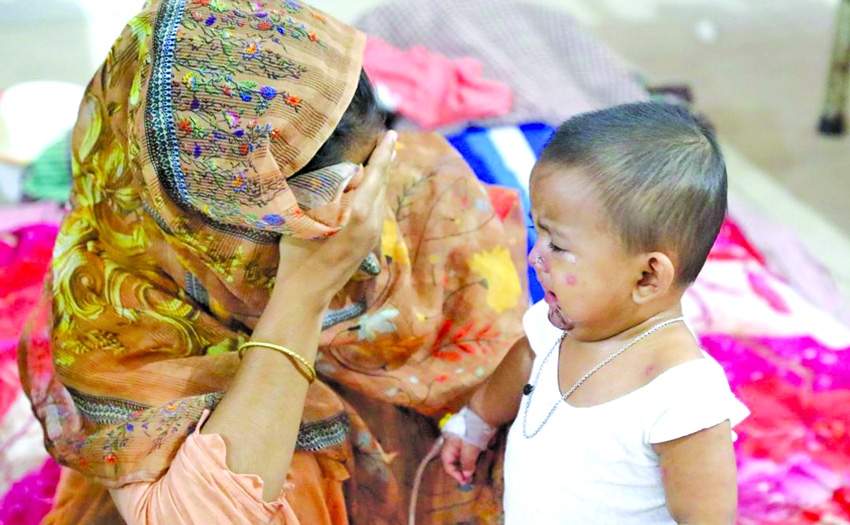
Over 500 children have in the meantime died of measles across Bangladesh. Thousands of critically ill infants are currently undergoing treatment in hospitals all over the country. The photo was taken from Mugda General Hospital in the capital on Saturday. -Md Mostafijur Rahman
Measles and deaths among children showing symptoms of the disease in Bangladesh have exceeded 500. To determine how the measles situation reached this stage, the government has informally requested the World Health Organization to conduct an "independent investigation."
S. M. Ziauddin Haider, Special Assistant to the Prime Minister on Health Affairs, told BBC Bangla that the global organization has responded positively to the request.
"We do not want to blame anyone indiscriminately or hold any single party solely responsible. However, to prevent such mistakes from happening again, it is necessary to understand why the measles situation became so severe. That is why we informally requested the WHO to carry out an independent inquiry, and they have shown interest," Ziauddin Haider said.
Earlier, however, UNICEF said at a press conference in Dhaka that they had sent at least five letters to the interim government of Muhammad Yunus warning about the measles situation, in addition to issuing warnings at least 10 times during various meetings.
But Professor Dr. Sayedur Rahman, former Special Assistant (Health) to the Chief Adviser of the dissolved interim government, rejected UNICEF's allegations in comments to Bangladeshi media.
Many critics have accused the interim government of failing to take proper measures to address the shortage of measles vaccines. Various political parties and social organizations in Dhaka have organized programs demanding punishment for those responsible for the deaths of hundreds of children with measles symptoms.
The matter has also reached the courts. Following a writ petition filed by a lawyer of the Supreme Court of Bangladesh, the High Court Division of the Supreme Court of Bangladesh issued a rule asking why an investigation commission should not be formed to probe child deaths caused by the measles outbreak.
Recently, the Health Secretary said at an event in Dhaka that the government has already begun investigating the vaccine shortage and child deaths linked to measles. The investigation will examine why so many children died and whether there was any negligence involved.
Public health expert and former Health Department director Benazir Ahmed said that the interim government's indecisiveness and delays in decision-making were initially responsible for the situation. However, after the outbreak began under the current government, many deaths could have been prevented if the situation had not been treated lightly.
The Health Department said today that from March 15 until now, 86 confirmed measles deaths have been recorded, while 426 children died showing measles-like symptoms.
During the same period, more than 62,000 children with measles symptoms were hospitalized across the country.
To address the situation, the government has taken initiatives to procure vaccines and launch a mass vaccination campaign for children aged six months to five years.
However, Health Minister Sardar Sakhawat Hossain Bakul has consistently blamed the previous government's failure in vaccine procurement and vaccination programs for the measles outbreak.
Speaking at an event at the Secretariat on Saturday, he said, "The nationwide measles outbreak occurred because of the negligence of the previous government. But rather than focusing on punishing those responsible right now, the government's priority is to ensure proper treatment for children infected with measles."
The writ petition filed in the High Court alleges that "by abandoning the vaccine procurement system through UNICEF and introducing an open tender process, the previous interim government created a severe vaccine shortage in the country."
In other words, critics of the interim government's handling of vaccines argue that changes to the vaccine procurement process during that period delayed vaccine collection, leading to a nationwide shortage.
Bangladesh usually administers two doses of the measles-rubella vaccine to children at 9 months and 15 months of age. In addition, nationwide special campaigns are conducted every four years to ensure that no child is left out. However, according to Health Minister Sardar Sakhawat Hossain, this campaign was not conducted during the interim government's tenure.


