
Published: 08:02 AM, 01 June 2026
One Year of Operation Sindoor
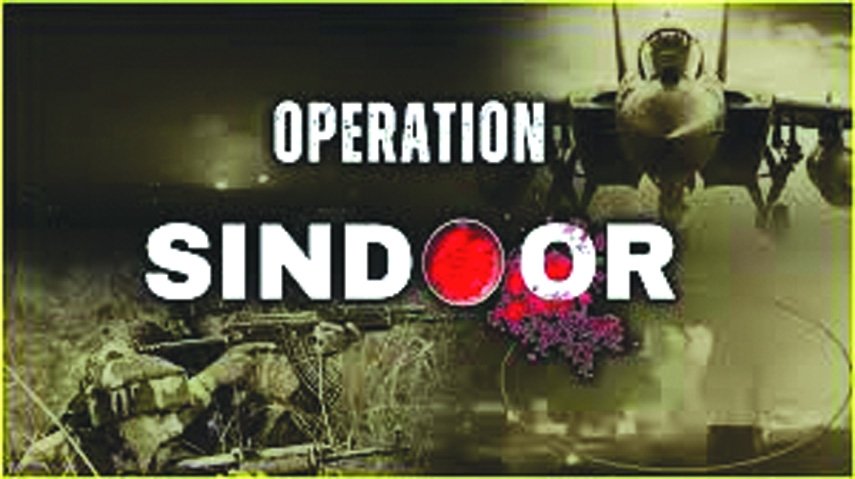
May 7th this year observed the first anniversary of Operation Sindoor which brought immense pride and honour to the proud country for hitting out at Pakistani military and terrorist targets which also demonstrated India’s military might particularly of the Air Force backed by sophisticated science and technology.
It may be reiterated that India had created history by successfully conducting Operation Sindoor in the wee hours of May 7, 2025, precisely targeting nine high-value targets well inside Pakistan, including Markaz Subhan Allah, Bahawalpur; Markaz Taiba, Muridke; Sarjal, Tehra Kalan; Mehmoona Joya, Sialkot; Markaz Ahle Hadith, Barnala; Markaz Abbas and Maskar Raheel Shahid, both in Kotli; and Shawai Nalla Camp and Syedna Bilal Camp, both in Muzaffarabad. These locations were hit hard with surgical accuracy, annihilating them completely. And this was no mean achievement. This was packed with super professionalism, as all the pinpointed targets were citadels of terror outfits including Lashkar-e-Taiba (LeT), Jaish-e-Mohammad (JeM), and their affiliates. Professionally, Operation Sindoor was not only the most effective cross-border strikes carried out by India since the Balakot operation of 2019, but it also displayed India’s strategic capabilities. It may be reiterated that the operation was in the wake of the April 22 terror attack in Pahalgam, where 26 innocents were slain most mercilessly.
It may also appear significant to recall that unlike the 2016 Uri and 2019 Balakot airstrikes or other previous Indian operations of similar nature, which were limited in scale and scope, Operation Sindoor was technologically precise, extensive, and unprecedented. The decision to strike deep into Pakistan-occupied territory revealed one thing: a clear departure from earlier thinking. This time, it was clearly offensive, result-oriented, and without any margin of error. The sheer extent of damage inflicted on the Pakistan-based terror camps had sent a strong message to the terrorist syndicates and their handlers. In the aftermath of Operation Sindoor, India reserves the right to strike preemptively, suggesting that no location is beyond its reach. And the message is loud and clear for the global community, particularly to Pakistan and its allies, who always underestimated India’s military capability and efficacy or at least feigned the same.
The Pahalgam terror attack was perpetrated by The Resistance Front (TRF), a different name for LeT. Operation Sindoor was conceived following this. It was not just a retaliatory show of force, but an attempt to degrade the logistical and operational foundations of terrorism emanating from Pakistani soil. As of now, Pakistan continues to be shaken after “Sindoor.” Yet, it is bizarre to see that observing Sindoor’s first anniversary, Pakistan’s reaction has been laughable when Lieutenant General Ahmed Sharif Chaudhry, Director General of Inter-Services Public Relation (DG ISPR) on May 7 this year said that Pakistan inflicted a “crushing defeat” on a five times larger enemy across all fronts in Marka-e-Haq. The term Marka-e-Haq refers to the 2025 conflict with India, which began with the April 22 Pahalgam attack and concluded with a ceasefire on May 10 last year following Operation Bunyanum Marsoos. Addressing a press conference in the presence of senior Pakistani military officials marking one year since the completion of Marka-e-Haq, he even extended congratulations to the nation on the occasion claiming that Pakistan had defeated India on every front during the conflict, describing it as a humiliating defeat for the adversary. Such exaggerated and manufactured lies once again expose Pakistan’s immature and baseless claims. Here, it is also important to state that Pakistan had lost its aggression during the `Operation Gibraltar’ launched through the abortive tribal infiltration in Kashmir 1947/48. Again, it decisively lost the 1965 and the 1971 wars where the defeats were not only outright and absolute but Pakistan also lost its eastern flank which is now Bangladesh as an independence country. Similarly, Pakistan tasted a humiliating defeat in its failed military misadventure of the Kargil conflict of 1999.
Now, what were the immediate implications of Operation Sindoor—preceding the strike and in its aftermath? The successful Operation Sindoor confirms that there was perfect coordination between the political and military leadership, a free hand by the Indian Prime Minister to the military leadership to deal with the challenges, complete secrecy, and seamless synergy among the government, intelligence, multiple security agencies, and other organizations connected with it. In sum, it needs to be told and retold that there was a flawless political will to send a clear message to Pakistan that should it dare to repeat such a misadventure, it would face disastrous consequences.
This operation also enhanced India’s image in the international community, and it is no exaggeration to say that India today is no less than countries like Israel in conducting such bold operations. Operation Sindoor also remains a class apart for striking only terror camps, exercising caution to spare civilian lives and targeting only those responsible for the Pahalgam terror attack. Last but not least, the nation stands united, cutting across party, caste, or religious lines. Such facts are being repeated again after one year to keep the public memory refreshed.
Further, on the first anniversary of Operation Sindoor, senior military officials have asserted that India’s response to cross border terrorism had changed the security scenario as it was not an end but just the beginning. In the same vein, Indian Defence Minister Rajnath Singh described it as a "unique" example of how the Indian military utilized advanced technology to deliver a decisive blow to terror groups and their "patrons". Addressing an event in Uttar Pradesh's Prayagraj, Mr. Singh emphasized that while the armed forces "showed patience", they were clinical in destroying terrorist infrastructure. He added that the operation served as a global reminder of Indian military's capabilities. He also said that advanced missile systems including Akash and BrahMos, along with a host of latest equipment, were used in this operation. Citing the current geopolitical environment, the Defence Minister underlined the need for the military to remain alert and adapt to the changing environment.
There have been several reactions within India from the strategic experts and political leadership. Likewise, Lieutenant General (Retired) Syed Ata Hasnain, former Military Commander, known strategist and now Governor of Bihar, says that “the most striking feature of Sindoor was not the scale of force employed, but the discipline with which it was applied. India chose not to be drawn into a wider conventional conflict, despite having both the capability and the provocation to do so. Instead, it demonstrated a doctrine of aggression blended with restraint-precise, time-bound, and politically directed”. He further notes that “the legacy of Operation Sindoor, therefore, lies not just in what it achieved, but in what it revealed. It showed that India can act with precision without losing control, that it can send a decisive message without inviting uncontrolled escalation, and that it can align its instruments of national power in pursuit of clear strategic objectives”.
Analytically speaking, Pakistan should not be under any illusions that it had got the better of India during Operation Sindoor. It should also clear its misconceptions that having “brokered” the Iran-US “peace” deal or “praise” by President Donald Trump has elevated Pakistan’s position amongst the international community. It may be forthrightly stated that it remains a state harbouring terrorists, promoting cross-border terrorism and vitiating world peace by acts and gestures of acrimony.
Shantanu Mukharji is a retired
IPS officer and former National
Security Advisor in Mauritius.


