
Published: 01:11 AM, 06 June 2026
US-Iran ceasefire on the brink
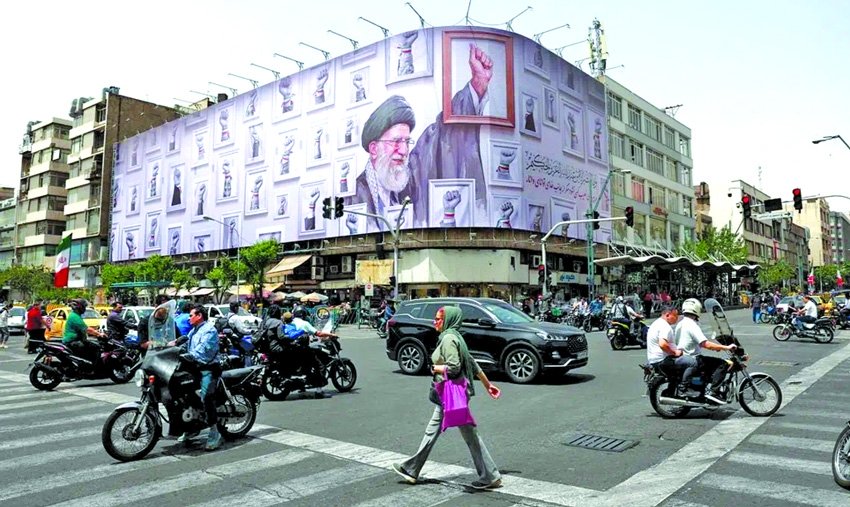
A huge poster of late Iranian supreme leader, Ayatollah Ali Khamenei, on a building at a corner of a traffic junction in Tehran on May 4. -EPA
A ceasefire between Iran and the United States was teetering on May 4 as the two countries traded fire over the strategic Strait of Hormuz and the United Arab Emirates (UAE) reported attacks for the first time since the truce was declared nearly a month ago.
A day after US President Donald Trump announced an operation to escort trapped vessels through the strait, Fox News quoted him as threatening that Iran would be "blown off the face of the earth" if it attacks US ships, according to news agencies.
Iran appeared undaunted as it vowed to keep exerting control over the Strait of Hormuz, the narrow waterway through which one-fifth of the world's oil flowed before the US and Israel attacked Iran on Feb 28.
A US admiral said American forces sank six small Iranian ships. The Islamic republic on May 5 denied any combat vessels had been hit but accused the US of killing civilians on boats.
US forces "attacked two small boats carrying people... they martyred five civilian passengers and must be held accountable for their crime", Iranian state TV posted on Telegram.
"We've shot down seven small boats or, as they like to call them, 'fast' boats," Mr Trump said in a Truth Social post, adding that Defence Secretary Pete Hegseth would hold a press conference on May 5.
The UAE, a close US ally and key Arab partner of Israel, said it came under a barrage of missiles and drones from Iran.
"These attacks represent a dangerous escalation and an unacceptable transgression, posing a direct threat to the state's security and stability and the safety of its territories," the UAE's Foreign Ministry said in a statement.
A strike targeting an energy installation in the emirate of Fujairah injured three Indian nationals, the UAE authorities said.
Two people were also injured when a residential building was hit in Oman's Bukha, along the coastline of the Strait of Hormuz, state media reported.
The violence shook a ceasefire that has largely held since going into effect on April 8.
It has also prompted calls for the US and Israel to renew attacks on Iran after a campaign that had previously struck thousands of targets, killed Iran's supreme leader and other top officials, and shuttered the vital Strait of Hormuz - causing global energy prices to soar.
On May 4, Republican Senator Lindsey Graham said on social media platform X that Iran's choice to attack the UAE and cargo ships "more than justifies a big, strong and short response to inflict further damage on Iran's war machine".
In a social media post, former Israeli prime minister Naftali Bennett said Iran's UAE strike amounted to "a declaration of the renewal of Iran's war against the allies of the United States and Israel across the region".
US Central Command chief, Admiral Brad Cooper, repeatedly declined to address questions about whether the ceasefire had been broken.
In a separate briefing on May 4, US Ambassador to the United Nations Mike Waltz said he would "defer to the White House on declaring violations" of the ceasefire.
"It's a fluid situation," he said.
Oil prices climbed further after the UAE attack, with the benchmark international contract Brent crude for July delivery jumping more than 5 per cent.
The soaring energy costs for consumers since the war have caused economic pain around the world and created a political headache for Mr Trump months before congressional elections.
In Israel, a military official said forces were on high alert.
The UAE ordered all schools to return to remote learning for the rest of the week.
According to the UAE's Defence Ministry, four cruise missiles were launched from Iran, with three successfully shot down and another falling into the water.
Iran also fired drones at a tanker affiliated with its state-owned oil giant ADNOC, the UAE authorities said.
A senior Iranian military official did not deny the strikes but said that the Islamic republic had "no pre-planned programme to attack the oil facilities in question".
"What happened was the product of the US military's adventurism to create a passage for ships to illegally pass through (Hormuz)," the official said, according to state television.
"The US military must be held accountable for it," the official added.
But Iranian Foreign Minister Abbas Araghchi - seen as a moderate in the cleric-run state - said that the clashes in the strait showed there was "no military solution to a political crisis" and pointed to Pakistan's efforts to keep mediating.
"The US should be wary of being dragged back into a quagmire by ill-wishers. So should the UAE. Project Freedom is Project Deadlock," he wrote on X.


