
Published: 11:55 AM, 03 August 2026
University Admission Tests: Where the Difference Lies
Badrul Huda Sohel
The undergraduate admission test conducted by Jadavpur University Bangla Department in India has recently arrested our eyes after it went viral on social media. The 50-mark written test has sparked a buzz among teacher, academics, and education enthusiasts in the country. The test has reignited an important debate: What should a university admission test look like? If we juxtapose a question paper of any of our universities and that of Jadavpur, then even a lay observer will find a far wide difference, leading to another question: What kind of admission test best identifies students prepared for tertiary education? The answer, perhaps, is not difficult to find.
Universities must evaluate the admission aspirants before intakes. The prime objective of arranging an admission test is not to measure rote memorization but to assess whether a student is cerebrally prepared for higher education. Jadavpur University’s admission test so far reflects precisely this philosophy.
Jadavpur University asked applicants to write an essay on any one of ten unconventional topics: the strongest female character students have encountered in literature or in film; a whimsical childhood wish; an open letter to their favorite author; a conversation among birds whose trees have been destroyed; or questions they would ask God if given the opportunity—all of which need human imagination, literary taste, language proficiency, and analytical ability to answer.
A close look at the question paper reveals a clear educational philosophy emphasizing not on rote learning. It, instead, values independent thought, critical reasoning, literary understanding, linguistic competence, and innovative creativity. Conventional guidebooks and coaching-centric techniques are there largely ineffective in such an admission process where no iota of conventional questions is set.
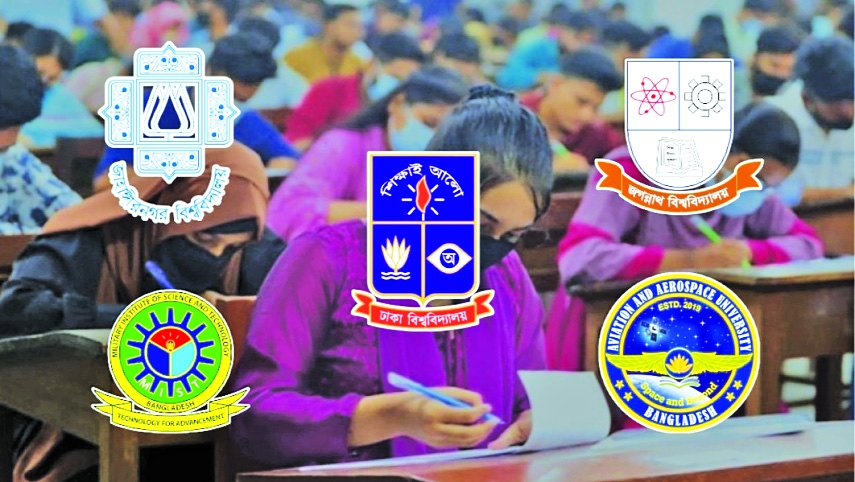
Admission tests, however, at most public universities in our country are on information-based multiple-choice questions (MCQs), underscoring memorization over intellectual pursuit. Therefore, after completing undergraduate studies, many graduates can hardly write even a one-page impromptu piece on any topic.
Moreover, admission process dominated by MCQ-based assessment often leaves students unable to express ideas persuasively either in Bangla or in English. Critical thinking, communication skills, and analytical writing, the qualities that universities should cultivate, remain largely unevaluated. Consequently, despite graduating with impressive academic transcripts, many students fail to meet the standards required in competitive recruitment examinations.
A striking example is the 47th Bangladesh Civil Service (BCS) examination, where more than two thousand cadre positions remained vacant because an insufficient number of candidates achieved the qualifying marks. Although nearly 375,000 applicants participated, the Bangladesh Public Service Commission was compelled to leave more than half of the advertised cadre posts unfilled. Does this not raise serious question about the effectiveness of our higher education system?
Recognizing the demands of an increasingly globalised world, the country’s University Grants Commission (UGC) is in a try to initiate Outcome-Based Education (OBE) following Benjamin Bloom’s influential Taxonomy of Educational Objectives introduced in 1956, placing significant emphasis on learners’ skills like analysis and creativity, resulting in a better learning outcome. If educational policymakers genuinely recognize the importance of these competencies, why should our admission teats still have maximum focus on memorization?
Conducting written examinations for the large number of applicants seeking admission to our public universities may face a little bit challenges. Nevertheless, quality should not be sacrificed entirely for convenience. A balanced approach combining MCQs with a modest written component could better evaluate students’ reasoning, writing ability, and creativity. Such assessment models stressing written part are being followed in many top ranking universities around the world.
Unfortunately, many of our universities appear to have drifted away from their fundamental mission of producing researchers, scholars, and innovators. This retreat, however, is not initiated by the universities themselves, nor was they compelled the students to do it. Over time, a system has evolved in the country that increasingly rewards those who aspire to administrative positions rather than intellectual ones. Surprisingly, unlike other countries, many talented students here prefer administrative positions over positions in research or academia.
This transformation is also reflected in students’ career aspirations. Children who once dreamed of becoming physicians or engineers, often discover themselves redirecting their ambitions towards non-professional civil service cadres such as administration, foreign affairs, or police because these positions, for many, offer greater prestige and social status. This is precisely why the late educationist Syed Manzoorul Islam lamented and called the country’s public universities ‘BCS Universities’. That the BCS guidebooks have replaced the academic textbooks in the hands of students at public university libraries bears the testimony to this. While other nations generate new knowledge, undertake pioneering research, and explore the frontiers of science, many of our students remain preoccupied with memorizing the dates of those achievements. In the book The Idea of a University, the British educationist John Henry Newman argued that the purpose of a university extends far beyond producing skilled employees for the job market. A university should cultivate intellectual minds for rational and liberal thinking. A university should work as a platform for nurturing critical reasoning and independent thoughts of an individual.
If Bangladesh truly aspires to build a knowledge-based society and elevate its universities to globally competitive standards, changes in the light of discussions mentioned above are necessary. It is a must to adopt a far-sighted plan now to bring about the desired changes. A comprehensive initiative is needed to address each phase of our system, starting form student admission to making the curriculum more relevant and practical. Without these structural changes, our repeated rhetoric about the holistic development of the nation will remain a far cry from reality.
Badrul Huda Sohel is Assistant Professor
and Head of Department of English
in Ishakha International University, Kishoreganj.


