
Published: 04:57 PM, 03 September 2026
Janmashtami: Krishna’s Eternal Message on Spiritual Reawakening and Divine Beauty

Mahfuz Ul Hasib Chowdhury
As the sanctified festival of Janmashtami arrives once again, millions of devotees across Bangladesh and around the world turn their hearts toward Lord Krishna, the enchanting divine personality whose life, teachings and sublime character have illuminated the Subcontinent’s spiritual consciousness for hundreds of years. Yet Janmashtami is far more than a commemoration of a miraculous birth. In the present age of restless desires, technological acceleration, ideological divides and communal volatility, the festival offers an opportunity to rediscover Krishna as a profound theological presence and an enduring guide to human life.
Janmashtami celebrates the birth of Lord Krishna, traditionally believed to have taken place in Mathura at midnight. The story of his appearance amid tyranny, darkness and fear has acquired a particularly resonant meaning in contemporary times. Krishna, the radiant embodiment of divine wisdom, compassion, beauty and joy, enters the world not merely as a historical or mythological figure but, for devotees, as the Supreme Being who restores moral order and awakens humanity to its higher destiny.
The magnificence of Krishna lies precisely in the extraordinary range of his personality. He is at once the playful child of Gokul, the beloved of the devotees of Vrindavan, the courageous destroyer of tyranny, the wise statesman of Dwaraka and the supreme spiritual teacher of the Bhagavad Gita. Few religious figures embody so beautifully the harmony of tenderness and strength, joy and wisdom, divine play and profound philosophical seriousness.
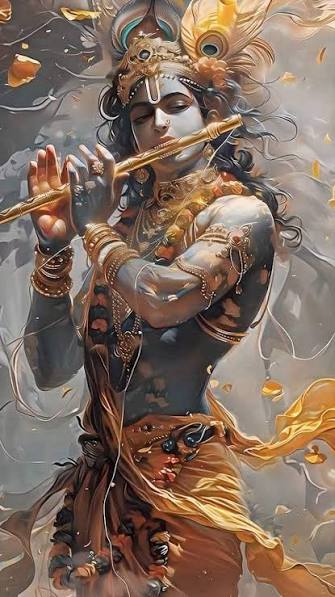
In the theological imagination of Hinduism, Krishna is celebrated as an incarnation of the Divine, and in many Vaishnava traditions he is revered as the Supreme Personality of Godhead. His presence transcends conventional categories. He is the irresistible flute-player of Vrindavan and simultaneously the majestic Lord who reveals the cosmic form to Arjuna. His greatness is not confined to one dimension of religious experience: Krishna encompasses devotion, knowledge, action, beauty, morality and transcendence.
This multidimensional character gives Janmashtami special relevance to present-day life. Modern existence often oscillates between material ambition and emotional exhaustion. People possess unprecedented technological conveniences yet frequently struggle with anxiety, loneliness and a sense of nothingness. Krishna's teachings invite humanity to look beyond the superficial turbulence of existence and discover a deeper spiritual epicenter.
The Bhagavad Gita, delivered by Krishna on the battlefield of Kurukshetra, remains perhaps his most influential theological legacy. His counsel to Arjuna addresses a crisis that is both ancient and remarkably contemporary: how should a person act when confronted by uncertainty, moral conflict and overwhelming responsibility? Krishna does not advise passive withdrawal from life. Instead, he teaches disciplined action, self-knowledge and devotion.
His celebrated teaching on karma yoga encourages individuals to perform their duties without becoming enslaved by the fruits of their actions. In an age dominated by competition, rankings, possessions and constant measurement of success, this principle carries considerable psychological and spiritual significance. Krishna reminds humanity that meaningful action should arise from duty, integrity and dedication rather than obsessive attachment to outcomes.
Equally profound is Krishna's teaching on devotion. Bhakti is not simply ceremonial worship; it represents a relationship between the human soul and the Divine founded upon love, surrender and remembrance. Janmashtami therefore provides an opportunity to ask whether religion in the modern world can become more than outward observance. Krishna's life suggests that spirituality can be intimate, joyful and deeply personal.
The devotional traditions surrounding Krishna are particularly rich in their celebration of divine love. The songs, dances, poetry and artistic traditions associated with Krishna portray an extraordinary vision of the relationship between the individual soul and God. His flute, his smile, his playful childhood and his loving presence in Vrindavan have inspired generations of poets and saints. In this tradition, divine beauty becomes a pathway towards spiritual reawakening.
At the same time, Krishna's theological significance should not be reduced to sentimentality. He is also a profound thinker on ethics, duty and the nature of reality. His teachings about the imperishable self, the temporary character of worldly existence and the importance of righteous action offer a philosophical framework for confronting hardship and uncertainty. The body changes, circumstances change and worldly achievements fade, but the spiritual self, Krishna teaches, possesses a deeper identity.
In today's world, Janmashtami can consequently become a festival of inner renewal. Its lamps can symbolize the triumph of wisdom over ignorance; its devotional music can represent the soul's longing for transcendence; and its midnight celebrations can remind believers that divine hope can emerge even in the darkest circumstances.
The festival also has an important social dimension. Krishna's life repeatedly demonstrates the value of courage against oppression, loyalty towards friends, compassion towards devotees and responsibility towards society. His example encourages contemporary citizens to resist injustice while cultivating humility and compassion. Spirituality, in this sense, is not an escape from society but a transformation of the way one participates in it.
For younger generations especially, Janmashtami can provide a bridge between inherited tradition and contemporary consciousness. Krishna need not remain confined to temples, paintings or ancient narratives. His questions are alive: What is my duty? What is genuine success? Who am I beyond my possessions and social identity? How should I act when circumstances become morally confusing? How can love and wisdom coexist?
These questions explain why Krishna continues to fascinate humanity. He is not merely remembered; he is encountered through prayers, music, philosophy, literature, art and devotion. His divine personality has generated one of the world's richest spiritual cultures.
As Janmashtami is observed with fasting, prayers, devotional singing, dramatic performances and midnight celebrations, the deeper invitation remains inward. The festival asks humanity to awaken—not only to Krishna's birth in sacred tradition, but to the possibility of awakening divine values within one's own life.
In an age searching for meaning, Lord Krishna shines with extraordinary brilliance. His wisdom is profound, his compassion captivating, his beauty celebrated beyond measure and his spiritual majesty incomparable. Janmashtami therefore remains not merely a festival marking a sacred birth, but a recurring invitation to rediscover truth, duty, devotion and love.
And perhaps that is Krishna's eternal gift: the assurance that even amid confusion, conflict and darkness, the human heart can turn towards the Divine—and find their wisdom, courage, joy and an inexhaustible light.
Mahfuz Ul Hasib Chowdhury is a contributor to different English newspapers and magazines. The writer is also a Commonwealth Open University Fellow.


