
Published: 11:54 PM, 02 October 2026
Vidyasagar Society Bangladesh: Three Decades of Keeping the Bengal Renaissance Alive

Few names in the history of Bengal embody the simultaneous pursuit of knowledge, social reform, humanism and intellectual courage as profoundly as Ishwar Chandra Vidyasagar. More than a scholar, educator and architect of modern Bengali prose, Vidyasagar represented a moral commitment to reason, compassion, social justice and human dignity.
For nearly three decades, Vidyasagar Society Bangladesh has sought to keep that legacy alive—through seminars, publications, intellectual exchanges, commemorative programmes and efforts to promote interfaith harmony, secular education and freedom of thought. The organisation’s own institutional profile describes its mission as carrying Vidyasagar’s ideals from the present generation to those yet to come.
The story of Vidyasagar Society Bangladesh has two distinct beginnings: an informal beginning in 1991 and a formal institutional foundation in 1997. The informal journey began on 26 September 1991, Vidyasagar’s birth anniversary. At the residence of National Professor Kabir Chowdhury in Jharoka, Gulshan-1, Dhaka, 21 followers of Vidyasagar, including writers and intellectuals, gathered to discuss the necessity of creating an organisation dedicated to his ideals.
Professor Kabir Chowdhury was nominated as President while writer and researcher Dr. Mohammad Abdul Hye was nominated as General Secretary. Thus, the organisation first emerged as an intellectual and cultural initiative before taking a formal organisational shape.
Six years later, on 26 September 1997, the initiative acquired its formal institutional identity. Vidyasagar Society Bangladesh was constituted under the Trust Act, 1882, with the aim of giving an organised and enduring form to the ideals that had inspired the original 1991 initiative. Its registration number is recorded as S-1894 (70)/98.
Its declared working area is particularly expansive: the whole of Bangladesh and Bengali communities across the world. The organisation has also developed links with international organisations, including United Religions Initiative (URI), San Francisco; International Interfaith Peace Group (IPG), South Korea; and the Theosophical Society, Chennai, India. It maintains branches at Dhaka University, Rajshahi University, Chittagong University and Jahangirnagar University.
The leadership history of Vidyasagar Society reflects a remarkable continuity of eminent academics and intellectuals.
Presidential chronology:
1. National Professor Kabir Chowdhury — Founding President
2. Professor Anisuzzaman — Second President
3. Professor AAMS Arefin Siddique — Third President; former Vice-Chancellor, University of Dhaka
4. Professor Dr Harun-Ur-Rashid Askari — Fourth and current President; former Vice-Chancellor, Islamic University, Kushtia, and Director General, Bangla Academy.
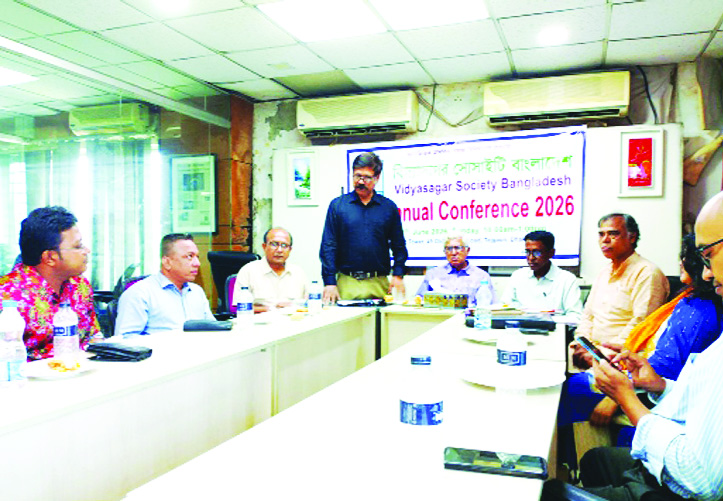
Dr. Mohammad Abdul Hai was its Founder General Secretary, while the current committee again lists him as Secretary General. This continuity was reaffirmed at the Society's 30th Annual Conference in June 2026, when Professor Dr Harun-Ur-Rashid Askari was elected President and Dr Mohammad Abdul Hye was re-elected Secretary General.
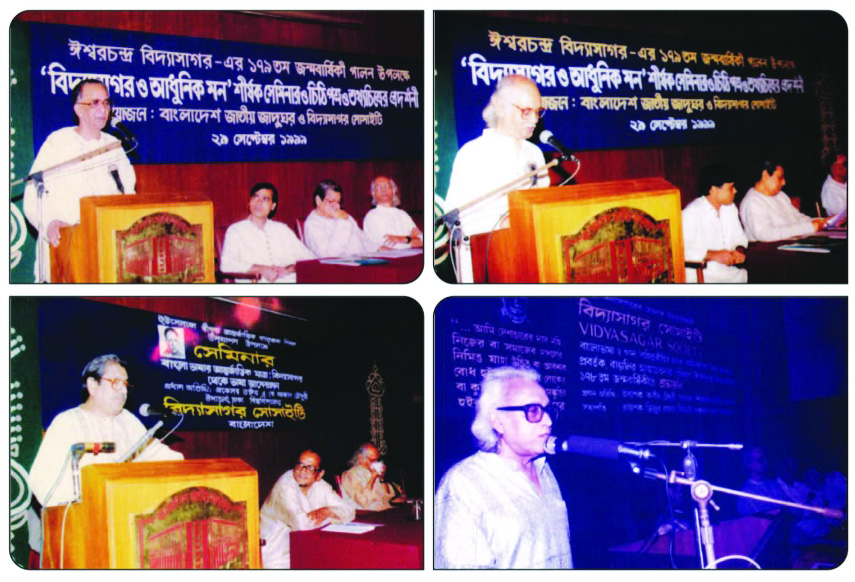
The organisation's work has extended far beyond ceremonial observances. So far, it has organised 18 international seminars in places including Kolkata, Santiniketan, Karmatar and New Delhi, while 32 national seminars have been organised at major academic centres in Bangladesh, including Dhaka University, Rajshahi University, Chittagong University and Jahangirnagar University.
These programmes have helped create an intellectual bridge between Bangladesh and the wider Bengali world, particularly around Vidyasagar’s ideas of education, rationalism, social reform, humanism and freedom of thought.
Its publication record is equally significant. The organisation's profile lists 18 books and 52 commemorative publications. A report on its 30th Annual Conference also records 18 books and 52 commemorative publications produced at home and abroad during its journey.
The organisation has also received support from the High Commission of India in Dhaka, various institutions and individual admirers of Vidyasagar. Its institutional record notes recognition from the Vishwakosh Parishad, Kolkata, in 2000, and an award from the Asiatic Society, Kolkata, in 2005.
Its declared objectives remain strikingly relevant: promoting interfaith harmony, supporting a secular education system and contributing to the establishment of freedom of thought.
Among Bangladesh’s eminent intellectuals and scholars, poet Shamsur Rahman, Justice Habibur Rahman, Professor Anisuzzaman, Mizanur Rahman, Mohiuddin Ahmed, Jatin Sarkar, Dwijen Sharma, Murtaja Baseer, Belal Chowdhury, Zahidul Haque, Rokeya Ahmed, Halima Khatun, Swapna Roy and many others were life members of the Vidyasagar Society Bangladesh.
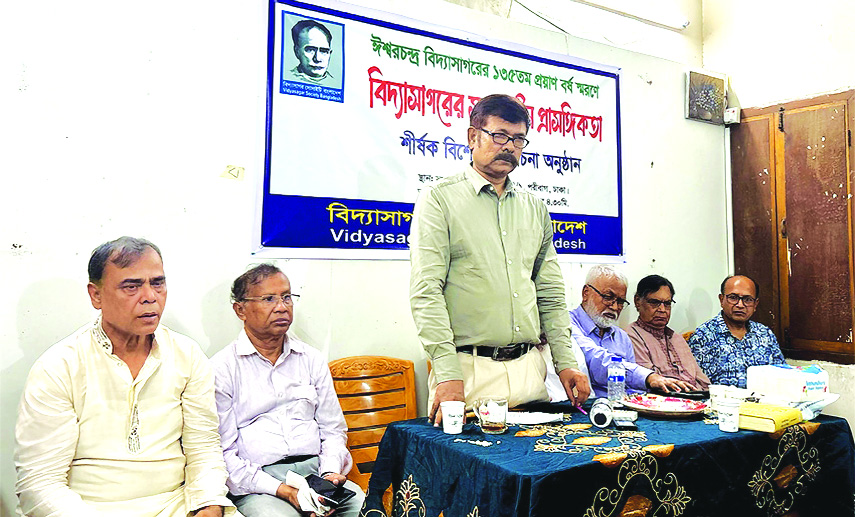
The year 2026 has been particularly significant for the organisation. On 29 July, it observed the 135th death anniversary of Ishwar Chandra Vidyasagar, bringing together writers, academics, intellectuals and admirers of his philosophy to reflect on the continuing relevance of his ideas.
Two months later, on 26 September 2026, the organisation observed Vidyasagar’s 207th birth anniversary with a major commemorative event at Sanskriti Bikash Kendra, Paribagh, Dhaka, also marking the organisation's 30th founding anniversary. The event featured the Vidyasagar Memorial Lecture. The event also marked the official launch of the website of Vidyasagar Society Bangladesh, opening a new digital chapter in the organisation’s journey.
Professor Anisuzzaman was the chief guest of the event. Vidyasagar Society Bangladesh’s President Professor Dr Harun-Ur-Rashid Askari presided over the event while Secretary General Dr Mohammad Abdul Hye narrated 30 years notes of the organization. The keynote paper was presented by Dr. Chinmoy Howlader, Professor of the Sanskrit Department at National University and Joint Secretary of the organisation. Professor Niranjan Adhikari was the special guest. The event was conducted by Mahbubul Islam, Vice President of the organisation.
The significance of the event went beyond remembrance. It demonstrated how Vidyasagar continues to function not merely as a historical figure but as a subject of contemporary intellectual inquiry.
The newly elected Vidyasagar Society Bangladesh Executive Council 2026 comprises:
President: Professor Dr Harun-Ur-Rashid Askari (Dr Rashid Askari)
Vice-President: Md Mahbubul Islam
Secretary General: Dr Mohammad Abdul Hye
Joint Secretary: Dr Chinmoy Howlader
Finance Secretary: Professor Md Zahir Uddin Arif
Media and Publications Secretary: Emran Emon
Office Secretary: Dr Jaganath Barua
Executive Members: Md Jalaluddin Tuhin, Meherun Nesa, Sumana Gupta and Shapla Singha.
The 2026 annual conference elected a new 21-member Executive Committee, underscoring the organisation's continuing institutional activity after three decades.
The enduring importance of Vidyasagar Society Bangladesh lies perhaps in the nature of the legacy it has chosen to inherit. Vidyasagar was not simply a nineteenth-century Sanskrit scholar or a reformer associated with widow remarriage and women’s education. His intellectual project was much broader: he sought to place education, reason, humanity and social responsibility at the centre of public life.
That is why the organisation's work remains relevant. Its seminars connect generations of scholars; its publications preserve and reinterpret intellectual heritage; its international engagements extend the conversation beyond Bangladesh; and its commemorative programmes transform anniversaries into occasions for renewed reflection.
Speaking about Vidyasagar Society Bangladesh's future plans and strategic priorities, its President Dr Rashid Askari said: "To my way of thinking, Vidyasagar Society Bangladesh is an intellectual organization aiming to promote Vidyasagar’s unorthodox, secular and humanistic ideals at this moment in time. The great 19th century Bengali reformer and the Renaissance Man Ishwar Chandra Vidyasagar was so far presented to people only through the printed word or the outdated seminar. But in today’s hyper-connected world, printed materials or discussions do not yield desired results. So, as the president of the organization, I am intrigued to introduce Vidyasagar to the new generations in their own sweet ways. I have thought up some new plans to showcase Vidyasagar thoughts on social media using modern ICT techniques that provide powerful digital tools and platforms to broadcast and share them globally. We have already launched a website on Vidyasagar’s 207th birth anniversary, held a few days ago, which is a real step forward in this regard. We also have plans to make animated documentaries on Vidyasagar to catch the fancy of the Alpha generation kids."
Dr Mohammad Abdul Hye, General Secretary of the Vidyasagar Society Bangladesh, spoke about his vision and plans for the organisation: “In my journey of self-discovery, I consider myself a partaker of the undivided Bengali consciousness; it is within this very idea of an undivided Bengali identity that I find the scope for my own intellectual and spiritual growth and expansion. That is why I am not a writer driven by a sense of religious distinctiveness. Rather, my literary self is inspired by universal human values and devoted to the indivisible human essence.
Although I was born into a Muslim family, my thoughts and consciousness are not confined to a sense of Muslim distinctiveness alone. This is precisely why, from the rich heritage of Bengali society, I have embraced Vidyasagar as an embodiment of the undivided Bengali consciousness.
Until we see, within the Muslim community, the emergence of human beings who are shaped by universal human values in the spirit of Vidyasagar—neither defined merely as ‘Hindu’ nor as ‘Muslim’, but as complete human beings rooted in the undivided Bengali identity—we shall continue to remember Vidyasagar as an ideal symbol of that undivided Bengali consciousness. It is from this very conviction that, thirty years ago, I undertook the universal humanistic endeavour of establishing the Vidyasagar Society.”
Three decades after its informal birth in a gathering at Kabir Chowdhury’s residence, and nearly three decades after its formal institutional establishment, Vidyasagar Society Bangladesh continues to serve as a bridge between memory and modernity.
The organisation's journey—from a small gathering of 21 Vidyasagar admirers in 1991 to a nationally and internationally connected intellectual organisation—illustrates the enduring power of an idea. The organisation's central challenge and its continuing promise is to ensure that Vidyasagar does not remain merely a name remembered on birth and death anniversaries, but remains a living intellectual presence in educational, cultural and social imagination.
Emran Emon is an eminent journalist, columnist and Media and Publications Secretary of Vidyasagar Society Bangladesh. He can be reached at [email protected]


