
Published: 12:02 AM, 19 November 2026
Qassabtuly Mosque: The ‘Sugar-Cube’ Jewel of Old Dhaka
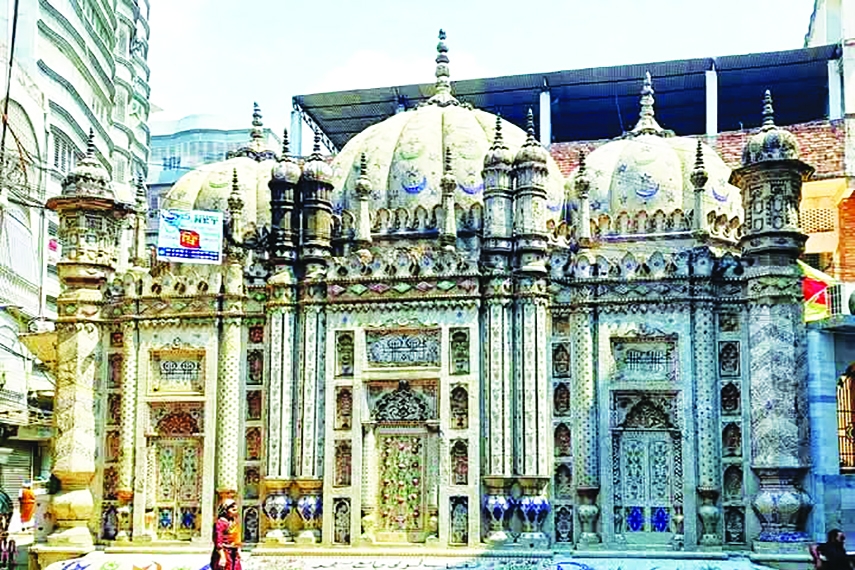
Dhaka, often described as the City of Mosques, is home to countless architectural landmarks that reflect its rich religious, cultural and historical heritage. Among the many mosques scattered across the bustling lanes of Old Dhaka, the Kasaituli Jame Mosque stands out for its extraordinary decorative artistry, colourful mosaic work and distinctive architectural character.
Affectionately known as the Chini-tukra Masjid, or the ‘Sugar-Cube Mosque’, this remarkable structure is a testament to the craftsmanship of a bygone era. Its walls, domes, minarets and prayer niches are adorned with intricate designs made from fragments of coloured porcelain and glass, transforming the mosque into an artistic treasure in the heart of the old city.
Located at the three-way junction of K.P. Ghosh Road in Kasaituli, northwest of Nayabazar, the mosque has captivated worshippers and admirers of architecture for generations. Despite the passage of nearly a century, its ornamental details continue to evoke admiration, even as the pressures of urbanisation and a shortage of funds threaten its preservation.
Kasaituli Jame Mosque is closely associated with the historical and social evolution of its surrounding neighbourhood. Kasaituli was once known as a locality inhabited by Muslim traders, and its community leaders, or sardars, played an influential role in local affairs.
The area also had a cultural dimension. According to Dhaka Somporko (Dhaka Connections), published by the Asiatic Society of Bangladesh, theatrical activities held an important place in the neighbourhood’s cultural life, with the Armenian community contributing to this tradition.
Against this historical backdrop, the mosque emerged as an important religious and architectural landmark. Its distinctive appearance earned it recognition as one of the decorative jewels of Dhaka.
Historical accounts associate the mosque’s development with the early decades of the twentieth century. The western extension is reported to have been completed in 1338 Hijri, corresponding to 1919, with Abdul Bari credited with commissioning the work and donating a substantial portion of land for the mosque’s expansion. Other accounts identify Abdul Ali as the mosque’s original patron.
These differing accounts point to the need for further historical documentation to establish a definitive chronology of the mosque’s construction and subsequent extensions.
The magic of chini-tikri artistry
The mosque’s greatest distinction lies in its elaborate chini-tikri ornamentation. The technique involves embedding small fragments of coloured porcelain and glass into plaster to create intricate patterns, floral motifs and geometric compositions.
The exterior walls display an impressive variety of decorative elements, including flower baskets, flowering vines, foliage, potted plants and stylised geometric designs. Shades of blue, green, purple and brown combine to create a vibrant visual effect.
Arabic calligraphy, including sacred Islamic inscriptions and Quranic verses, adds spiritual significance to the decorative scheme. The result is a striking fusion of religious devotion and artistic expression.
The mosque’s ornamental treatment is particularly noteworthy around the arches, prayer niches and wall surfaces. Lime-mortar decoration, enhanced with delicate porcelain inlay, lends additional depth and refinement to the structure.
Unlike buildings whose beauty depends primarily on their scale or grandeur, Kasaituli Mosque derives much of its appeal from the painstaking detail of its craftsmanship. Each fragment contributes to a larger composition, demonstrating the patience and technical skill of the artisans who created it.
The mosque is also popularly known as the Char Tukrar Masjid, or ‘Four-Piece Mosque’, a name associated with its distinctive segmented decorative patterns.
Three domes crowned with lotus motifs
Architecturally, the original mosque is a rectangular structure crowned by three domes. The central dome is the largest, while the other two complement the building’s balanced composition.
The domes feature ribbed, star-fruit-like patterns and rest on octagonal drums supported by pendentives. Lotus-petal motifs encircle the drums, while pitcher-shaped kalasa finials rise from lotus bases at the apex of the domes.
Four octagonal towers mark the corners of the main structure. Additional turrets and slender minarets along the walls reinforce the mosque’s vertical emphasis and decorative richness. Their smaller domes and ornamental details contribute to the building’s distinctive silhouette.
The eastern façade contains three recessed arched entrances leading into the prayer hall. These entrances correspond to three mihrabs, or prayer niches, on the western wall. Further arched entrances on the northern and southern sides provide access to the interior.
The main prayer niche and the surrounding arches are especially notable for their ornamental treatment, combining traditional architectural forms with colourful mosaic inlay.
Although the mosque incorporates features associated with Mughal-era architecture, its decorative language reflects a broader regional tradition of Islamic ornamentation. Its combination of domes, minarets, floral motifs, geometric patterns and calligraphy demonstrates how established architectural influences continued to inspire mosque construction in later periods.
Kasaituli Mosque shares an important decorative tradition with another celebrated landmark of Old Dhaka: Tara Mosque in Armanitola.
Both mosques are renowned for their chini-tikri ornamentation, which uses small pieces of coloured material to create elaborate patterns across architectural surfaces. Yet each possesses a distinct character.
Tara Mosque benefits from a relatively open setting that allows visitors to appreciate its façade and overall composition from a distance. Kasaituli Mosque, by contrast, is tucked into a dense urban neighbourhood where narrow lanes, closely packed houses and shops restrict visibility.
The contrast makes Kasaituli Mosque particularly fascinating. Its architectural richness is not immediately apparent from a broad avenue or open courtyard. Instead, visitors encounter its beauty within the intimate, crowded setting of Old Dhaka, where historic buildings remain intertwined with everyday urban life.
During the 1980s and 1990s, the mosque’s striking ornamentation reportedly received wider public exposure when it appeared on Bangladesh Television during broadcasts of the azan, or call to prayer.
A living centre of faith
Beyond its architectural significance, Kasaituli Jame Mosque continues to serve the religious needs of the local community.
Mufti Muhib, the mosque’s Imam and Khatib, says he conducts a weekly tafsir session devoted to explaining the Quran, alongside his regular religious responsibilities.
He recalls becoming interested in the mosque’s historical significance after joining the institution and subsequently undertaking some research into its past.
The mosque remains an active place of worship, accommodating approximately 1,500 to 1,600 worshippers during Friday prayers and Eid congregations, according to the mosque’s representatives.
Its religious activities extend beyond daily prayers. A gathering dedicated to the recitation of Surah Yasin takes place after the Isha prayer, attracting a considerable number of worshippers.
Community contributions remain the principal source of funding for the mosque’s maintenance and development. As the number of worshippers increased, additional space became necessary, prompting successive rounds of expansion.
The original structure, once a single-storey mosque, has gradually been incorporated into a larger complex with extended sections rising to three storeys. Renovation and expansion work has been undertaken over the decades, with accounts referring to work in 1979 and further expansion beginning in 2002. Although these additions have helped accommodate the growing congregation, they have also changed the relationship between the original historic building and its newer sections.
A jewel worth saving
For nearly a century, Kasaituli Jame Mosque has stood as a striking example of the artistic imagination that shaped the religious architecture of Old Dhaka. Its three domes, lotus motifs, slender minarets, colourful porcelain mosaics and finely executed calligraphy distinguish it from the surrounding urban landscape.
Yet its future depends on more than admiration. Without systematic conservation and sustained financial support, the intricate details that give the mosque its identity may gradually disappear.
Hidden among the narrow lanes of Kasaituli, this ‘Sugar-Cube Mosque’ offers a glimpse of a time when architecture was not simply about constructing a building but also about transforming it into a work of art. Preserving Kasaituli Jame Mosque would mean safeguarding not only a historic place of worship but also the craftsmanship, cultural memory and architectural diversity that make Old Dhaka unique. It is a heritage treasure that deserves to be protected for generations to come.
Adnan Hadi is a senior journalist
mainly writing on archeological
sites and sports. He can be
reached at: [email protected]


