
Abdul Jabbar: 1938-2017
Published: 01:58 AM, 31 August 2017
TRIBUTE: Abdul Jabbar . . . epitome of meaningful music
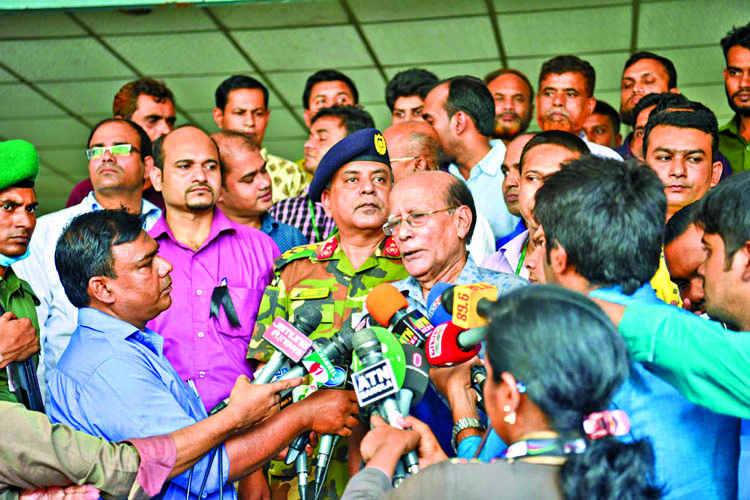
 Veteran singer Khurshid Alam speaking to journalists recalling the journey of Abdul Jabbar (right top) and relatives of the legendary singer broke into tears on his demise at BSMMU on Wednesday. -AA
Muhammad Abdul Jabbar's moment of glory came, without ambiguity and without ambivalence, on the afternoon of 16 December 1971.
Minutes after the Pakistan occupation army had surrendered to the Indo-Bangladesh Joint Command at the Dhaka Race Course in the afternoon, Dhaka Radio --- Dhaka Betar in local parlance at that point --- came forth with Jabbar's coruscating rendition of 'hajar bochhor pore / abar eshechhi phire / Banglar buuke achhi danrhiye'.
You can imagine the thrill of freedom which coursed through the heart and soul of every Bengali happy to be alive on the day as the song played itself out.
Today, forty six years after that momentous day in our collective life, the song remains testimony to our golden moment and to Jabbar's enduring reputation as an artiste. By the time he sang that song, Jabbar had already gained a reputation as a leading playback singer in the world of Bengali films produced in the Pakistan era.
His participation in the War of Liberation only burnished that reputation, not least because it revealed the huge patriotism which defined his being.
Jabbar's patriotism was intricately linked to that of the millions who were fortunate enough to be alive at a time when Bangabandhu Sheikh Mujibur Rahman navigated the nation's path to liberty. Jabbar was fortunate enough to lay claim to something more: the Father of the Nation loved him, for the good Bengali that he was and for the patriotic songs he sang in the course of the non-violent non-cooperation movement in March 1971, right till the moment the Pakistan military cracked down on an unarmed, peaceful nation struggling for democratic rights.

But Jabbar was not to be silenced. He made his way to the fields of war, to fight battles in the way an artiste should. At Shwadhin Bangla Betar, he sang his heart out for the growing number of young freedom fighters turning into martyrs waging war against the enemy. 'Salam salam hajar salam' became a signature tune for all Bengalis engaged in the armed struggle for liberty. It was heard by the freedom fighters, the Muktijoddhas, even as they prepared for fresh onslaughts against the enemy.
The song was an inspiration, like all those others Jabbar sang through the nine months of the war. In 'sharhe shaat koti manusher aaj ekti naam / Mujibor Mujibor Mujibor', he encapsulated the sentiments of seventy five million Bengalis who knew that in Sheikh Mujibur Rahman they had their voice, that the incarcerated leader of the nation was the strongest defence against the alien soldiers laying waste to the country. There was then the very invigorating 'Mujib baiya jao re', a variation on the old number, 'majhi baiya jao re', which Jabbar put to effective use as the war went on. He was waging his battles. And he did not mean to lose.
Abdul Jabbar's romanticism, as it came into play through his songs for the movies in the 1960s and later, remains yet another reason why the history of this country, in terms of culture and heritage, will treat him well. Half a century has gone by since he crooned 'tumi ki dekhechho kobhu / jiboner porajoy' and yet the song and Jabbar's delivery of it have not dimmed in appeal. A strong sense of ardour, a desire of becoming the song rather than being the artiste behind the song was the driving force behind his artistry.
Think here of the romance in every pore of the number, 'ogo lajuk lota shudhu ei logone / mon chaaye nirobe tomare / keno bare baare'. The devotion to the beloved is absolute, in much the same way it comes through in 'tara bhora raate / tomar kotha je / mone porhe bedonae go'.
The voice in Jabbar brought the soul with it. The songs he sang were picturised on the leading men in the many movies, but you had the feeling that the ecstasy and the sadness and the loneliness, as the case might be, were definitions of the Jabbar character itself. He was going through all these emotions. In 'ekti moner ashish tumi / kachhe jokhon ele', he gathers the woman, the object of pure love, to his soul in untrammeled union. And sadness, the sense of deprivation, drips through the lyrics of 'prem tui de na amaye / ektu porichoy'.
The world being a place of unremitting tragedy, Jabbar's song, 'nirob prithibi duaare tomar/ royechhi du haath pete' aptly depicts the human condition as it often defines life for the dispossessed, in terms of love and other things besides. In the number, 'orey neel doriya / amaye de re de charhhiya', it is Bengal's heritage in relation to its rivers that emerges in sync with the lives of those who live through the currents of the river, and often perish in them, that finds expression.
In the death of Muhammad Abdul Jabbar, a generation passes into memory. In Abdul Jabbar was the epitome of fine, meaningful music which illuminated, in a multiplicity of colours, the galaxy of our culture. The galaxy shines brighter, now that Abdul Jabbar mingles with it and loses himself in the timelessness of its passion.
The writer is Associate Editor, The Asian Age
The writer is Associate Editor, The Asian Age


